
Municipal Infrastructure as a Catalyst for Economic and Real Estate Growth: The Webster, NY Case Study


 Aime Summary
The Role of Infrastructure in Economic Revitalization
Infrastructure upgrades are not merely about repairing roads or expanding sewer systems; they are foundational to creating environments where businesses can thrive. In Webster, the FAST NY grant has funded critical improvements to a 300-acre brownfield site, including enhanced electrical systems, expanded sewer capacity, and road realignments. These upgrades position the area to compete with industrial hubs in the Sun Belt and Midwest, where logistics and manufacturing firms have historically clustered.
Governor Kathy Hochul's broader strategy of creating "shovel-ready" sites is evident in Webster's transformation. The site's redevelopment has already attracted significant private investment, such as the $650 million fairlife® dairy plant, which is projected to create 250 jobs. This project underscores how infrastructure spending can act as a magnet for high-value industries, particularly in sectors like advanced manufacturing and renewable energy. By 2025, the site is expected to host over one million square feet of industrial space, a testament to the scalability of such initiatives.
Commercial Real Estate Dynamics: Vacancy Rates and Value Appreciation
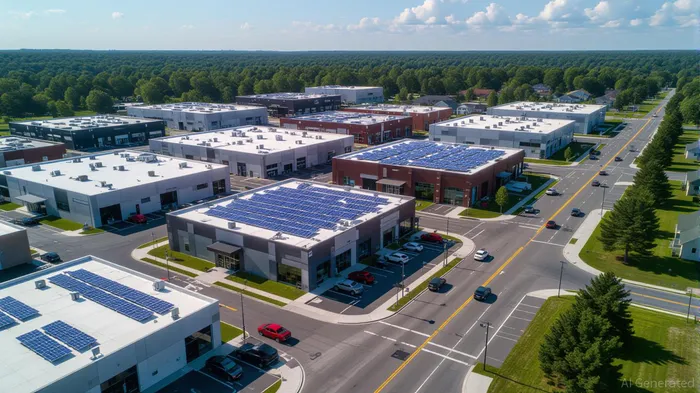 The economic impact of infrastructure-driven development is acutely visible in Webster's commercial real estate market. As of 2025, the town's industrial sector boasts a 2% vacancy rate, starkly contrasting the national average of 7.3%. This low vacancy rate reflects the area's appeal to logistics and manufacturing firms, drawn by its proximity to Buffalo's port and rail systems, affordable energy, and a skilled workforce.
Residential property values are also surging, with a 10.1% increase recorded in the past year. This growth is not incidental but a direct consequence of the town's strategic investments. Improved infrastructure not only attracts businesses but also enhances the quality of life, making the area more attractive to residents and, by extension, to employers seeking a stable labor pool. The interplay between industrial and residential real estate markets illustrates a virtuous cycle: infrastructure spending drives commercial demand, which in turn fuels residential value appreciation.
Strategic Planning and Public-Private Synergy
Webster's success hinges on the alignment of public and private interests. The FAST NY grant, a public funding mechanism, has been instrumental in de-risking private investment by addressing the upfront costs of brownfield remediation and infrastructure upgrades. This synergy is critical in regions like Upstate New York, where historical underinvestment has left many areas lagging behind national trends.
The demolition of the 600 Ridge Road site, part of the West Webster Hamlet Revitalization Project, further exemplifies this approach. By repurposing underutilized land for mixed-use developments, Webster is creating a diversified economic base that reduces reliance on single-industry cycles. Such projects are not merely about physical transformation but about fostering ecosystems where innovation, manufacturing, and residential communities coexist.
Broader Implications for Investors
For investors, Webster's experience highlights the importance of identifying regions where infrastructure spending is catalyzing structural change. The town's ability to attract a $650 million dairy plant-a project that would likely struggle to gain traction in a market without pre-existing infrastructure-demonstrates the multiplier effect of strategic public investment.
Moreover, the data suggests that such projects yield returns beyond immediate job creation. The 10.1% rise in residential property values and the projected one million square feet of industrial space indicate that infrastructure-driven development generates compounding benefits. Investors in commercial real estate, industrial land, or even residential properties in Webster stand to benefit from a self-reinforcing cycle of growth.
Conclusion
Webster, NY, is a microcosm of a broader trend: municipalities that prioritize infrastructure as a tool for economic and real estate development can achieve outsized returns. The FAST NY grant and Xerox campus redevelopment illustrate how targeted public investment, when paired with private-sector ambition, can transform brownfields into blueprints for growth. For investors, the lesson is clear: regions where infrastructure is treated as a strategic asset-rather than a cost-offer fertile ground for long-term value creation.

Blending traditional trading wisdom with cutting-edge cryptocurrency insights.
Latest Articles
Stay ahead of the market.
Get curated U.S. market news, insights and key dates delivered to your inbox.




Comments
No comments yet