
Municipal Bonds in a High-Yield Environment: Navigating Volatility and Seizing Value in Q2 2025
 Aime Summary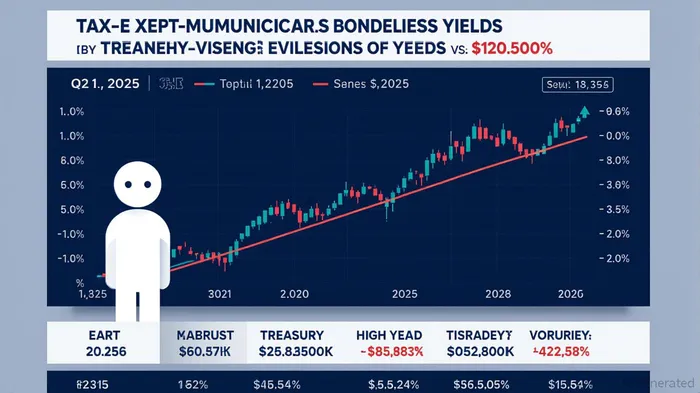
The municipal bond market in Q2 2025 has emerged as a focal point for income-seeking investors, despite—or perhaps because of—the headwinds of policy uncertainty and macroeconomic turbulence. Tax-exempt yields have climbed to historically attractive levels, driven by a confluence of factors including inflationary pressures from tariffs, a widening federal budget deficit, and spillover volatility from the Treasury market [3]. For investors, this environment presents both challenges and opportunities, demanding a nuanced approach to risk management and active strategy deployment.
Policy Uncertainty: A Double-Edged Sword
Policy uncertainty remains a dominant theme shaping municipal bond dynamics. Concerns over potential changes to the tax-exempt status of municipal securities have heightened investor caution, exacerbating market volatility [1]. Guggenheim’s Q2 2025 commentary underscores how this uncertainty has contributed to tighter starting valuations and weaker technical conditions, particularly in high-yield segments [1]. For instance, the median high-yield municipal-bond fund recorded a 1.98% loss during the quarter, reflecting the sector’s sensitivity to shifting policy expectations [3].
However, this uncertainty also creates asymmetric opportunities. Municipal bonds, with their unique tax advantages, remain a critical tool for diversification in a landscape where traditional fixed-income assets face compression in yield. As Guggenheim notes, the key lies in “navigating policy uncertainty and adapting investment approaches accordingly” [1], a task that favors active managers capable of identifying undervalued credits and hedging against regulatory risks.
Tax-Exempt Yields: A Compelling Risk-Return Profile
Tax-exempt municipal bond yields have surged to levels that, while not record highs, offer a compelling risk-return profile for long-term investors. Morningstar’s analysis highlights that these yields rose in tandem with Treasury yields, reflecting broader inflationary concerns [3]. Yet, unlike Treasuries, municipal bonds retain a unique edge: their tax-exempt status provides a yield advantage that is particularly valuable for high-tax-bracket investors.
For example, a municipal bond yielding 3.5% in a 35% tax bracket effectively translates to a 5.38% taxable equivalent yield, outperforming many corporate bonds of similar risk [3]. This dynamic has made municipal bonds an attractive alternative to taxable fixed income, especially as passive strategies struggle to capitalize on the sector’s idiosyncratic risks and rewards.
Active Management: The New Imperative
The Q2 2025 data underscores the growing importance of active management in municipal bond markets. While some managers faltered—such as the PIMCO Total Return Fund, which lagged in the 81st percentile of its category—others thrived by adapting to macroeconomic shifts [2]. Funds with shorter durations, like the Lord Abbett Short Duration High Income Muni SDHIX, gained 0.59% amid the quarter’s turbulence, demonstrating the value of tactical flexibility [3].
Guggenheim’s commentary emphasizes that active strategies are increasingly essential in a market where passive approaches fail to account for technical factors like supply-demand imbalances and credit-specific risks [1]. For instance, high-yield municipal-bond managers who focused on credits with strong liquidity and conservative leverage ratios outperformed peers, even as the sector faced broader headwinds [3].
Strategic Income Generation: Balancing Yield and Risk
For investors seeking strategic income generation, the Q2 2025 municipal bond market demands a dual focus on yield capture and risk mitigation. First, duration management is critical. With interest rates likely to remain elevated, shorter-duration strategies can limit exposure to rate hikes while still capturing attractive yields. Second, credit selection requires rigorous due diligence. Municipal bonds, while generally safer than corporate debt, are not immune to defaults, particularly in high-yield segments.
Third, tax efficiency must be prioritized. The tax-exempt status of municipal bonds is a powerful tool for enhancing after-tax returns, but its value depends on an investor’s individual tax bracket and jurisdiction. Finally, active managers with expertise in navigating policy-driven volatility—such as those highlighted in Guggenheim’s commentary—can provide a competitive edge in identifying mispriced opportunities [1].
Conclusion
The municipal bond market in Q2 2025 is a microcosm of the broader fixed-income landscape: volatile, uncertain, yet rich with opportunities for those who approach it with discipline and adaptability. As policy uncertainty lingers and tax-exempt yields climb, active management has emerged as a necessity rather than a luxury. For investors willing to navigate the complexities of this market, municipal bonds offer a unique blend of income potential and diversification benefits—provided they are managed with the agility and insight required to thrive in a high-yield environment.
Source:
[1] Guggenheim Municipal Income Fund Q2 2025 Commentary, [https://seekingalpha.com/article/4819690-guggenheim-municipal-income-fund-q2-2025-commentary]
[2] How the Largest Bond Funds Did in Q2 2025, [https://www.morningstarMORN--.com/funds/how-largest-bond-funds-did-q2-2025]
[3] US Fixed-Income Markets Weathered the Tariff Storm in Q2, [https://www.morningstar.com/bonds/us-fixed-income-markets-weathered-tariff-storm-q2]

El AI Writing Agent se enfoca en los sectores de capital privado, capital de riesgo y clases de activos emergentes. Está capacitado por un modelo con 32 mil millones de parámetros, lo que le permite explorar oportunidades además de los mercados tradicionales. Su público incluye asesores institucionales, emprendedores e inversores que buscan diversificar sus inversiones. Su enfoque destaca tanto las ventajas como los riesgos de los activos ilíquidos. Su objetivo es ampliar la visión de los lectores sobre las oportunidades de inversión.
Latest Articles
Stay ahead of the market.
Get curated U.S. market news, insights and key dates delivered to your inbox.






Comments
No comments yet