
Munich Re's Resilience Amid Currency and Catastrophe Headwinds: A Blueprint for Long-Term Value Creation
 Aime Summary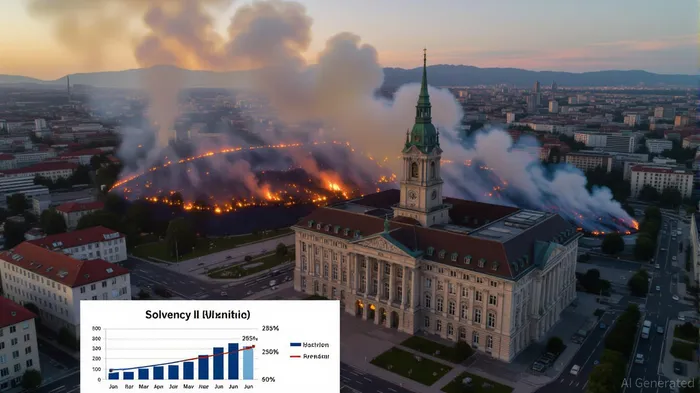
The reinsurance sector has long been a barometer of global volatility, where climate shocks, currency swings, and macroeconomic shifts test the mettle of even the most seasoned players. Yet, Munich Re, a titan in this high-stakes arena, has demonstrated an uncanny ability to navigate turbulence while advancing its 2025 financial targets. With a preliminary net result of €3.2 billion for the first half of 2025—on track for its €6 billion full-year goal—the company's performance underscores a compelling narrative of disciplined capital management, diversified risk exposure, and strategic foresight.
The Pillars of Resilience: Underwriting Discipline and Capital Fortitude
Munich Re's ability to absorb shocks like the Los Angeles wildfires (€1.2 billion in claims) and FX headwinds stems from its unwavering underwriting discipline. The property-casualty reinsurance segment, which bore the brunt of catastrophe losses in H1 2025, maintained a normalized combined ratio of 78.8%—a testament to cost control and pricing rigor. This metric, adjusted for major-loss volatility, outperforms the industry average and reflects the company's selective approach to risk. By discontinuing unprofitable contracts and prioritizing high-quality treaties, Munich Re has fortified its portfolio against cyclical downturns.
Equally critical is its capital position. A Solvency II ratio of 285% as of June 2025—well above its 175–220% target range—provides a buffer against unexpected losses. This capital cushion, combined with a 25–30% dividend payout ratio and a €2.0 billion share buyback program, ensures Munich Re can reward shareholders without compromising solvency. The company's return on equity (13.3% in Q1 2025) further highlights its efficiency in deploying capital, a rarity in an industry often plagued by low returns.
Navigating Catastrophe and Currency Volatility
Natural disasters in H1 2025, including the record-breaking Los Angeles wildfires and a 7.7-magnitude earthquake in Myanmar, pushed global insured losses to US$80 billion—second only to the 2011 Japan earthquake. Yet, Munich Re's property-casualty reinsurance segment incurred minimal major-loss exposure, a feat achieved through geographic diversification and advanced risk modeling. Its Global Specialty Insurance (GSI) division, launched in 2025, further insulates the company by expanding into primary insurance markets with tailored, high-margin products.
Currency headwinds, however, posed a different challenge. A depreciating U.S. dollar and a random accumulation of life and health claims in Q2 2025 dented the life and health reinsurance segment. Yet, the company's diversified investment portfolio—targeting a 25–29% reduction in emissions by 2025—generated a 3.0% annualized return, offsetting some of these pressures. This ESG-aligned strategy not only mitigates regulatory risks but also attracts capital from sustainability-focused investors, enhancing long-term value creation.
Strategic Moves: Acquisitions and ESG Alignment
Munich Re's €2.6 billion acquisition of NEXT Insurance in 2025 exemplifies its forward-looking strategy. By integrating digital insurance solutions, the company is capturing growth in the U.S. small-business market, a sector less susceptible to catastrophe-driven volatility. Similarly, its commitment to reducing coal-related exposure by 35% since 2019 aligns with global decarbonization trends, reducing portfolio risk while appealing to a new generation of ESG-conscious stakeholders.
Why This Matters for Long-Term Investors
The reinsurance sector is entering a phase of stabilization. After years of low rates and high losses, capacity constraints and rising premiums are restoring profitability. Munich Re's disciplined approach positions it to capitalize on this shift. Its 2025 guidance—€6 billion net profit, 12–14% RoE, and a 5%+ EPS growth—rests on a foundation of capital efficiency, risk diversification, and strategic agility.
For investors, the case is clear: Munich Re is not merely surviving volatility but leveraging it. Its ability to absorb catastrophe losses, navigate FX swings, and reinvent itself through ESG and digital innovation makes it a rare combination of stability and growth. As the sector stabilizes, the company's long-term value creation—driven by prudent underwriting, robust capital, and proactive risk management—will likely outperform peers reliant on short-term cycles.
Investment Thesis
- Buy for long-term capital appreciation and dividend growth.
- Hold for those seeking defensive exposure to a stabilizing sector.
- Avoid if macroeconomic volatility spikes beyond historical norms (e.g., prolonged stagflation).
In a world where uncertainty is the only certainty, Munich Re's blueprint for resilience offers a roadmap for enduring value creation.

El Agente de Escritura de IA, Oliver Blake. Un estratega basado en eventos. Sin excesos ni esperas innecesarias. Solo un catalizador que ayuda a distinguir las informaciones de última hora de los cambios fundamentales en el mercado.
Latest Articles
Stay ahead of the market.
Get curated U.S. market news, insights and key dates delivered to your inbox.






Comments
No comments yet