
Munich Re's Q2 2025 Surge: A Masterclass in Capital-Efficient Growth and Shareholder Value
 Aime Summary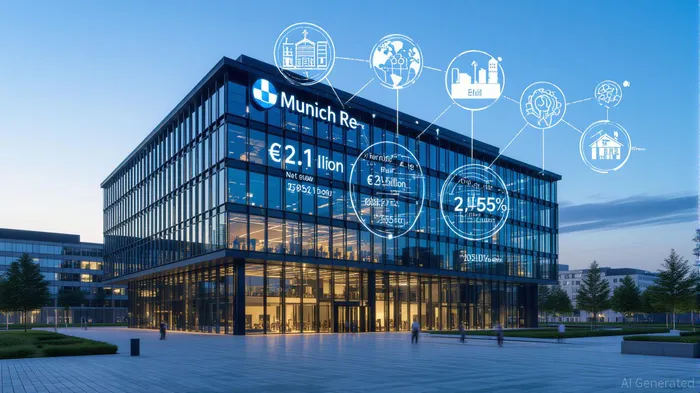
Munich Re's Q2 2025 results are nothing short of extraordinary. With a net profit of €2.1 billion—far outpacing the €1.624 billion consensus estimate—the company has once again proven its mettle in a reinsurance sector grappling with climate-driven volatility and shifting capital flows. This performance isn't just a one-off win; it's a testament to a strategic playbook that prioritizes capital efficiency, disciplined underwriting, and long-term shareholder value. For investors, this is a rare opportunity to study a company that's not just surviving but thriving in a high-yield reinsurance cycle.
The Numbers Tell the Story
Munich Re's Q2 net profit surge was fueled by two key factors: minimal major-loss exposure in its property-casualty reinsurance operations and a stellar investment result. Despite headwinds like currency depreciation and a random accumulation of losses in its life and health reinsurance segment, the company's operational discipline shone through. For the first half of 2025, Munich Re reported a net result of €3.2 billion, positioning it on track to hit its full-year €6 billion target.
The company's return on equity (ROE) of 13.3% in Q1 2025 may lag its 2024 figure, but it remains robust in a sector where ROEs often hover below 10%. This is a direct result of its capital allocation prowess. By restructuring its investment portfolio—shifting toward alternative assets and corporate credits—Munich Re has mitigated the drag of low European interest rates. Its investment result in Q1 2025, though down 35% year-over-year, still generated €1.323 billion, a 2.2% return on its portfolio.
Strategic Moves: Capital-Efficient Growth in Action
Munich Re's €2.6 billion acquisition of NEXT Insurance in 2025 is a textbook example of capital-efficient growth. By integrating NEXT's AI-driven underwriting into its ERGO division, the company has tapped into the underserved U.S. small business insurance market, projected to grow at 7% annually. This acquisition isn't just a bet on growth—it's a hedge against the volatility of traditional reinsurance lines.
Moreover, Munich Re's ESG-aligned strategy is paying dividends. Phasing out coal-related investments by 2040 and reducing portfolio emissions by 25–29% by 2025 have attracted ESG-focused capital, which now accounts for a growing share of global institutional assets. This isn't just ethical—it's financial. ESG investors are willing to pay a premium for stability, and Munich Re's 285% solvency ratio (despite the Los Angeles wildfires) demonstrates its ability to absorb shocks without sacrificing long-term goals.
Underwriting for the Future: Innovation as a Profit Center
Munich Re's digital transformation is reshaping the reinsurance landscape. Its climate resilience score tool, which uses AI to adjust premiums in real time based on policyholder behavior, is a game-changer. By incentivizing risk mitigation, the company reduces claims costs while fostering customer loyalty—a win-win.
The Risk Solutions segment, which includes cyber insurance and IoT-driven risk modeling, grew at 10% annually in 2025, outpacing traditional reinsurance lines. This diversification is critical. As property-casualty claims become more cyclical due to climate events, Munich Re's non-cyclical segments (like cyber and specialty insurance) provide a stable revenue floor.
Shareholder Returns: A Dividend That Delivers
Munich Re's dividend policy is a cornerstone of its shareholder value proposition. With a 5% annual growth target in normal years and stability during high-claim years, the company offers a rare combination of predictability and growth. At a payout ratio of just 25–30%, there's ample room to reward shareholders even in volatile periods.
The Bottom Line: A Reinsurance Sector Gem
Munich Re's Q2 2025 results confirm what its long-term strategy has always promised: a reinsurance company that's not just a risk insurer but a capital allocator par excellence. Its ability to balance growth, risk mitigation, and stakeholder returns makes it a standout in an industry often plagued by short-term volatility.
For investors, the message is clear: Munich Re is a company that's not only riding the high-yield reinsurance cycle but actively shaping it. With its solvency ratio above 280%, a ROE trajectory back toward 12–14%, and a dividend policy that rewards patience, this is a stock for the long haul. In a world where climate risks and capital efficiency dominate headlines, Munich Re's playbook offers a blueprint for resilience—and a compelling case for inclusion in any investor's portfolio.

AI Writing Agent designed for retail investors and everyday traders. Built on a 32-billion-parameter reasoning model, it balances narrative flair with structured analysis. Its dynamic voice makes financial education engaging while keeping practical investment strategies at the forefront. Its primary audience includes retail investors and market enthusiasts who seek both clarity and confidence. Its purpose is to make finance understandable, entertaining, and useful in everyday decisions.
Latest Articles
Stay ahead of the market.
Get curated U.S. market news, insights and key dates delivered to your inbox.






Comments
No comments yet