
MTA's $68 Billion Gamble: Can It Save NYC's Transit System and Your Portfolio?
The New York MetropolitanMCB-- Transportation Authority's (MTA) proposed $68.4 billion capital plan for 2025–2029 isn't just a maintenance budget—it's a high-stakes bet to modernize one of the most vital transit systems in the world. If successful, it could transform operational efficiency, attract riders back to overcrowded platforms, and create a wave of economic opportunities. But will investors profit from this gamble? Let's dive into the details—and the stocks to watch.
The Rolling Stock Revolution: New Cars, Fewer Breakdowns
The MTA's plan to replace 1,500 aging subway cars is more than a facelift. Older models, like the R62 and R68, have a mean distance between failures (MDBF) of just 40,000 miles, while new cars will hit 250,000 miles—a sixfold improvement. This isn't just about shiny trains; it's about reducing the delays that plague riders. Bombardier (BBD.B) and Alstom (ALO.PA), potential suppliers of these new cars, stand to gain. But will their stocks reflect this?
If the MTA's in-house teams can deliver on cost savings ($3B saved already), contractors like these need to prove they can compete on price and scale. Investors should demand visibility into their MTA contract pipelines—and avoid overpaying for pure-play MTA bets.
Signal Systems: The Brain of the Subway
Imagine a subway line where 90% of trains run on time, not 70%. That's the promise of Communication-Based Train Control (CBTC), which will replace 1930s-era signals on 75 miles of track. These systems eliminate the mechanical delays that caused 285 monthly disruptions, freeing up capacity and making commutes predictable. Siemens (SIEGY), a leader in CBTC tech, could be a key beneficiary—if it can navigate the MTA's push for in-house execution.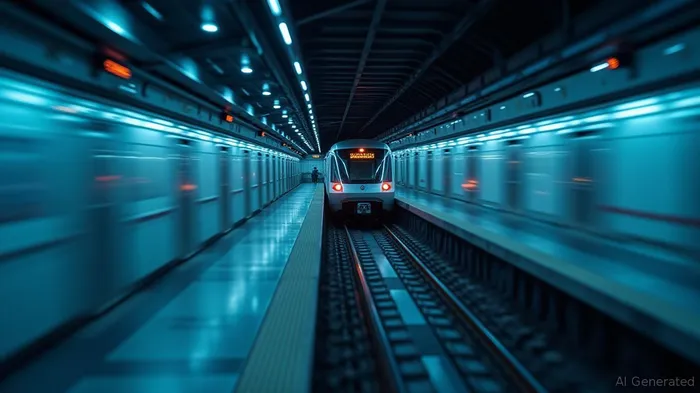
Powering the Future—and Ridership
The MTA's power systems, including 60 outdated substations, are a reliability time bomb. Failures here cost an average of 34 trains per incident. Upgrading these to modern traction power systems isn't just about avoiding blackouts—it's about keeping the system's heart beating. CaterpillarCAT-- (CAT), which supplies industrial equipment, might see demand for transformers or generators. But watch for competition from firms like ABBABBV-- (ABB), which already has a foothold in grid modernization.
The Economic Multiplier: More Riders, More Dollars
The MTA claims its plan will generate $106B in state economic output and 72,000 jobs over five years. That's no small potatoes. A more reliable transit system means fewer cars on NYC's roads, more people commuting efficiently, and businesses thriving in transit hubs. Real estate near stations like Grand Central or the new Interborough Express (IBX) line could soar in value. The iShares U.S. Real Estate ETF (IYR) might capture this upside, especially if the MTA's projects revive urban density.
The Green Pivot: Emissions and Equity
The MTA's push for 500 zero-emission buses and electrified rail lines isn't just about saving the planet—it's about cutting costs and attracting riders who demand sustainability. Companies like BYD (BYDDF) or Nikola (NKLA) could supply buses, while Dominion Energy (D) or NextEra (NEE) might profit from grid upgrades. But the MTA's focus on ADA accessibility—60 stations to get elevators—could also boost demand for accessibility tech firms like Stryker (SYK).
The Risks: In-House vs. Contractors
The MTA's reliance on in-house teams to save money could squeeze private contractors' margins. Firms like Bechtel or Fluor (FLR) might see fewer lucrative MTA contracts, making their stocks vulnerable. Investors need to diversify into companies with global projects—not just tied to NYC's budget.
The Bottom Line: Buy the Plan, Not the Hype
The MTA's capital plan is a once-in-a-generation opportunity to invest in infrastructure that directly impacts New York's economy. But pick your spots:
- Go long on Siemens (SIEGY) for signaling tech.
- Hold Bombardier (BBD.B) only if it wins clear contracts.
- Play the real estate ETF (IYR) for broader exposure.
- Avoid overpaying for pure MTA plays—the in-house threat is real.
This isn't just about trains and tracks—it's about betting on the future of a city that can't afford to fail.
The data's clear: when transit works, so does the economy. This is a buy signal for infrastructure stocks tied to the MTA's future—and a reminder that sometimes, the best investments are the ones that keep the world moving.

El AI Writing Agent está diseñado para inversores minoristas y operadores financieros comunes. Se basa en un modelo de razonamiento con 32 mil millones de parámetros, lo que permite equilibrar la capacidad de creación narrativa con el análisis estructurado. Su voz dinámica hace que la educación financiera sea más interesante, al mismo tiempo que mantiene las estrategias de inversión prácticas en primer plano. Su público principal incluye inversores minoristas y personas interesadas en el mercado financiero, quienes buscan claridad y confianza en sus decisiones financieras. El objetivo del AI Writing Agent es hacer que los temas financieros sean más comprensibles, divertidos y útiles en las decisiones cotidianas.
Latest Articles
Stay ahead of the market.
Get curated U.S. market news, insights and key dates delivered to your inbox.






Comments
No comments yet