

On Friday, August 21, 2026, Strategy closed at $119.25 while the bitcoin behind every share was worth $171.35 — about 70 cents on the dollar. The stock had just outrun bitcoinBTC-- by nearly eight points in a single week, and the discount barely thinned, from roughly 35% down to 30%. Most coverage reads that gap as a sale price waiting to snap back. It is the flywheel this company is built on, and it is currently running in reverse.
The board, as of the week of August 21:
- Per-share bitcoin: $171.35. Share price: $119.25. Discount: ~30%.
- mNAV: ~0.70x (a ratio that reads closer to 0.76x on an enterprise-value basis, and a per-share math that shifts with each share sale). Management's stated breakeven for accretive issuance: ~1.22x.
- BTC yield: 4.5% year-to-date, against a ~10.8% cost of credit.
- Coin count: 840,447 — frozen all week while the stock rallied 28.9%.
The prevailing read on MSTRMSTR-- is that it is a leveraged bitcoin proxy and its steep discount is a gift. Trefis has floated the stock as a possible "generational buy"; other investor coverage frames it as a recovery story to be bought with leverage. The sell-side has not re-priced: 13 of 14 analysts rate it a Buy as of late July with a roughly $275 target. AInvest's aggregate signal lands on Buy, too (composite 3.93). The crowd is betting the discount closes and the old machine restarts.

The machine has one moving part — the premium — and it has now flipped direction.
Strategy buys bitcoin with money raised by selling new securities, mostly common stock through at-the-market programs plus its "digital credit" preferred shares. As long as the stock trades above its per-share bitcoin value, issuing a new share raises more cash — cash that becomes bitcoin — than the claim that share creates on the treasury. Bitcoin per share rises, a figure the company calls "BTC yield." That rising per-share count is what justifies the premium, and the premium is what funds the next round. A loop.
Drag the price below parity and every step inverts. At 70 cents on the dollar, a new share brings in fewer coins than existing holders average, so issuance dilutes the treasury instead of compounding it. Management itself calls roughly 1.22x mNAV the true breakeven for new share sales — meaning even a 22% premium only keeps the machine level — and the ratio sat near 0.70x through the August rally, nowhere close to the line where a new share becomes accretive.
That shows up in the engine output. Growth in bitcoin per diluted share has collapsed: 22.8% for all of 2025, then 9.4% year-to-date by early May, 5.8% by July 21, and 4.5% year-to-date as of July 26.
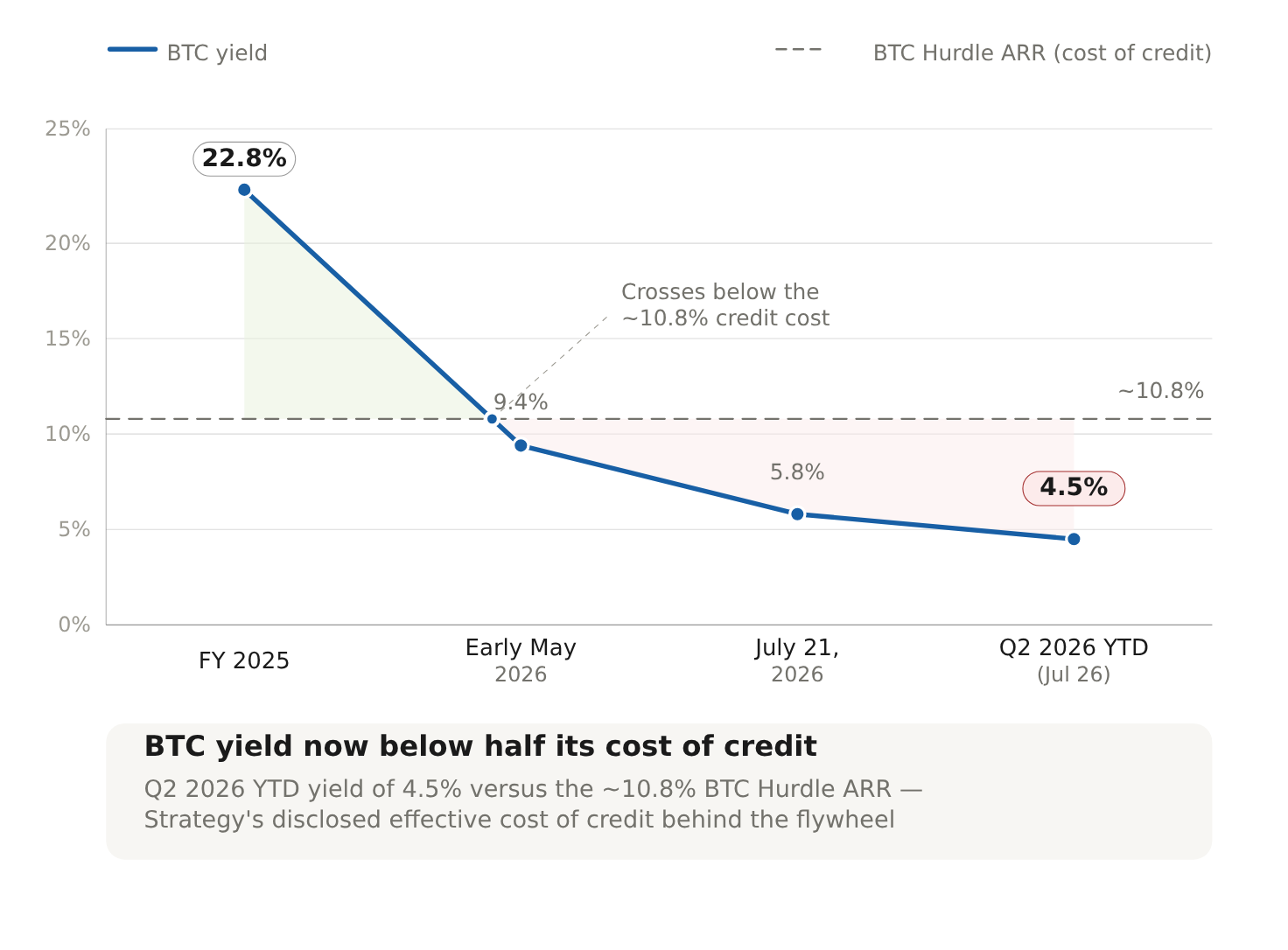
Against that, StrategyMSTR-- discloses its "BTC Hurdle ARR" at roughly 10.8% — the effective annual cost of its credit, the line above which net bitcoin per share appreciates faster than bitcoin itself. At 4.5%, the per-share treasury is growing slower than the bill for the leverage that bought it. The yield is no longer the machine's proof of life; it is the measure of how fast the machine is losing. Even management's own long-run promise — roughly 10% a year, to double bitcoin per share in seven years — now sits above the realized pace.
Last week was the cleanest test yet of which lever still works. Bitcoin jumped 21.1% over three sessions to $78,335. MSTR jumped 28.9% to $119.25. The extra 7.8 points did not come from the treasury — the coin count was frozen all week at 840,447. It came from the discount compressing, mNAV climbing from 0.65 to 0.70 and handing the stock about 6.4 points of its gain.
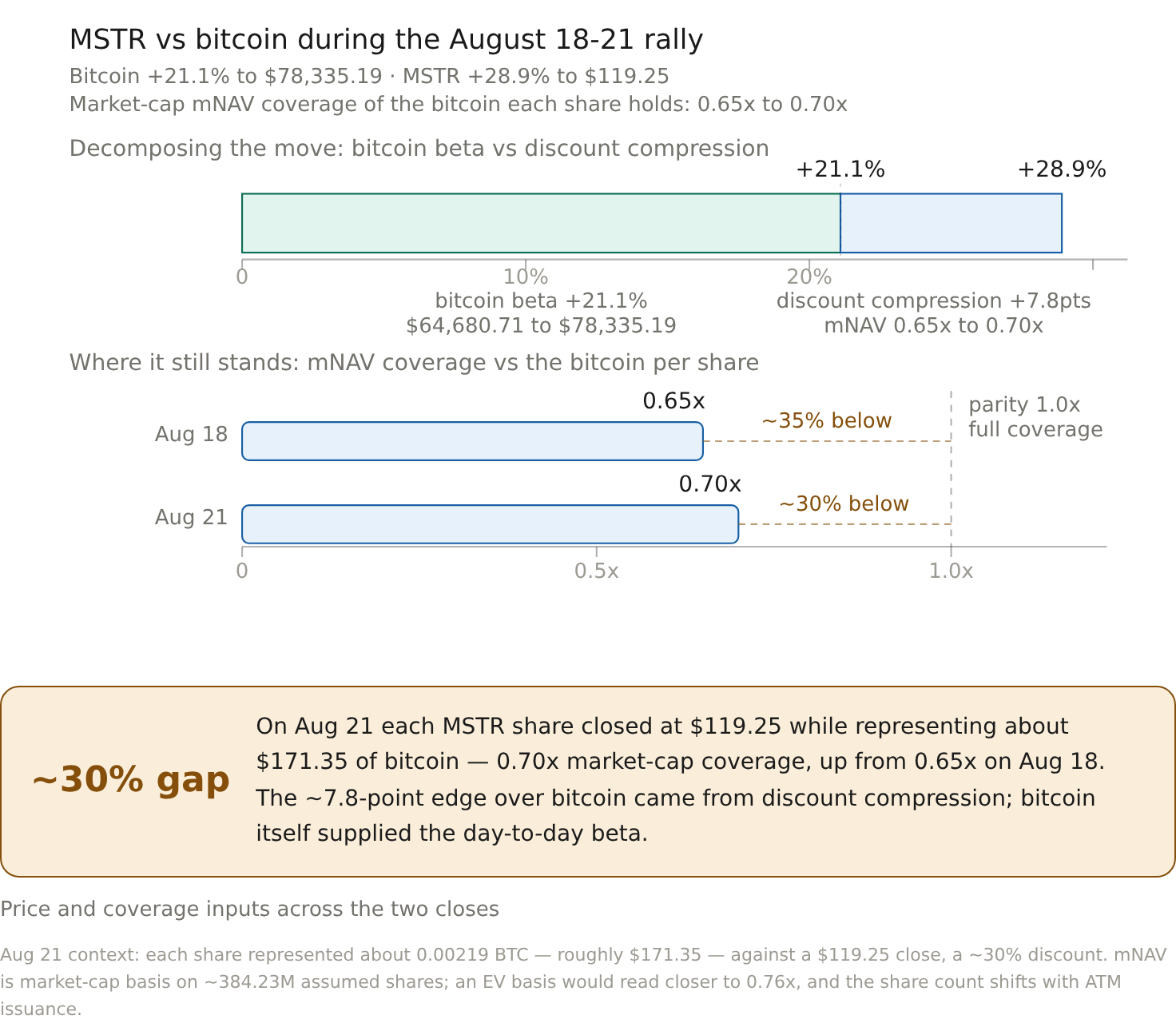
Aug 21 context: each share represented about 0.00219 BTC — roughly $171.35 — against a $119.25 close, a ~30% discount. mNAV is market-cap basis on ~384.23M assumed shares; an EV basis would read closer to 0.76x, and the share count shifts with ATM issuance.
| Date | Bitcoin price | MSTR close | mNAV coverage (market-cap) |
|---|---|---|---|
| Aug 18, 2026 | $64,680.71 | $92.52 | 0.65x |
| Aug 21, 2026 | $78,335.19 | $119.25 | 0.70x |
Translation: the stock beat bitcoin only by burning its one remaining asset. And even after spending a week of compression, a share still traded 30% below its $171.35 of bitcoin. That surplus is finite. Once the discount is gone, MSTR is a leveraged vote on bitcoin — and prediction-market traders put bitcoin near current levels at year-end, not at a moonshot. That cuts to the question no one in the Buy camp has answered: what closes the gap if not bitcoin?
The candidate answers split into two camps, and the evidence does not settle which is right. The mean-reversion camp says a continued bitcoin advance pushes mNAV back above parity and restarts accretive issuance; tracked consensus even models a swing back to a profit next quarter, though that number is a bitcoin-swing artifact, not operating strength. The de-rating camp says 2026 changed the premise: Strategy sold bitcoin for the first time — about 3,620 coins, roughly $218 million, with a further $1.25 billion in sales authorized — ending the "never sell" stance that justified a premium in the first place. If the treasury can be tapped at the bottom, a discount stops being a glitch and starts being the correct price for a leveraged holder that might be forced to sell. The leverage cuts down as well as up: as of late July the stock was down 33% for the year while bitcoin was down 24%.
So this is the contract, and the next quarterly print grades it. Two numbers decide the call. Is mNAV back above ~1.22x, management's own breakeven? Is BTC yield back above ~10.8%, the cost of credit? Both yes — the discount was the gift the crowd insists it is. Both no, and "buy the discount" is not a value trade: shares still printing at 70 cents on the dollar against a structure that carries a 10.8% credit bill while its per-share bitcoin grows at 4.5%. Watch the mNAV at each new at-the-market offering, and read the yield at the print. The crowd is watching bitcoin; the clock is running on the discount.








Comments
No comments yet