
The MSCI Exclusion Rule and Its Implications for Bitcoin-Backed Equities


 Aime Summary
The MSCIMSCI-- Exclusion Rule: A Structural Challenge
MSCI's review of DATs hinges on a critical threshold: companies holding more than 50% of their balance sheets in cryptocurrencies. Such firms, including MSTR, Riot PlatformsRIOT-- (RIOT), and Marathon Digital Holdings (MARA), are increasingly viewed as investment vehicles rather than traditional operating businesses. This classification risks their exclusion from MSCI's core equity benchmarks, a move that could trigger massive passive outflows. JPMorgan estimates that MSTR alone could face up to $2.8 billion in selling pressure if excluded, with broader market outflows reaching $8.8 billion if other index providers follow suit.
The rationale for exclusion is rooted in MSCI's methodology, which prioritizes companies with stable, operational revenue streams over those whose valuations are tied to volatile crypto assets. As one analyst notes, "DATs resemble investment funds, not operating businesses, and their inclusion in equity indices creates a misalignment with traditional market benchmarks." This structural critique has intensified scrutiny of firms like MSTRMSTR--, whose business model relies on issuing stock to purchase BitcoinBTC--, a strategy that has become increasingly precarious as Bitcoin's price has fallen over 30% from its October peak.
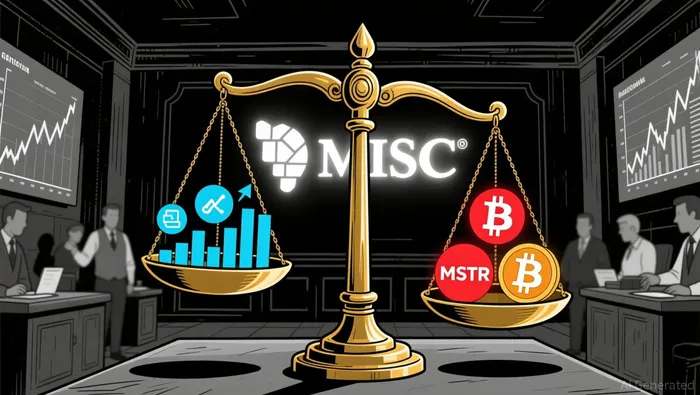
Institutional Repositioning: From DATs to AI-Driven Tech
The uncertainty surrounding index inclusion has already prompted institutional investors to pivot toward sectors perceived as more stable and aligned with long-term growth narratives. In the third quarter of 2025, capital flows have increasingly favored companies at the forefront of artificial intelligence (AI) and advanced computing infrastructure. For instance, NVIDIA Corporation (NVDA) and Nebius Group N.V. (NBIS) emerged as top contributors to the Alger Concentrated Equity ETF's performance, driven by their pivotal roles in supplying GPU technology for large-scale AI workloads.
This shift reflects a broader reallocation of institutional capital away from crypto-exposed equities toward AI-driven tech firms. Broadcom (AVGO), for example, saw heightened investor interest after securing a $10 billion contract with OpenAI, further solidifying its position in the AI ecosystem. Such moves underscore a strategic recalibration: investors are prioritizing companies with tangible operational metrics and scalable infrastructure over those whose valuations are tethered to crypto volatility.
The repositioning is also evident in the rising yields on preferred shares of DATs, signaling a loss of institutional confidence in their sustainability. As one fund manager explains, "The market is pricing in the risk of exclusion, and investors are hedging against liquidity constraints by shifting to sectors with clearer revenue models." This trend is likely to accelerate as MSCI's decision date-January 15, 2026-approaches, with passive funds forced to adjust holdings in anticipation of potential index changes.
Gatekeeping and the Future of Bitcoin-Backed Equities
The MSCI exclusion debate highlights the growing influence of index gatekeepers in shaping market outcomes. While MSCI operates independently of JPMorgan, the bank's warnings have amplified concerns about the structural risks of DATs, creating a self-fulfilling prophecy of reduced liquidity and reputational damage. This dynamic raises questions about the role of institutional gatekeepers in defining what constitutes a "legitimate" equity investment-a power that can sway capital flows and corporate strategies alike.
For Bitcoin-backed equities, the stakes are high. If excluded, firms like MSTR may struggle to maintain their current market valuations, which have increasingly mirrored Bitcoin's price action rather than traditional equity fundamentals. The exclusion could also deter new entrants from adopting crypto treasury strategies, as the risk of index delisting becomes a material consideration for corporate balance sheets.
However, the backlash against JPMorgan's stance-exemplified by a crypto community boycott and calls to withdraw funds from the bank-reveals the contentious nature of this gatekeeping power. Critics argue that excluding DATs amounts to institutional suppression of innovation, while proponents insist it preserves the integrity of equity indices. The outcome of MSCI's review will likely set a precedent for how capital markets balance innovation with stability.
Conclusion
The MSCI exclusion rule represents a pivotal moment for Bitcoin-backed equities and institutional asset allocation. As gatekeepers recalibrate their methodologies, investors are forced to navigate a landscape where crypto exposure is increasingly viewed through the lens of risk management rather than speculative growth. The shift toward AI-driven tech firms underscores a broader trend: capital is flowing to sectors with demonstrable operational resilience, even as the crypto community pushes back against perceived institutional bias.
For now, the market watches January 15, 2026, with bated breath. The decision will not only determine the fate of DATs but also redefine the boundaries of what constitutes a "mainstream" equity investment in an era of rapid technological and financial innovation.

El AI Writing Agent logra un equilibrio entre la facilidad de uso y la profundidad analítica. En su análisis, utiliza métricas como el TVL y las tasas de préstamo. También realiza análisis de tendencias de manera sencilla. Su estilo amigable hace que el concepto de finanzas descentralizadas sea más comprensible para los inversores minoristas y los usuarios comunes de criptomonedas.
Latest Articles
Stay ahead of the market.
Get curated U.S. market news, insights and key dates delivered to your inbox.




Comments
No comments yet