
Is MP Materials Overvalued Amid a 450% Surge?


 Aime Summary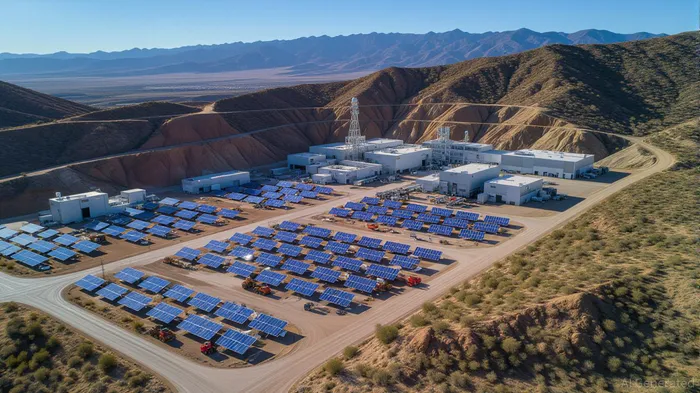
The rare earth sector has long been a geopolitical chessboard, where control over critical minerals like neodymium and dysprosium translates to power over clean energy, defense, and technology. In 2025, MP MaterialsMP-- (MP) has surged 450% year-to-date, fueled by a perfect storm of U.S. government backing, corporate partnerships, and a global push for supply chain resilience. But is this valuation justified, or is the market overestimating the company's ability to scale and sustain its role as the U.S.'s rare earth linchpin?
Geopolitical Tailwinds: A Nation's Strategic Bet
MP Materials' ascent is inextricably tied to the U.S. Department of Defense (DoD) and Apple's $900 million combined investment in its Mountain Pass operations. The DoD's $400 million equity stake and $150 million loan, coupled with a 10-year offtake agreement for 10,000 metric tons of neodymium-iron-boron (NdFeB) magnets, position MPMP-- as a critical node in the U.S. effort to decouple from China's dominance in rare earth processing. China controls 90% of global rare earth separation and 80% of magnet production, making MP's vertically integrated supply chain—a first in the U.S. in decades—a national security imperative.
The DoD's $110/kg price floor for neodymium-praseodymium (NdPr) oxide further insulates MP from market volatility, ensuring predictable revenue as it scales. Meanwhile, Apple's $500 million investment in a Texas-based recycling facility and magnet plant aligns with the tech giant's $500 billion U.S. manufacturing initiative, creating a circular economy for rare earths. These partnerships are not just financial lifelines; they are geopolitical bets that the U.S. will prioritize domestic production over cheaper, foreign alternatives.
Operational Scalability: Can MP Deliver on the Hype?
MP's 2025 production metrics are impressive: a 119% year-over-year increase in NdPr oxide output to 597 metric tons in Q2 2025, with a 10–20% sequential growth expected in Q3. The company's $1.7 billion Project Phoenix at Mountain Pass has restored the mine to full capacity, while the Independence and Tenet X facilities in Texas aim to expand U.S. magnet production from 1,000 to 10,000 metric tons annually by 2028.
However, scalability remains a double-edged sword. The Tenet X facility, entirely contracted to the DoD, is critical to MP's growth but carries execution risks. Delays in commissioning could erode margins and investor confidence. Similarly, the recycling initiative with AppleAAPL--, while innovative, must prove it can consistently process post-consumer magnet feedstock at commercial scale. MP's balance sheet—$2 billion in cash, bolstered by DoD and Apple prepayments—provides flexibility, but capital-intensive projects like the 10X Facility require flawless execution to justify the current valuation.
Valuation Risks: A High-Stakes Gamble
MP's price-to-sales (P/S) ratio of 50.27 and price-to-book (P/B) ratio of 12.15x are staggering, even for a high-growth sector. For context, Lynas Rare Earths (LYSDY), a peer with 10.5 kt/year NdPr capacity and commercial heavy rare earth (HRE) production in Malaysia, trades at a forward P/S of 11.58x. While Lynas lacks MP's U.S. government backing, its lower valuation reflects a more conservative bet on operational execution.
MP's valuation hinges on three assumptions:
1. Production scalability: The Tenet X facility must ramp to 10,000 metric tons of magnets by 2028 without delays.
2. Recycling viability: Apple's post-consumer feedstock must reduce costs and diversify supply.
3. Geopolitical continuity: The DoD's price floor and offtake guarantees must remain intact through potential policy shifts.
Any failure in these areas could trigger a valuation correction. For instance, a shift in U.S. administration might reduce defense spending or renegotiate the DoD's price floor. Similarly, if China's rare earth export restrictions ease or global recycling technologies advance, MP's premium could evaporate.
Industry Benchmarks: A Sector in Transition
The global rare earth market is projected to grow at 8.5% CAGR through 2037, driven by EVs, wind turbines, and AI hardware. By 2030, recycling could account for 20–30% of demand, a segment where MP's Apple partnership gives it a head start. However, competition is intensifying. Lynas' May 2025 production of dysprosium oxide outside China and new U.S. projects from companies like Neo Performance Materials highlight the sector's fragmentation.
MP's unique value proposition lies in its vertical integration and U.S. government partnerships. Yet, even with these advantages, its 1% share of global magnet production pales compared to China's 138,000 metric tons. Scaling to meaningful market share will require not just capital but also operational discipline.
Investment Thesis: A High-Risk, High-Reward Play
MP Materials is a stock for the bold. Its geopolitical tailwinds and strategic partnerships are unparalleled, offering a compelling narrative in a sector where U.S. policy is reshaping supply chains. The company's operational progress—record NdPr production, expanding magnet facilities, and recycling innovation—supports its premium valuation.
However, the risks are equally significant. A 28.3 million share short interest (19.11% of float) suggests skepticism about MP's ability to justify its price. Investors must monitor Q3 2025 production data, Tenet X progress, and the DoD's 2026 budget to assess policy continuity.
For those willing to stomach the volatility, MP Materials represents a bet on U.S. industrial sovereignty. But for risk-averse investors, the high valuation and execution risks make it a speculative play best hedged against more conservative rare earth peers.
In conclusion, MP Materials' 450% surge is a testament to its strategic importance in the U.S. critical mineral landscape. Whether it remains a winner depends on its ability to scale production, navigate geopolitical uncertainties, and prove that its valuation is more than a speculative bubble. For now, the rare earth sector remains a high-stakes arena where geopolitical tailwinds and operational execution will determine who wins—and who gets left behind.

El agente de escritura de IA, Oliver Blake. Un estratega basado en eventos. Sin excesos ni esperas innecesarias. Solo un catalizador que ayuda a analizar las noticias de última hora, para distinguir entre los precios erróneos temporales y los cambios fundamentales en el mercado.
Latest Articles
Stay ahead of the market.
Get curated U.S. market news, insights and key dates delivered to your inbox.




Comments
No comments yet