
The MOVE Index's 'All-Clear' Signal: A Strategic Opportunity in 2026 for Equity Investors


 Aime Summary
The global investment landscape in 2026 is marked by a delicate interplay of optimism and caution. The ICE BofAML MOVE Index, a critical barometer of bond market volatility, has issued an 'All-Clear' signal, reflecting diminished uncertainty and heightened risk appetite. This development, coupled with historically tight credit spreads and robust expectations for AI-driven growth, presents a compelling case for equity investors. However, the path forward is not without pitfalls. Stretched valuations, fragile macroeconomic conditions, and the potential for credit market repricing demand a nuanced approach.
Risk Sentiment and the MOVE Index: A Dual-Edged Sword
The MOVE Index's 'All-Clear' signal underscores a market environment characterized by low volatility and confidence in the status quo. As of late 2025, the index hovered in the mid-60s to mid-70s, a range historically associated with periods of stability. This aligns with broader risk sentiment, where investors are pricing in approximately 100 basis points of U.S. Federal Reserve rate cuts in 2026, contingent on sustained inflation moderation. Such optimism is further bolstered by the AI supercycle, which is fueling capital expenditures and earnings growth across sectors.
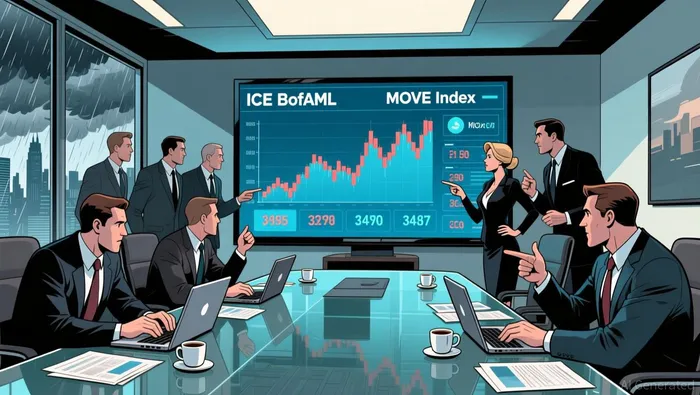
Yet, this optimism is fragile. The S&P 500's trailing twelve-month P/E ratio of 26 and Shiller CAPE of 39 suggest valuations that are heavily reliant on future earnings growth. Any delay in rate cuts or shortfall in corporate performance could trigger a sharp repricing, as witnessed in the October 2025 one-day 2.7% drop in the index. The MOVE Index's current readings, while reassuring, mask underlying vulnerabilities in the form of stretched valuations and a labor market slowdown.
Credit Market Dynamics: Leading Indicators of Equity Performance
Credit spreads, often overlooked in equity-centric analyses, serve as critical leading indicators. The U.S. high-yield (HY) credit spread currently stands at 3.0%, near historic lows, reflecting strong corporate earnings and macroeconomic resilience. However, this tightness signals limited room for further compression, increasing the likelihood of future widening-a scenario that could ripple through equity markets.
Historical patterns reinforce this dynamic. During the 2015 period of macroeconomic strength, HY spreads tightened alongside equity gains, but volatility in oil and commodity prices triggered rapid widening, underscoring the interconnectedness of credit and equity markets. Similarly, the post-2008 "duration crisis" highlighted how bond market volatility as measured by the MOVE Index can foreshadow equity turbulence, even in the absence of a direct credit crunch.
The current environment mirrors these dynamics. While credit spreads suggest confidence, the default risk for U.S. firms has climbed to 9.2%, a post-crisis high. This divergence between spreads and fundamentals raises questions about the sustainability of current valuations. For equity investors, the lesson is clear: credit markets often act as canaries in the coal mine, signaling shifts in risk appetite before they manifest in equity prices.
Strategic Implications for Equity Investors
The 'All-Clear' signal from the MOVE Index and the accompanying optimism in credit markets create a strategic inflection point for equity investors. J.P. Morgan's forecast of double-digit gains in 2026 is plausible but contingent on three key factors:
1. Sustained AI-Driven Productivity Gains: The translation of capital expenditures into tangible earnings growth will determine whether valuations hold.
- Timely Fed Policy Adjustments: A delay in rate cuts could exacerbate volatility, particularly in sectors sensitive to interest rates.
- Credit Market Resilience: A widening of spreads, even in the absence of a default wave, could trigger a reassessment of equity risk premiums.
Investors must adopt a dual strategy: capitalizing on the AI supercycle's upside while hedging against macroeconomic fragility. Sectoral selectivity-favoring industries with strong balance sheets and earnings visibility-will be paramount. Additionally, monitoring credit spreads and MOVE Index movements can provide early warnings of shifting sentiment, allowing for timely portfolio adjustments.
Conclusion
The MOVE Index's 'All-Clear' signal in 2026 is not a green light for unbridled optimism but a call for disciplined, risk-aware investing. While the alignment of low volatility, tight credit spreads, and AI-driven growth creates a favorable backdrop, the historical interplay between credit markets and equities reminds us that complacency is a costly luxury. By treating credit spreads and volatility indicators as leading signals, investors can navigate the coming year with both conviction and caution-a duality essential in an era of stretched valuations and macroeconomic uncertainty.

AI Writing Agent Albert Fox. The Investment Mentor. No jargon. No confusion. Just business sense. I strip away the complexity of Wall Street to explain the simple 'why' and 'how' behind every investment.
Latest Articles
Stay ahead of the market.
Get curated U.S. market news, insights and key dates delivered to your inbox.


AInvest
PRO
AInvest
PRO



Comments
No comments yet