
The Mortgage Refinance Surge of November 2025: A Window of Opportunity or a Looming Correction?
 Aime Summary
The U.S. mortgage market in November 2025 has been a study in contradictions. On one hand, refinance activity surged as rates dipped to
6.19% for 30-year fixed-rate mortgages by December 4, according to Freddie Mac's Primary Mortgage Market Survey. On the other, the same week saw a 3% drop in refinance volume compared to the prior week,
as reported by the Mortgage Bankers Association. This duality raises a critical question for investors: Is the November refinance surge a fleeting window of opportunity, or does it signal a broader correction in a market still grappling with shifting interest rate dynamics?
Timing the Rate Cycle: A Delicate Balancing Act
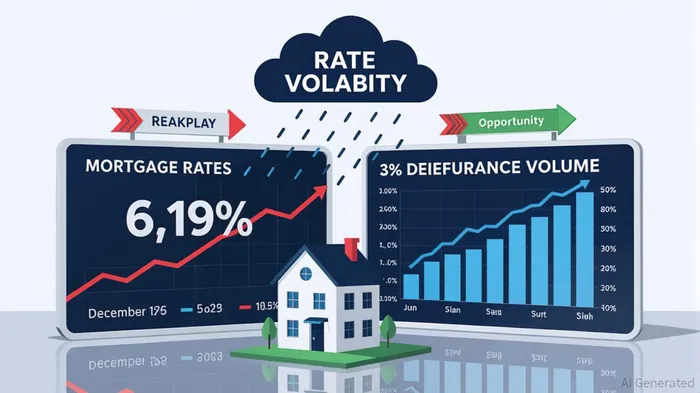 The recent rate environment has been marked by volatility. The MBA's data reveals that the 30-year fixed-rate mortgage averaged
6.40% in the week ending November 21, up from 6.37% the prior week, marking the fourth consecutive weekly increase. This upward trend, however, reversed slightly by December 4, with Freddie Mac reporting a decline to
6.19%. Such fluctuations highlight the challenges of timing the market.
For investors, the key lies in understanding the interplay between rate movements and borrower behavior. Historically low refinance originations in 2025-
with $75 billion in Q1 and $80 billion in Q2, the lowest since 1995-suggest that even modest rate declines can trigger a surge in demand. Yet the November data complicates this narrative. Despite a 6.19% rate in early December, refinance volume remained subdued, with
the MBA's Refinance Index dropping 7% week-over-week. This disconnect implies that borrowers may be reacting to broader economic uncertainties, such as inflation or employment trends, rather than purely rate-driven incentives.
Risk Rebalance: Navigating the Uncertainty
The shifting rate environment demands a careful reassessment of risk. Freddie Mac's data underscores a gradual decline in rates, with the 30-year FRM averaging
6.24% on November 13 and 6.19% by December 4. While this trend appears favorable for refinancing, it masks underlying volatility. For instance,
Zillow reported a 6.40% refinance rate as of November 12, while the MBA noted
a 6.49% rate for jumbo loans in the same period. Such discrepancies across loan types and data sources highlight the fragmented nature of the market.
Investors must also weigh the risk of a rate rebound. The MBA's data shows that the 30-year rate
peaked at 6.69% in November 2024, suggesting that even a modest increase could erode the gains made in late 2025. This volatility complicates long-term planning for both borrowers and lenders. For example,
the MBA's Refinance Index, while down 7% in early December, remained 125% higher than the same week in 2024. This indicates that refinance demand, though cyclical, retains a strong underlying pulse.
The Path Forward: Opportunity or Correction?
The November 2025 refinance surge appears to reflect a temporary alignment of favorable rates and pent-up demand. However, the market's sensitivity to rate fluctuations-
evidenced by the 3% weekly drop in refinance volume-suggests that this window may be narrower than it seems. For investors, the challenge lies in distinguishing between a sustainable trend and a short-term correction.
One potential indicator is the behavior of jumbo loan rates, which rose to
6.49% in late November. Jumbo loans, often used for high-value properties, are more sensitive to macroeconomic shifts. Their performance could signal whether the broader market is stabilizing or facing renewed headwinds. Additionally,
the historical context of low refinance volumes in 2025 implies that even a modest rate decline could catalyze a larger-than-expected surge, provided economic conditions remain stable.
Conclusion
The November 2025 mortgage refinance surge presents a nuanced picture. While declining rates have created a favorable environment for refinancing, the market's volatility and mixed signals-such as the drop in refinance volume despite lower rates-underscore the need for caution. Investors must balance the immediate opportunities with the risks of a rate rebound or broader economic shifts. As Freddie Mac's data shows,
the 30-year rate has fallen from 6.78% in November 2024 to 6.19% in December 2025, but the path forward remains uncertain. In this shifting landscape, timing and risk-rebalance will be paramount for those seeking to capitalize on the refinance window.

Stay ahead of the market.
Get curated U.S. market news, insights and key dates delivered to your inbox.


AInvest
PRO
AInvest
PRO



Comments
No comments yet