
Mortgage Refinance Opportunities in a Cooling Market: Strategic Timing and Fixed-Income Positioning for Long-Term Wealth Preservation


 Aime Summary
The U.S. housing market in 2025 is navigating a complex interplay of Federal Reserve policy shifts, mortgage rate volatility, and structural imbalances. While the Fed's rate cuts have injected liquidity into short-term borrowing, their impact on long-term fixed-rate mortgages has been muted, creating a unique window for strategic refinancing and fixed-income positioning. For investors and homeowners alike, understanding this dynamic is critical to preserving wealth in an environment of evolving risks and opportunities.
Federal Reserve Policy and Mortgage Rate Disconnect
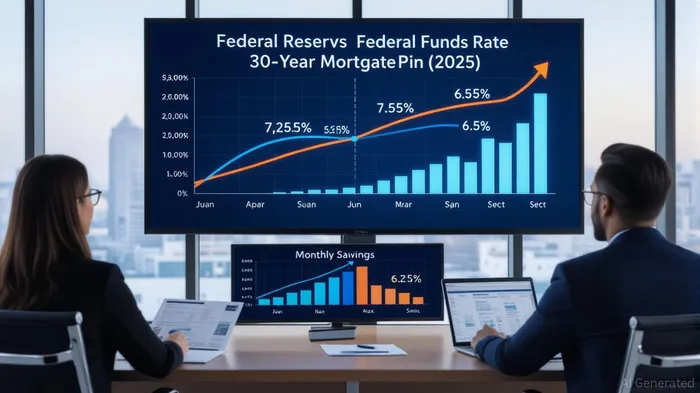
The Federal Reserve's three consecutive rate cuts in 2025-lowering the federal funds rate to a target range of 3.5% to 3.75% by December-have primarily benefited short-term debt instruments
according to financial analysis. However, long-term mortgage rates, which are more closely tied to 10-year Treasury yields and inflation expectations, have remained stubbornly high.
As of December 2025, the average 30-year fixed-rate mortgage hovered near 6.32%, reflecting persistent inflationary pressures and investor risk premiums. This disconnect underscores the importance of timing: while the Fed's actions signal a cooling economy, mortgage rates may lag, offering a narrow but actionable opportunity for refinancing.
Experts
caution that further declines in mortgage rates will depend on the trajectory of Treasury yields and broader economic data. For instance,
a hypothetical 0.75-percentage-point drop in rates-from 6.30% to 5.55%-could reduce monthly payments by hundreds of dollars for a $400,000 mortgage. However, homeowners must act decisively, as
waiting for dramatic rate declines (e.g., to 4–5%) may be unrealistic in the near term.
Strategic Refinance Windows: Balancing Costs and Benefits
Refinance activity surged in late 2025, with refinances accounting for nearly half of all mortgage applications in September. This trend is particularly advantageous for homeowners who locked in high rates during 2023 and 2024. For example,
refinancing a $400,000 mortgage from 7.25% to 6.5% could save approximately $232 monthly, or over $40,000 in interest over the loan's life. Crucially,
borrowers must evaluate break-even points-calculating upfront costs divided by monthly savings-to ensure refinancing aligns with their long-term plans.
Adjustable-rate mortgages (ARMs) and home equity lines of credit (HELOCs) have also become more attractive
as the Fed's cuts have directly reduced their rates. Short-term holders may benefit from ARMs' lower initial rates, while long-term homeowners should prioritize fixed-rate refinancing to lock in stability
according to market analysis.
Non-bank lenders, with their agile digital platforms, have retained 35% of refinancing customers in Q3 2025, further easing access to competitive rates.
Fixed-Income Positioning: Leveraging Refinance Proceeds for Wealth Preservation
The proceeds from refinancing present an opportunity to enhance wealth preservation through strategic fixed-income allocations. In 2025, fixed-income markets emphasize diversification, liquidity, and high-quality collateral.
Unconstrained fixed-income strategies, which blend government bonds, corporate debt, and securitized credit, offer flexibility in a volatile environment. Intermediate government/credit bonds, for instance, provide a balance of yield and safety, while
residential mortgage-backed securities benefit from strong home equity fundamentals.
Refinance-driven liquidity can also be directed toward collateralized loan obligations (CLOs) and asset-backed securities (ABS), which offer attractive yields amid low financing costs. For example,
CLO equity has gained traction due to its potential to capitalize on U.S. economic growth and geopolitical volatility. Similarly,
high-quality municipal bonds and investment-grade corporate debt remain resilient, with tight credit spreads reflecting demand for stable income streams.
Navigating Structural Challenges and Policy Uncertainty
Despite these opportunities, structural challenges persist.
Elevated mortgage rates have discouraged homeowners from selling, keeping inventory levels tight and limiting housing turnover. This dynamic constrains the supply of agency mortgages and affects the performance of mortgage-backed securities
according to market analysts. Additionally,
the Fed's admission that it lacks tools to address structural housing shortages-such as supply-side bottlenecks-introduces uncertainty.
To mitigate these risks, investors should prioritize liquidity and diversification.
Maintaining cash reserves and allocating to sectors with strong fundamentals-such as non-agency RMBS with robust collateral-can buffer against market volatility. Tax-efficient strategies, including
utilizing tax-deferred accounts and optimizing capital gains, further enhance wealth preservation.
Conclusion: A Holistic Approach to Wealth Preservation
In a cooling market, the interplay between Federal Reserve policy, mortgage rate dynamics, and fixed-income opportunities demands a holistic approach. Homeowners should act swiftly to capitalize on current refinancing windows, while investors can deploy refinance proceeds into high-quality fixed-income instruments to generate income and preserve capital. By aligning short-term refinancing gains with long-term portfolio resilience, stakeholders can navigate the uncertainties of 2025 and beyond.

Stay ahead of the market.
Get curated U.S. market news, insights and key dates delivered to your inbox.


AInvest
PRO
AInvest
PRO



Comments
No comments yet