
Mortgage Rates Today: Why Refinance Activity Collapses Amid War Fears
 Aime Summary
The housing market is currently caught in a precarious balance where minor rate reductions are failing to spark the renewed activity that lenders and builders desperately need. Despite the average 30-year fixed mortgage rate dipping to 6.331% from 6.403% in the preceding week, the broader narrative is one of stagnation rather than recovery. This disconnect stems from a perfect storm of factors: lingering economic uncertainty, geopolitical instability, and a borrower base that is effectively frozen out of refinancing options.
For the average homeowner holding a mortgage at rates significantly below 6%, the incentive to refinance has evaporated. Meanwhile, prospective buyers are finding that even a marginal decrease in rates does little to offset the crushing weight of higher monthly payments compared to recent years. The result is a market where inventory is slowly increasing, but transaction volumes are plummeting, leaving many potential deals on the table.
What Are Current Mortgage Rates Driving Refinance Volume Down?
The mechanics of the current housing landscape reveal a stark reality: while headline rates may show minor fluctuations, the cost of borrowing remains prohibitively high for many. Data from the Mortgage Bankers Association indicates that the refinance index has fallen by 3% week-over-week and is down 4% year-over-year, marking the lowest levels seen since December 2025. This decline is not merely a statistical blip but a structural shift driven by the fact that the vast majority of existing borrowers are locked into rates that are significantly lower than current benchmarks.
Even as the average contract interest rate for 30-year fixed mortgages with conforming balances dropped to 6.51% from 6.57%, this reduction was insufficient to entice a significant number of borrowers to refinance. The math simply does not work for many. For a borrower with an existing rate of 3% or 4%, refinancing into a 6.5% loan would result in a substantial increase in monthly payments, negating any potential benefits from a shorter loan term or cash-out options. Consequently, the refinance share of total mortgage activity has dwindled to 44.3%, a figure that suggests a market where the primary engine of growth has stalled.
Furthermore, the slight rate decreases have not been enough to overcome the psychological barrier of high borrowing costs. The average interest cost on a $300,000 loan remains substantial, with total interest payments over 30 years exceeding $370,000 at these current levels. This reality has left many homeowners in a state of "rate lock," where they are unwilling to trade their low rates for the current market environment, effectively removing a massive segment of potential activity from the market.
Why Is the Housing Market Struggling Amidst Rising Oil Prices?
The primary driver of the current mortgage rate volatility and subsequent market stagnation is the geopolitical tension surrounding the conflict in Iran. This conflict has triggered a surge in oil prices, pushing costs above $4 per gallon for the first time since 2022, which has in turn stoked fears of renewed inflation. Higher energy costs are a classic inflationary pressure, forcing the Federal Reserve to maintain a hawkish stance and keep the federal funds rate between 3.50% and 3.75%.
This inflationary pressure is directly impacting the bond market, which serves as the benchmark for mortgage rates. The 10-year Treasury yield has soared from 3.94% to 4.34% in about a month, sending mortgage rates climbing for the fifth consecutive week to reach 6.46% before a slight pullback. The market is currently pricing in zero rate cuts from the Federal Reserve through the remainder of 2026, with some officials even suggesting that a rate hike could become necessary if energy prices continue to spike.
The impact on the housing market has been immediate and severe. Purchase applications fell 3% last week, while refinance applications dropped 17% as buyers and borrowers alike pause to assess the economic fallout. The uncertainty is particularly damaging because it disrupts the spring homebuying season, a critical period for the real estate industry. Homebuyers are hesitant to lock in loans at rates that could remain elevated or even rise further, leading to a market that is waiting on the sidelines for more clarity.
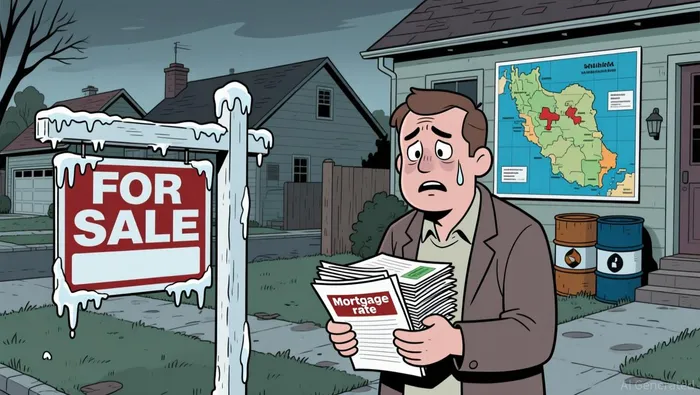
How Are Mortgage Rate Spikes Affecting Homebuilder Stocks?
The ripple effects of higher mortgage rates extend far beyond the housing market, deeply impacting the broader economy and equity markets. Homebuilder stocks have been among the hardest hit, with companies like Lennar plunging 14.3% over the past month and PulteGroup down 8.9% according to recent reports. Similarly, home improvement retailers such as Home Depot and Lowe's have seen their stock prices drop by 11% and 8.5%, respectively, as fewer homeowners are willing or able to undertake major renovation projects.
The correlation is direct: as mortgage rates rise, the pool of qualified buyers shrinks, leading to a decline in new home sales. This reduction in demand forces homebuilders to slow construction, cut back on marketing, and in some cases, reduce workforce levels. The stock market has reacted swiftly to these fundamentals, discounting the future earnings potential of these companies in light of the current rate environment.
Additionally, the impact is felt by the supply chain. With fewer homes being built and sold, the demand for materials, appliances, and services drops, creating a domino effect that ripples through the manufacturing and retail sectors. The market is currently in a state of flux, with investors waiting for signs that inflation will cool and rates will stabilize before committing capital to these cyclical industries. The upcoming Consumer Price Index data will be critical in determining whether the housing market sees a recovery or if the current headwinds will persist for the rest of the year.
What Is The Outlook For Mortgage Rates In The Near Future?
Looking ahead, the outlook for mortgage rates remains uncertain and heavily dependent on the trajectory of inflation and geopolitical stability. While a two-week ceasefire in the Middle East has provided a temporary boost to market sentiment, causing the 10-year Treasury yield to react sharply, the underlying inflationary pressures from energy prices remain a concern. Market observers note that the likelihood of mortgage rates returning to pandemic-era lows below 3% remains negligible barring a major economic disaster.
The Federal Reserve is currently in a delicate position, assessing the economic fallout from the war-driven energy shock before deciding on future policy moves. Fed Chair Jerome Powell has signaled that officials are monitoring the situation closely, but the path forward is fraught with challenges. If oil prices continue to rise or if inflation data comes in hotter than expected, the Fed may be forced to hold rates steady for even longer, or potentially hike them again.
For investors and homeowners, the key takeaway is patience. The market is likely to remain volatile in the near term, with rates fluctuating based on weekly economic data and geopolitical news. While there may be brief periods of relief, the structural shift in the housing market means that the era of ultra-low rates is likely over. Borrowers and investors should focus on long-term planning rather than short-term rate movements, as the cost of capital is expected to remain elevated for the foreseeable future.

Stay ahead of the market.
Get curated U.S. market news, insights and key dates delivered to your inbox.


AInvest
PRO
AInvest
PRO



Comments
No comments yet