
Mortgage Rates Hit 6.85%, Defying Trump's Push for Lower Borrowing Costs
US mortgage rates have climbed to their highest level in more than a year, reversing much of the relief that briefly appeared at the beginning of 2026 and complicating President Donald Trump's effort to make homeownership more affordable. The average contract rate on a 30-year fixed mortgage rose six basis points to 6.85% in the week ended September 4, according to the latest Mortgage Bankers Association data. That was the highest level since June 2025. Refinancing applications fell 6.2% from the previous week, while total mortgage applications declined 2.7%, showing how quickly borrowers have responded to the renewed increase in financing costs.
The difference is significant for buyers already dealing with elevated home prices. On a $400,000 mortgage, the monthly principal-and-interest payment would be about $2,620 at 6.85%, compared with roughly $2,410 when rates were near 6.06% in January. That is an increase of around $210 a month, or more than $2,500 a year, before property taxes, insurance and maintenance costs are included. Higher rates also reduce how much buyers can borrow, forcing some households to increase their down payment, consider a less expensive property or leave the market altogether.

The Fed and Bond Market Are Overpowering Trump's Plan
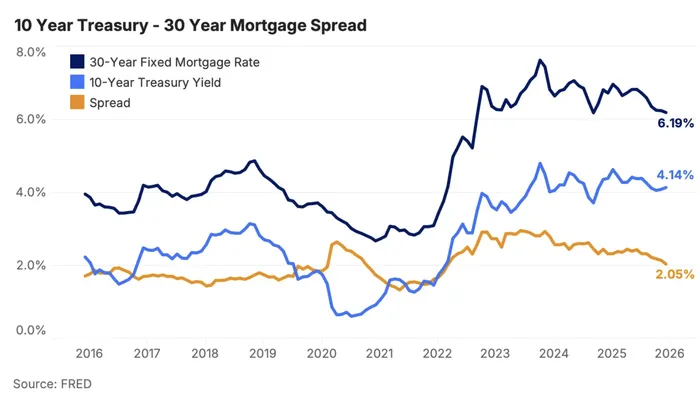
Mortgage rates are influenced by the Federal Reserve, but the central bank does not set them directly. They generally follow longer-term bond yields—especially the 10-year Treasury yield—plus an additional premium demanded by investors in mortgage-backed securities. When Treasury yields rise because investors expect stronger inflation, heavier government borrowing or tighter monetary policy, lenders usually charge more for home loans.
The 10-year Treasury yield recently approached 4.8% and subsequently reached its highest level since late 2023. Several forces have driven the increase. Oil prices have surged as the conflict involving the US and Iran threatens energy supplies and shipping through the Middle East, raising concerns that transportation and consumer costs will remain elevated. The federal debt exceeded $40 trillion in August, increasing the amount of government financing the market must absorb. At the same time, technology companies are spending heavily on artificial-intelligence infrastructure, adding another source of demand for capital. Investors are consequently demanding higher yields to hold long-term US debt.
The outlook for Federal Reserve policy has intensified the pressure. Traders currently see approximately a 60% probability that the Fed will raise its benchmark rate by a quarter percentage point at its September 15–16 meeting. Expectations have shifted in response to stronger employment data, renewed energy inflation and hawkish signals from Fed Chair Kevin Warsh. Upcoming producer- and consumer-price reports could still change the calculation, but markets now view a rate increase as more likely than another hold.
A Fed hike would not automatically add 25 basis points to mortgage rates because markets typically price in policy changes before they occur. Mortgage rates could even decline if investors believe a hike will successfully prevent inflation from becoming entrenched. The larger risk is that the Fed signals rates must remain elevated for longer or that additional increases may be required. Such a message would support Treasury yields and could keep mortgage rates close to 7%.
This is directly at odds with Trump's preferred policy. The president has repeatedly demanded lower interest rates, arguing that the US should have some of the lowest borrowing costs in the world. After stronger-than-expected August job creation caused traders to increase their rate-hike bets, Trump again called on the Fed to cut rates. The central bank, however, is responsible for controlling inflation and supporting employment—not meeting the White House's target for mortgage costs. If higher oil prices keep inflation above the Fed's 2% goal, political pressure is unlikely to produce the immediate cuts Trump wants.
Why Trump's $200 Billion Intervention Wasn't Enough
The administration has already tried to lower mortgage rates without waiting for the Fed. In January, Trump instructed Fannie Mae and Freddie Mac to purchase up to $200 billion of mortgage-backed securities. The two government-controlled companies support the housing market by buying mortgages from lenders, packaging them into securities and providing liquidity that enables lenders to issue additional loans. By creating a large new buyer for mortgage bonds, the administration hoped to raise their prices, reduce their yields and narrow the spread between mortgage rates and Treasury yields.
The announcement initially appeared to work. Fannie and Freddie began with approximately $3 billion of purchases, and the average 30-year mortgage rate fell to 6.06%, its lowest level since September 2022. Trump said the purchases would drive mortgage rates and monthly payments lower, while Treasury Secretary Scott Bessent explained that the program was partly intended to offset the Federal Reserve's reduction of its own mortgage-bond portfolio. The Fed's holdings—built up during earlier economic crises—had been shrinking by roughly $15 billion to $17 billion each month.
However, analysts warned that the effect would probably be modest. The Federal Reserve still holds more than $2 trillion of mortgage-backed securities, meaning the proposed $200 billion program is relatively small compared with previous central-bank interventions. Economists estimated that Trump's plan might reduce mortgage rates by approximately 10 to 15 basis points. It could compress the premium on mortgage bonds, but it could not prevent rates from rising if the underlying 10-year Treasury yield moved sharply higher.
That limitation is now visible. Mortgage rates have increased by nearly 80 basis points from their January low despite the government-backed purchases. The administration targeted one component of mortgage pricing, but the broader bond market moved in the opposite direction as investors became more concerned about oil-driven inflation, federal debt and another Fed hike. Higher Treasury yields eventually overwhelmed the benefit created by Fannie and Freddie's purchases.
The White House has explored several other ways to improve housing affordability. Trump has proposed restricting large institutional investors from buying single-family homes, arguing that ordinary families should not have to compete with Wall Street. Federal housing officials have expanded the use of VantageScore as an alternative to FICO and are considering changes to credit-report requirements to reduce transaction costs. A 50-year mortgage has also been discussed as a way to lower monthly payments by spreading repayment over a longer period.
But these policies address only individual parts of the problem. Alternative credit scores may broaden access to mortgages without materially reducing the cost of capital. A 50-year loan can lower monthly payments but keeps borrowers in debt longer and substantially increases the total interest paid. Restricting institutional investors may help buyers in some local markets, but it does not solve the national shortage of available homes. Even successful efforts to lower mortgage rates could push home prices higher if cheaper financing stimulates demand without a corresponding increase in supply.
The rise to 6.85% therefore highlights the limits of presidential influence over the housing market. Trump can direct Fannie Mae and Freddie Mac to purchase mortgage bonds, change credit-scoring rules and pressure the Fed to cut rates. He cannot easily force private investors to ignore inflation, fiscal deficits or geopolitical risk. Lasting relief for homebuyers would require a sustained decline in inflation and Treasury yields, a meaningful expansion in housing supply, or both.
The next major test will come from US inflation data and the Fed's September decision. Softer readings could reduce the probability of a hike, pull Treasury yields lower and give the administration's mortgage policies room to work again. Hotter inflation—especially if oil remains above $100 a barrel—could keep the Fed hawkish and push home-loan costs closer to 7%.
For American buyers, the message is increasingly clear: Washington can intervene in the mortgage market, but it cannot dictate the final interest rate. Trump succeeded in temporarily pulling borrowing costs toward 6%, yet the rebound to 6.85% shows that the bond market ultimately has the stronger hand.

Senior Research Analyst at Ainvest, formerly with Tiger Brokers for two years. Over 10 years of U.S. stock trading experience and 8 years in Futures and Forex. Graduate of University of South Wales.
Latest Articles
Stay ahead of the market.
Get curated U.S. market news, insights and key dates delivered to your inbox.


AInvest
PRO
AInvest
PRO



