
Mortgage Rate Volatility and the Fed's December Rate Cut Outlook


 Aime Summary
Labor Market Trends: A Mixed Picture
The September 2025 jobs report added 119,000 nonfarm payroll jobs, a modest rebound from August's revised 4,000 job losses, but the unemployment rate remained unchanged at 4.4%. However, broader measures of unemployment, such as the U-6 rate, which includes part-time workers and those not actively seeking employment, fell to 8%. This divergence highlights a labor market that, while not in freefall, is showing uneven resilience. Wage growth, at 3.8% year-over-year, remains above the Fed's 2% target but has moderated from earlier in the year.
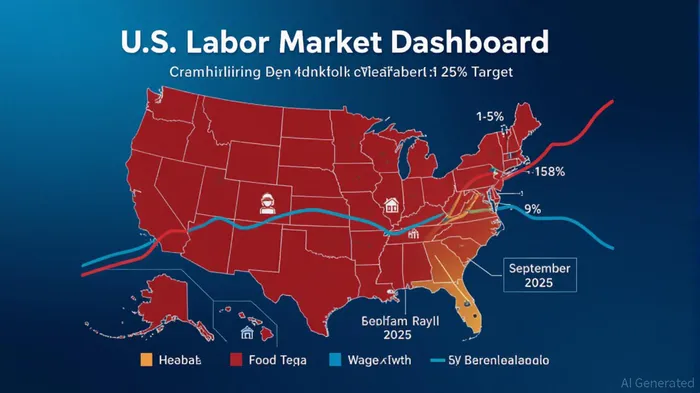 Yet, the picture is complicated by the government shutdown, which delayed the release of October and November 2025 labor data. The combined report, scheduled for December 16, 2025, will provide critical insights into whether the labor market is cooling further. For now, the Fed must rely on older data and anecdotal evidence, such as the Beige Book, which notes weaker employment conditions in roughly half of the 12 Federal Reserve districts.
The Fed's Dilemma: Policy Uncertainty and Market Signals
The Federal Reserve faces a stark dilemma. On one hand, inflation has edged closer to its 2% target, and labor market softness-evidenced by rising unemployment and cautious hiring-suggests the need for accommodative policy. On the other, persistent inflationary pressures and the risk of overstimulation complicate the case for aggressive rate cuts.
Market expectations for a December rate cut have surged to 80%, driven by dovish signals from officials like New York Fed President John Williams and the September FOMC minutes, which indicated that "most participants believed further downward adjustments to the target range would likely be warranted." However, internal divisions within the FOMC remain evident. Some policymakers caution against a December cut, arguing that the labor market's resilience-reflected in robust job gains in sectors like healthcare and food services-may not justify immediate action.
Housing Market Sentiment: Caught in a Vicious Loop
The housing market, already under strain from elevated mortgage rates and affordability challenges, is caught in a "vicious loop" of compounding stresses. Weaker labor market prospects and wage growth have dampened demand for home purchases, while supply constraints persist due to regulatory hurdles and construction bottlenecks according to recent analysis. According to the Beige Book, consumer spending has declined, particularly among lower- and middle-income households, who are increasingly prioritizing discounts over discretionary purchases.
Fixed mortgage rates, which had stabilized in recent months, may see further downward pressure if the Fed cuts rates in December. However, the absence of October and November labor data introduces uncertainty. As one analyst notes, "The housing market is waiting on the Fed to signal whether it will act as a stabilizer or a source of renewed volatility."
Fixed-Income Allocations: Navigating a Shifting Landscape
Investors in fixed-income markets are recalibrating their strategies in response to the Fed's potential rate cuts. Short-term instruments such as money-market funds and short-term Treasurys are expected to see yields decline as the Fed lowers borrowing costs. Longer-term bonds, including the 10-year Treasury, may also see modest adjustments, though their sensitivity to inflation and rate hike risks remains a concern.
The Fed's decision to end its balance sheet reduction (quantitative tightening) by December is another factor influencing allocations. This move is expected to improve liquidity in financial markets, potentially boosting demand for high-quality fixed-income assets according to Fidelity analysis. However, the 2025 Global Fixed Income Outlook cautions that long-term bonds remain vulnerable to inflationary shocks or policy reversals, urging investors to prioritize short-duration and high-credit-quality instruments.
Conclusion: A Delicate Balancing Act
The Fed's December decision will hinge on its ability to navigate a fragile economic landscape. A rate cut could provide a much-needed boost to the labor market and housing sector, but it risks reigniting inflationary pressures if the economy rebounds more strongly than anticipated. For investors, the key lies in hedging against uncertainty: maintaining flexibility in fixed-income portfolios while closely monitoring labor market data and policy signals.
As the December 16 jobs report looms, the coming weeks will be critical in determining whether the Fed's next move will be a lifeline for the housing market-or a harbinger of renewed volatility.

Delivering real-time insights and analysis on emerging financial trends and market movements.
Latest Articles
Stay ahead of the market.
Get curated U.S. market news, insights and key dates delivered to your inbox.


AInvest
PRO
AInvest
PRO



Comments
No comments yet