
Mortgage Rate Declines and Strategic Asset Allocation: Navigating a Shifting Housing and Financial Landscape


 Aime Summary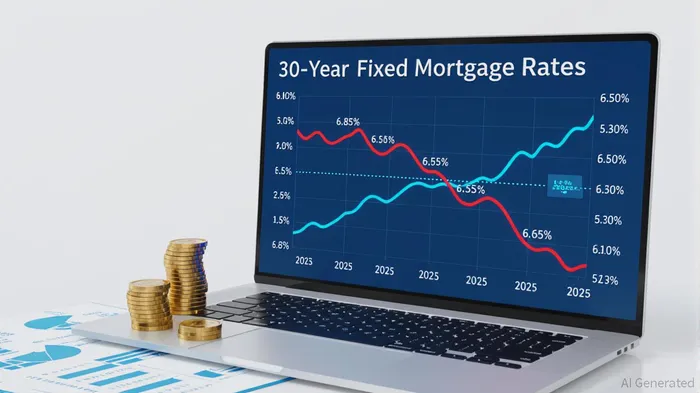
The gradual decline in U.S. mortgage rates through 2025 has sparked a nuanced shift in housing market dynamics, consumer behavior, and financial sector strategies. As the 30-year fixed-rate mortgage averaged 6.58% as of August 21, 2025—a drop from 6.85% at the start of the summer—investors and policymakers are recalibrating expectations for asset allocation and risk management. This article examines the cascading effects of these rate declines, focusing on how they reshape housing demand, consumer spending, and financial market opportunities, while offering actionable insights for investors navigating a low-rate environment.
The Housing Market: A Delicate Balance of Affordability and Inventory
The modest easing of mortgage rates has injected cautious optimism into the housing sector. Purchase applications have outpaced 2024 levels, yet first-time buyers remain hesitant, wary of locking in at current rates. This hesitation is compounded by the "lock-in effect," where homeowners with low-rate mortgages from the 2020–2021 period are reluctant to sell, keeping inventory constrained. For example, active listings in the Northeast and Midwest remain 15–20% below pre-pandemic averages, despite a 31% year-over-year increase in December 2024.
The risk of a self-fulfilling cycle looms: as rates dip below 6%, increased demand could drive home prices upward, offsetting affordability gains. Investors in real estate must weigh regional disparities. Urban centers with strong employment growth (e.g., Austin, Seattle) offer resilience, while Sun Belt markets face affordability gaps and oversupply. For instance, Florida's housing market, already strained by high inventory, may see further downward pressure on prices if demand fails to materialize.
Consumer Spending: A Modest Stimulus in a Slowing Economy
The March 2025 Economic Developments report projects a 1.7% GDP growth rate for 2025, down from 2.2% earlier in the year, reflecting broader economic moderation. However, declining mortgage rates are expected to provide a counterbalance. Lower borrowing costs could free up household budgets, potentially boosting spending on durable goods and services. The challenge lies in translating this into broader economic momentum, as personal savings rates remain depressed and wage growth has plateaued.
For investors, the key is to identify sectors poised to benefit from this modest stimulus. Home improvement retailers and smart home technology providers stand to gain as homeowners invest in renovations to enhance property value. Conversely, discretionary sectors like luxury goods may see muted demand unless wage growth accelerates.
Financial Markets: Opportunities and Risks in a Low-Rate Environment
The Federal Reserve's anticipated rate cuts—projected at 25 basis points in September and further reductions in October and December—have already been partially priced into financial assets. Mortgage REITs (e.g., MORT, RLOC) and short-duration mortgage-backed securities (MBS) are prime beneficiaries, as lower rates drive refinancing activity and reduce prepayment risk. However, regional banks with heavy commercial real estate (CRE) exposure, particularly in office sectors with rising vacancy rates, face heightened vulnerability.
Strategic asset allocation must prioritize diversification. Large-cap banks with diversified revenue streams (e.g., JPM, WFC) offer stability, while investors should underweight regional institutions with concentrated CRE portfolios. Fixed-income investors, meanwhile, should favor short-duration MBS to mitigate rate volatility.
Risk Mitigation: Hedging Against Uncertainty
The path of mortgage rates remains contingent on inflation, labor market data, and policy shifts. A 72% probability of a September Fed rate cut exists, but its immediate impact on mortgage rates is likely limited. Investors should adopt proactive hedging strategies:
1. Urban Real Estate Overweights: Target markets with strong job growth and infrastructure investment.
2. Defensive Sectors: Allocate to utilities and consumer staples for downside protection.
3. Policy-Linked Infrastructure: Position in sectors tied to government spending (e.g., renewable energy, transportation).
Conclusion: A Call for Agility and Diversification
The 2025 mortgage rate decline, while modest, signals a pivotal shift in housing and financial market dynamics. For investors, the path forward requires agility: balancing growth opportunities in resilient real estate and financial sectors with defensive allocations to mitigate risks. As rates approach the psychologically significant 6% threshold, the housing market may see a surge in activity—but only if inventory constraints are addressed. In this environment, strategic asset allocation and proactive risk management will be the cornerstones of long-term success.

Delivering real-time insights and analysis on emerging financial trends and market movements.
Latest Articles
Stay ahead of the market.
Get curated U.S. market news, insights and key dates delivered to your inbox.


AInvest
PRO
AInvest
PRO



Comments
No comments yet