
Mortgage Rate Decline to 10-Month Low: Unlocking Housing Market Recovery and Investment Opportunities


 Aime Summary
The U.S. housing market is on the cusp of a pivotal inflection point. After a decade of volatility, the 30-year fixed mortgage rate has fallen to a 10-month low of 6.56% as of August 28, 2025, according to Freddie Mac. This decline, driven by the Federal Reserve's dovish pivot and moderating inflation, has reignited investor interest in homebuilder stocks and housing-related ETFs. For those attuned to the interplay between monetary policy and real estate fundamentals, this shift presents a compelling case for strategic entry into a sector poised for recovery.
The Mortgage Rate-Driven Catalyst
Mortgage rates, which peaked at 7.12% in October 2022, have fallen nearly 21 basis points in the past month alone. This decline is not merely a statistical blip but a structural shift. With rates projected to stabilize in the mid-6% range through 2025 and dip further to 6.1% by 2026, affordability for first-time buyers is improving. For a $320,000 loan, a 6.56% rate translates to a monthly payment of $2,076, compared to $2,200 at 7%. This 100-basis-point difference could unlock millions of new buyers, particularly in Sunbelt markets where population growth outpaces supply.
Homebuilder Stocks: A Tale of Resilience and Margin Compression
Homebuilder stocks have surged in response to this rate-driven optimism. The SPDR S&P Homebuilders ETF (XHB) is up 10.4% year-to-date, while the iShares U.S. Home Construction ETF (ITB) has gained 42.93% over the past year. Individual names like LennarLEN-- (LEN) and D.R. HortonDHI-- (DHI) have outperformed the S&P 500, with DHI's stock jumping 24% in Q2 2025 after a surprise earnings beat.
However, this rally masks underlying challenges. Builder confidence remains at 32—the third-lowest level since 2012—due to inventory imbalances and margin compression. For example, Lennar's Q4 2024 gross margin fell short of expectations, and D.R. Horton has relied on price concessions to close deals. These metrics suggest that while the sector is gaining momentum, profitability remains fragile.
Housing ETFs: Diversification and Structural Risks
For investors seeking exposure without picking individual stocks, housing ETFs like XHBXHB-- and ITB offer diversified access to the sector. XHB, with a 0.35% expense ratio, tracks the S&P Homebuilders Select Industry Index and includes 35 securities, while ITB (0.39% fee) focuses on 44 home construction firms. Both have benefited from the rate-driven rally, but their valuations reflect mixed fundamentals.
The InvescoIVZ-- Building & Construction ETF (PKB) and Hoya Capital Housing ETF (HOMZ) provide alternative entry points, with varying levels of diversification. However, analysts caution that the sector's growth is driven more by expectations of Fed rate cuts than by tangible improvements in demand. For instance, the National Association of Realtors (NAR) forecasts home price increases of 2.6% in 2025, a far cry from the 7% growth seen in 2023.
Strategic Investment Considerations
- Rate Sensitivity and Duration: Homebuilder stocks and ETFs are highly sensitive to mortgage rate movements. A 10-basis-point drop in rates could boost builder margins by 2–3%, but a reversal could erode gains. Investors should monitor the Fed's September and December 2025 meetings for clues about the pace of rate cuts.
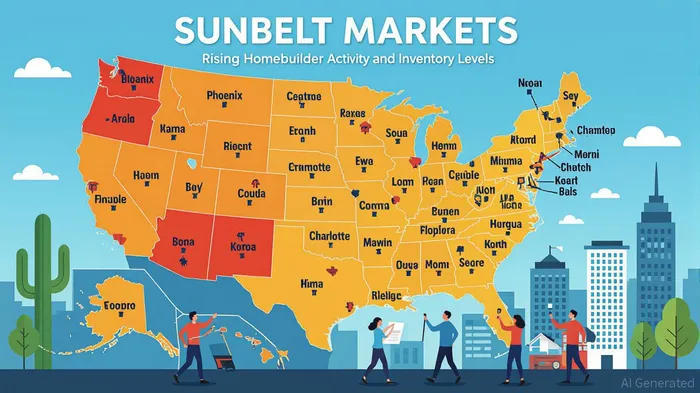
- Regional Diversification: While Sunbelt markets like Phoenix and Las Vegas are seeing inventory surges, urban hubs like Miami and Phoenix face prolonged listing times. ETFs with geographic diversification (e.g., HOMZ) may mitigate regional risks.
- Valuation Caution: Despite strong stock performance, homebuilders trade at low forward P/E ratios (e.g., Lennar at 8.6x). This suggests the market is pricing in margin compression, not growth. Investors should prioritize firms with strong balance sheets and cost-control measures.
The Road Ahead: Balancing Optimism and Caution
The housing market's recovery hinges on three key factors:
- Federal Reserve Policy: Three rate cuts in 2025 (as forecasted by J.P. Morgan and Goldman Sachs) could push mortgage rates below 6% by year-end, further stimulating demand.
- Inventory Normalization: With a 4.6-month supply of homes (vs. the balanced 6-month benchmark), builders must address supply gaps without overbuilding.
- Affordability Dynamics: While lower rates help, wages must keep pace with home price growth to sustain demand.
For investors, the path forward is clear: position in a diversified mix of homebuilder stocks and ETFs, while hedging against rate volatility. The SPDR S&P Homebuilders ETF (XHB) and iShares U.S. Home Construction ETF (ITB) offer broad exposure, while individual names like PulteGroupPHM-- (PHM) and KB HomeKBH-- (KBH) provide targeted opportunities in high-growth regions.
Final Thoughts
The decline in mortgage rates to a 10-month low is a watershed moment for the housing market. While structural challenges remain, the combination of improving affordability, Fed easing, and strategic builder adaptations creates a favorable environment for long-term investors. By balancing optimism with caution—focusing on diversified ETFs, regional trends, and valuation discipline—investors can position themselves to capitalize on the next phase of the housing recovery.

Delivering real-time insights and analysis on emerging financial trends and market movements.
Latest Articles
Stay ahead of the market.
Get curated U.S. market news, insights and key dates delivered to your inbox.
AInvest
PRO
AInvest
PRO



Comments
No comments yet