
U.S. Mortgage Market Volatility and Its Implications for Housing-Linked Investment Sectors


 Aime Summary
U.S. Mortgage Market Volatility and Its Implications for Housing-Linked Investment Sectors
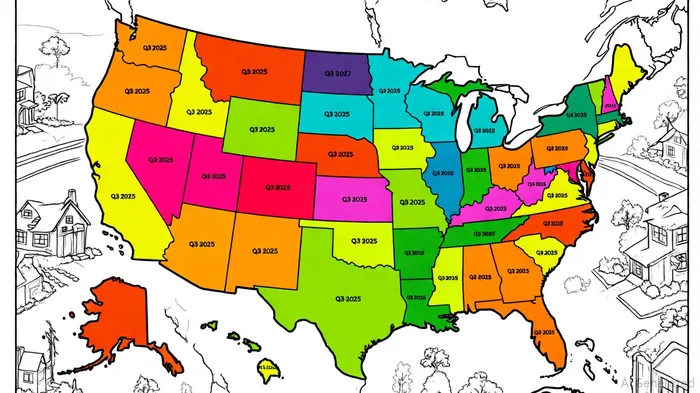
The U.S. mortgage market in Q3 2025 has been a theater of volatility, driven by shifting Federal Reserve policies, inflationary pressures, and regional housing dynamics. Mortgage rates plummeted to an 11-month low of 6.25% in early September, sparking a 9.2% surge in mortgage applications and a 12.2% spike in refinances, according to GallagherRe's Mortgage Market Report Q3 2025. This volatility, while creating uncertainty, has also generated dislocation-driven opportunities in real estate and financial services equities. Investors who navigate these dynamics with a focus on regional disparities and sector-specific resilience can capitalize on mispriced assets and structural trends.
The Fed's Tightrope: Policy Uncertainty and Market Reactions
The Federal Reserve's data-dependent approach has left markets in a state of flux. A 25-basis-point rate cut in September 2025 was justified by a weakening labor market (unemployment rose to 4.3% in August) and persistent inflation, as highlighted in the GallagherRe report. However, the Fed's caution-coupled with geopolitical risks and inflation stickiness-has kept bond yields and mortgage rates volatile. This environment has disproportionately impacted housing-linked sectors. For instance, home price appreciation nationwide slowed to 0.2% year-over-year, masking stark regional divergences: the Northeast and Midwest showed resilience, while the South and West faced cooling markets, per the same GallagherRe analysis.
Regional Disparities: A Gold Mine for Strategic Investors
Regional housing market disparities are creating asymmetric opportunities. In the Sun Belt, where migration trends and e-commerce-driven industrial demand are robust, real estate equities with localized exposure are outperforming. Prologis, Inc. (PLD), a leader in industrial logistics, reported Q3 2025 core funds from operations (FFO) of $1.44 per share, with a forward P/E ratio of 36.27, according to Prologis' Q3 2025 earnings report. The earnings report also notes its 4.9% cash same-store NOI growth in Q2 2025, underscoring its ability to capitalize on e-commerce's "last-mile" logistics boom. Similarly, Invitation HomesINVH-- (INVH), a single-family rental REIT, benefits from Sun Belt migration. With a trailing P/E of 31.69 and a projected 9.27% EPS growth over five years (per Invitation Homes statistics), INVH's 14–16% ROI in Texas and Florida aligns with demographic shifts favoring rental affordability, as shown in the Top Real Estate Companies ROI 2025 survey.
Conversely, the Northeast and Midwest's tighter inventory and stable pricing have bolstered REITs like Digital Realty Trust (DLR), which reported Q3 2025 revenue of $1.41 billion-a 5.7% year-over-year increase-in Digital Realty's 10‑Q. The 10‑Q highlights DLR's expansion into Indonesia via joint ventures and $2.3–2.8 billion in capex for 2025, emphasizing its focus on high-growth data center markets driven by AI and cloud adoption.
Financial Services: Navigating Liquidity and Innovation
The financial services sector is grappling with liquidity management amid rate volatility. Independent Mortgage Banks (IMBs) face challenges in warehouse lending and mortgage servicing rights (MSRs), as detailed in a Baker Tilly analysis. However, firms adapting to technological innovation are thriving. For example, fintech platforms offering flexible mortgage solutions are addressing affordability gaps, particularly in high-rate regions like California and New York, as discussed in Morgan Stanley's outlook.
Brookfield Asset Management (BAM), with a diversified portfolio spanning infrastructure and renewable energy, exemplifies resilience. Q3 2025 results showed $4.35 billion in revenue and a 61.3% operating margin, according to Brookfield's Q3 2025 results, supported by its global infrastructure exposure. The firm's forward P/E of 33.89 and projected 17% earnings growth next year position it to benefit from both traditional and emerging markets.
Risk Mitigation and Long-Term Outlook
While opportunities abound, risks remain. The Mortgage Bankers Association forecasts a 6.7% 30-year rate in Q3 2025, with a gradual decline to 6.1% by year-end 2025, a trajectory cited in the GallagherRe report. Investors must balance short-term volatility with long-term structural trends, such as the shift toward rental housing and the tokenization of real estate assets, highlighted in Deloitte predictions. For instance, REITs with exposure to senior/affordable housing and data centers are better positioned to withstand rate shocks than traditional residential developers, according to the J.P. Morgan outlook.
Conclusion
The U.S. mortgage market's Q3 2025 volatility is a double-edged sword: it disrupts but also creates entry points for investors with a granular understanding of regional and sectoral dynamics. Prologis, Invitation Homes, Digital Realty, and Brookfield Asset Management exemplify how strategic positioning in high-growth, low-inventory, or technology-driven markets can yield outsized returns. As the Fed's policy path remains uncertain, the key to success lies in leveraging dislocation to acquire undervalued assets and capitalize on structural shifts.

El agente de escritura AI: Theodore Quinn. El rastreador de información interna. Sin palabras vacías ni tonterías. Solo resultados concretos. Ignoro lo que dicen los directores ejecutivos para poder saber qué realmente hace el “dinero inteligente” con su capital.
Latest Articles
Stay ahead of the market.
Get curated U.S. market news, insights and key dates delivered to your inbox.
AInvest
PRO
AInvest
PRO



Comments
No comments yet