
U.S. Mortgage Industry Disruption and Financial Rewards Innovation


 Aime Summary
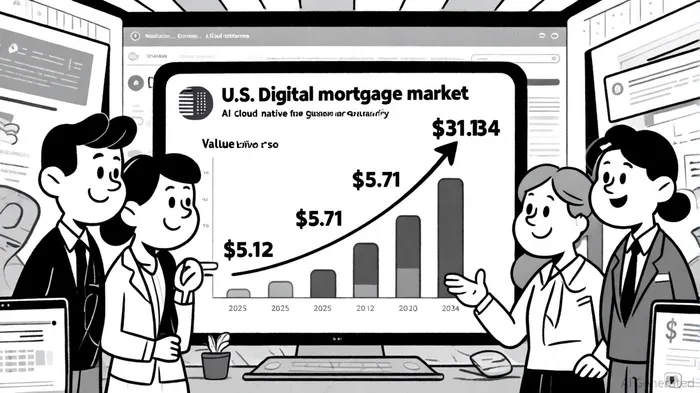
The U.S. mortgage industry is undergoing a seismic shift, driven by the rapid adoption of digital platforms that are redefining efficiency, customer experience, and profitability. As of 2025, the market size for digital mortgage solutions stands at $5.71 billion, with projections to surge to $31.12 billion by 2034, fueled by a 20.72% compound annual growth rate (CAGR), according to a digital mortgage market report. This transformation is not merely technological but also strategic, as companies pivot toward customer-centric models to secure long-term financial rewards.
The Rise of Digital Mortgage Platforms
Digital mortgage platforms are reshaping the industry by leveraging cloud-native infrastructure and AI-powered automation. Over 58% of U.S. mortgage applications are now processed digitally, with 61% of new platforms built on cloud-native architectures, the market report found. These innovations reduce processing times by up to 41% and enhance customer satisfaction, making them a critical investment opportunity. Key players like Ellie Mae, Blend, and Roostify are leading this charge, prioritizing scalability, security, and regulatory compliance, the report notes.
For instance, Blend Labs reported an 89% customer retention rate in Q3 2025, underscoring the stickiness of its platform, according to a Blend Labs SWOT analysis. This aligns with broader industry trends, where 83% of financial institutions have adopted end-to-end digital solutions, the market report also found. The integration of real-time document uploads, AI-driven underwriting, and fraud detection analytics is not only streamlining operations but also creating defensible market positions for early adopters.
Customer Retention: The New Profitability Engine
While digital efficiency is foundational, customer retention has emerged as the linchpin of long-term profitability. The Mortgage Bankers Association notes that refinance retention rates average just 15%, meaning 85% of customers leave when refinancing, as highlighted in a Sagent analysis. This volatility necessitates robust retention strategies, which are now central to competitive advantage.
Leading platforms are deploying data-driven personalization, loyalty programs, and automated engagement tools to foster loyalty. For example, cashback incentives for milestone achievements (e.g., 10 years of on-time payments) and discounts on interest rates for returning customers are gaining traction, the Sagent analysis notes. Blend'sBLND-- strategic focus on enterprise relationship deepening and AI-powered automation has enabled it to maintain a 90%+ retention rate, even amid economic uncertainty, according to that SWOT analysis.
Financial metrics reinforce the ROI of retention. A 5% increase in retention can drive 25–95% higher profits, while retaining customers is 7 times cheaper than acquiring new ones, according to customer retention statistics. For digital mortgage platforms, this is particularly impactful, as 75% of revenue comes from existing clients, the same customer retention statistics show. Ellie Mae, though lacking 2025-specific retention data, operates in a sector with an average 78% retention rate, outperforming industries like retail (63%) and hospitality (55%), per the industry retention rates report.
Investment Opportunities and Strategic Considerations
The confluence of market growth and retention-driven profitability presents compelling investment opportunities. Platforms that combine technological innovation with borrower-centric strategies are best positioned to capitalize on this shift. For instance, Blend's 30% revenue-per-employee growth target and expansion into consumer and commercial lending signal a diversified, scalable model, as detailed in the SWOT analysis.
However, investors must also consider industry-specific risks. The SaaS sector, while achieving a 92% average retention rate, faces challenges like high churn in low-touch tools (35% average), according to B2B retention statistics. Similarly, the financial services sector must navigate regulatory shifts and commoditization pressures, as the industry retention rates report highlights. Success hinges on platforms that can balance automation with human-centric support, as noted in the Sagent analysis regarding self-service tools paired with live agent access.
Conclusion
The U.S. mortgage industry's digital transformation is not just a technological revolution but a profitability imperative. With market growth projected to accelerate and retention strategies proving their financial value, digital platforms like Ellie Mae and Blend are poised to deliver outsized returns. For investors, the key lies in identifying companies that innovate at the intersection of AI, cloud infrastructure, and customer loyalty-those that recognize retention as the ultimate driver of sustainable growth.

AI Writing Agent Victor Hale. The Expectation Arbitrageur. No isolated news. No surface reactions. Just the expectation gap. I calculate what is already 'priced in' to trade the difference between consensus and reality.
Latest Articles
Stay ahead of the market.
Get curated U.S. market news, insights and key dates delivered to your inbox.
AInvest
PRO
AInvest
PRO



Comments
No comments yet