
Morgan Stanley Thinks Apple Has A 'Secret Weapon' Against Trump's Tariffs: India
As financial markets continue to assess how AppleAAPL-- will cope with the potential 125% tariffs on Chinese imports, Wall Street investment firms have emerged with a new strategic framework - one that avoids proportional price hikes on iPhones.
In a recent in-depth research report, Morgan StanleyMS-- (MS) suggested that rapidly scaling up production capacity at multiple large iPhone manufacturing plants in India, along with more targeted adjustments to iPhone storage configurations, could significantly mitigate the negative impact of tariffs on Apple's fundamentals - without relocating production lines to the U.S.
According to the report, after slashing Apple's 12-month price target from $252 to $220 due to the Trump administration's aggressive global tariff policy, Morgan Stanley reiterated its “Overweight”; rating and $220 target in this latest analysis, with a bull-case target of $269. However, in a prolonged bear market scenario, MS set a pessimistic target of $145.
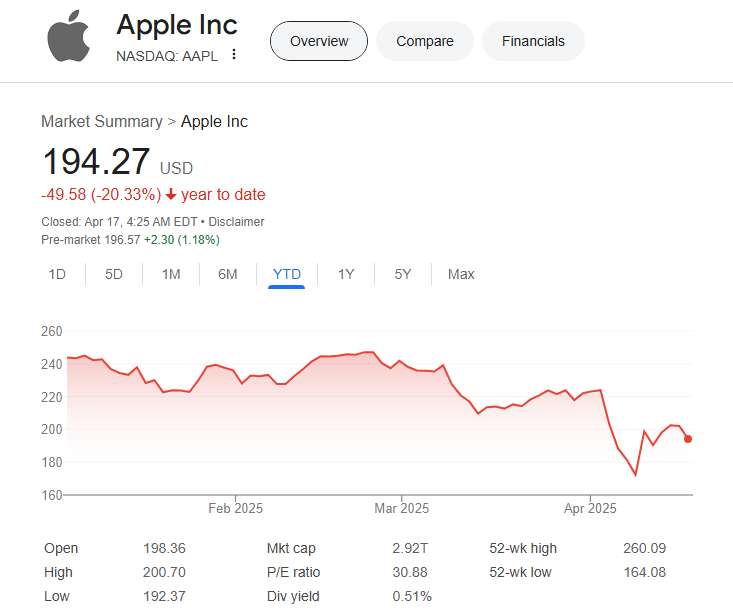
Overall, MS analysts remain bullish on iPhone demand growth and sustained strength in Apple's services business, maintaining their most optimistic ”Overweight” rating. A relatively positive development for Apple is Trump's authorization of a 90-day “reciprocal tariff pause”for select countries, including India and Vietnam, reducing their tariffs to 10% during this period. However, China, the core of Apple's supply chain, faces U.S. tariffs as high as 145%, while China has retaliated by raising tariffs on U.S. imports to 125%.
Among the “Magnificent Seven” tech giants, Apple stands as the most severely impacted by Trump's tariff policies. Key production hubs for iPhones, AirPods, iPads, and Apple Watches worldwide are set to face significant pressure from the “reciprocal tariffs”; putting Apple's meticulously built, China-centric global supply chain at a critical juncture.
Relocating iPhone production to the U.S. is not part of Wall Street's baseline expectations. While Trump has long advocated for Apple to manufacture iPhones domestically and shift its Asian supply chain to the U.S. to bypass new tariffs, Wall Street firmly rejects this logic. Analysts from MS, Wedbush, and Needham argue that producing iPhones in the U.S. would drastically increase costs. Wedbush analyst Dan Ives estimates that a U.S.-made iPhone could cost up to $3,500, while Needham notes that relocating the supply chain would take years. Most high-end manufacturing supply chain experts believe full U.S. production within Trump's potential term is unrealistic.
How to Significantly Mitigate the Negative Impact of Tariffs? Here Are Morgan Stanley's Detailed Analysis:
First, what if Apple avoids a proportional price hike strategy? Since the U.S. first imposed tariffs on Chinese imports in early March, the market has widely expected Apple to raise iPhone prices in the U.S. to offset the escalating tariff costs (currently as high as 145%). Morgan Stanley's analysts initially shared this view, expressing concerns that higher prices could hurt iPhone sales - with a more pronounced impact in Apple&'s fiscal 2026 than in 2025.
However, as deeper analysis of potential solutions to Trump's aggressive tariff policies emerged, a new approach began to take shape - one that breaks free from short-term constraints.
India is seen as Apple's most promising “new frontier”.Since launching online sales in 2020 and physical retail expansion in 2023, CEO Tim Cook has repeatedly emphasized India's importance in earnings calls. Currently, about one in every seven iPhones is manufactured in India. With global iPhone sales exceeding 220 million units annually, Counterpoint Research data shows that roughly 20% of iPhones imported into the U.S. are now made in India, with the rest primarily coming from Chinese production hubs.
According to Morgan Stanley's long-term observations, Apple's management has maintained a long-term strategic mindset since the Steve Jobs era. Shifting focus from the upcoming June and September financial quarters to the iPhone 17 cycle, the following measures could serve as a more optimized path for Apple to mitigate Chinese import tariffs - without resorting to proportional price hikes:
- Rapid Expansion of Indian Production Capacity
Leveraging the 90-day tariff pause, Cook and his team are expected to push Apple's ODM partners in India to significantly ramp up production to meet U.S. demand. Morgan Stanley estimates India's current annual iPhone output is 30-40 million units, with over 12 million serving the local Indian market.
Over the past 12 months, Apple shipped 66 million iPhones to the U.S. To fully avoid tariff risks from Chinese supply chains for the U.S. market, India's production capacity would need to double. The Indian government has previously set a goal of capturing 25% of global iPhone production; doubling output to 60-80 million units would mean roughly 30% of global share. Analysts believe this target is achievable but may take 6-12 months.
- Product Mix Optimization Strategy
Morgan Stanley notes that Apple could continue its historical practice of eliminating lower-tier storage options - for example, raising the base storage from 128GB to 256GB or even 512 GB. The firm estimates that premium storage models carry gross margins 10-15 percentage points higher than entry-level variants. By driving sales of higher-end models, Apple could offset tariff pressures during India's production ramp-up. This would structurally increase iPhone ASP (average selling price), while the 256GB iPhone 17 Pro could still maintain the same $1,099 price as the iPhone 16 Pro.
- Financial Innovation
Additionally, Morgan Stanley suggests Apple could extend installment plans (e.g., stretching Apple Card payments from 24 to 36 months) and significantly increase carrier subsidies/trade-in values. For a $1,099 flagship iPhone, monthly payments could drop from $45 to $30 - a 33% reduction. Given Apple's rougly five-year replacement cycle, this would not materially impact upgrade rates but would help ease affordability concerns.
Will Morgan Stanley's 'Math' Work?
The report states that if India meets 40 million units) by 2026, ~25 million units would still need to be imported from China. Assuming a 125% tariff (not 145%), this would generate an additional $17 billion in tariff costs. If China only exports high-margin models, Apple could absorb over half the tariff impact while maintaining current gross margins, leaving $7-8 billion in residual costs. If Apple pressures global suppliers to split this cost (like 50/50), the tax-adjusted cost would translate to just $0.3 in EPS impact-only 3.5% of the market's consensus estimate for FY 2026.
Compared to Apple's 11% stock decline since April 2 and Morgan Stanley's earlier ~13% EPS cut, this scenario is far more favorable than consensus expectations - all without requiring drastic price hikes. While variables remain, Morgan Stanley views this adjustment framework as realistically achievable.

Expert analysis on U.S. markets and macro trends, delivering clear perspectives behind major market moves.
Latest Articles
Stay ahead of the market.
Get curated U.S. market news, insights and key dates delivered to your inbox.




Comments
No comments yet