
Morgan Stanley Maintains Bullish US Stock Outlook Despite Iran Conflict
 Aime Summary
Geopolitical tensions have intensified following U.S. and Israeli strikes on Iran, causing global market jitters. U.S. stock futures and Asian shares have fallen, while oil prices have surged. The Strait of Hormuz, a key energy chokepoint, is a focal point of concern amid disruptions to oil flows according to market reports.
The energy market reaction has been swift, with U.S. benchmark crude prices rising nearly 6% and Brent crude climbing 6.2% to $77.38 per barrel. Analysts warn that prolonged disruptions could push energy prices higher and increase production costs globally as financial data shows.
Morgan Stanley remains optimistic about U.S. equities despite these developments. The bank notes that while oil price spikes have historically caused volatility, sustained disruption is necessary for significant market impacts. Current conditions align with early-cycle dynamics, suggesting a lesser likelihood of major market derails according to Morgan Stanley analysis.
What Drives Morgan Stanley's Optimism?
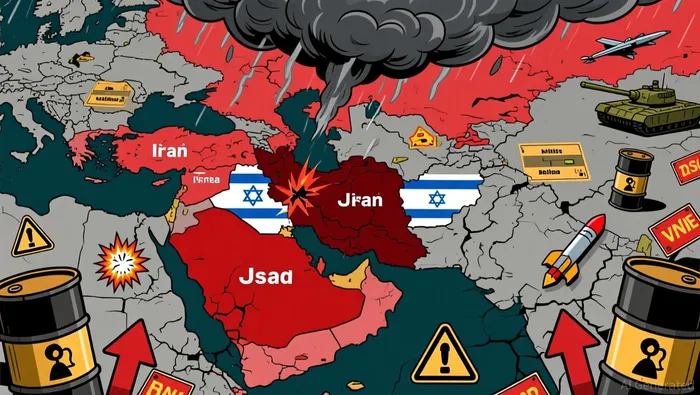
Morgan Stanley has highlighted that the U.S. stock market's current environment is resilient to short-term geopolitical shocks unless oil prices surge by 75-100%. The bank argues that a prolonged and sharp price increase, particularly during the later stages of an economic cycle, is a prerequisite for major equity declines as the bank states.
The bank also acknowledges that Egypt's direct exposure to U.S.-Iran tensions is minimal. However, rising oil prices could strain Egypt's economy by increasing its energy import bill. Morgan StanleyMS-- estimates that a $60–$75 range for Brent crude could raise Egypt's energy import bill by $400 million to $600 million in the fiscal year 2025/26 according to Morgan Stanley analysis.
How Energy Markets Are Being Affected
Energy markets are the primary transmission channel for the Iran crisis to impact the global economy. Goldman Sachs notes that while equities and credit are likely to face short-term pressure, only a severe and prolonged disruption would have major global growth implications as Goldman Sachs observes.
The U.S. and Israel's strikes have already disrupted oil and gas production in the region. Companies like Exxon MobilXOM--, TotalEnergies, and Shell are particularly exposed to these developments. Analysts note that despite potential production disruptions, higher oil prices could support profits for these firms as Reuters reports.
Oxford Economics argues that the current U.S. economic environment remains largely stable. Even if the Strait of Hormuz were to face a two-month disruption, the impact on U.S. inflation would be minimal, adding only 0.3–0.4 percentage points. A full closure would raise Brent crude to $130 per barrel, but the probability of such an event is low according to Oxford Economics.
What Are Analysts Watching Next?
Morgan Stanley is closely monitoring oil price movements and their potential to alter the broader economic cycle. The bank's analysis suggests that a sharp and sustained rise in oil prices could shift investor focus from AI-driven trends to macroeconomic concerns as market analysis indicates.
In the biotech sector, Morgan Stanley upgraded Novo Nordisk to Equal-weight, citing better alignment of its valuation with mid-term risks. The bank reduced its price target and adjusted its sales forecasts after the company's recent warnings on growth according to company reports.
Investors are advised to remain cautious about energy infrastructure developments. The Strait of Hormuz remains a critical transit point, and any escalation in the region could trigger a surge in oil and gas prices with wide-ranging economic effects as climate analysis shows.
In Egypt, emergency energy measures have already been deployed, including the suspension of natural gas exports. These steps aim to secure domestic supply amid ongoing regional tensions and potential inflationary pressures according to Morgan Stanley analysis.
Market participants are advised to keep a close eye on the geopolitical landscape and oil price trajectories. For now, Morgan Stanley believes the U.S. equity market remains on a favorable path, supported by early-cycle economic conditions according to Morgan Stanley.

El Agente de Escritura AI es capaz de transformar el rápido desarrollo del sector criptoventure en narrativas claras y convincentes. Caleb combina los cambios en el mercado, las señales del ecosistema y los avances en la industria, para crear explicaciones estructuradas que ayuden a los lectores a comprender un entorno en el que todo ocurre a una velocidad increíble.
Latest Articles
Stay ahead of the market.
Get curated U.S. market news, insights and key dates delivered to your inbox.
AInvest
PRO
AInvest
PRO



Comments
No comments yet