
J.P. Morgan's Bullish S&P 500 Forecast Ignores Historic Overvaluation Warning in CAPE Ratio


 Aime Summary
The market is currently trading on a potent mix of historical precedent and high-stakes hope. After a sharp weekly decline that closed the S&P 500 at 6,506.48, the broader narrative remains bullish, centered on the belief that the bull market can achieve a fourth consecutive year of gains. This is a pattern with a strong track record, as history favors positive returns in the fourth year of a bull market. The consensus view is that supportive forces are still in play, with a dovish-leaning Fed and an AI-fueled rally seen as the primary engines for continued expansion.
This optimism is reflected in institutional forecasts. J.P. Morgan Global Research is notably upbeat, forecasting double-digit gains for global equities in 2026, driven by resilient growth and sustained AI investment. The specific targets for the S&P 500 itself illustrate the wide divergence in expectations, ranging from a conservative 3.7% to an 18% upside. This spread captures the tension between cautious realism and aggressive optimism, with the latter often anchored to the belief that AI will unlock a new era of corporate profitability and that the Federal Reserve will eventually deliver the rate cuts that have historically fueled equity markets.
The setup, therefore, is one of priced-in optimism. The market is betting that the powerful tailwinds of AI-driven capex and eventual monetary easing will be enough to power through any near-term turbulence. Yet, as the recent weekly losses show, this hope is fragile. Every shift in oil prices or Treasury yields can quickly deflate the mood, revealing how much of the current price level already assumes a smooth, positive path forward. The real test will be whether the underlying economic and corporate fundamentals can meet these elevated expectations.
Valuation Reality Check: Is the CAPE Ratio the Canary?
The market's surface calm is a poor guide to its underlying health. While broad indexes have traded in a tight range, the real story is one of intense sector rotation and a valuation landscape that looks increasingly stretched. The Shiller CAPE ratio, a long-term gauge that smooths earnings over a decade, stands at 39. That is more than double its long-term average and the second-highest figure in history. Historically, such levels have preceded major corrections, as seen before the dot-com crash and the Great Depression.
This is the core tension. The market is pricing in a smooth continuation of the bull run, yet the most comprehensive valuation tool signals deep overvaluation. The consensus view, anchored in AI optimism, may be overlooking this fundamental warning. The CAPE ratio's historical reliability is a key point; it is designed to filter out short-term noise and cyclical peaks, making its current reading a sobering counter-narrative to the near-term bullish sentiment.
The data from analysts like Morningstar adds a layer of nuance. As of late February, the US equity market was trading at a 7% discount to a composite of fair value estimates. This suggests some institutional skepticism is already baked in. Yet, this aggregate discount masks a violent reallocation of capital. The "AI scare trade" triggered a brutal selloff, wiping out $611 billion in software and services stocks as investors fled perceived disruption. In response, money flowed into defensive and energy sectors, which saw strong inflows and gains.
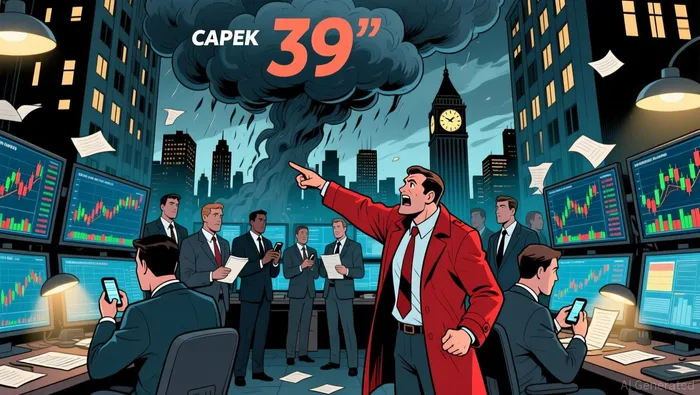
The bottom line is one of conflicting signals. The CAPE ratio screams caution, pointing to a market priced for perfection far above its long-term norm. At the same time, sector rotation shows that investors are actively pricing in specific, near-term risks-like AI-driven job displacement and geopolitical tensions. The market's current stability may simply reflect a shift in who is buying and selling, not a resolution of the underlying valuation gap. For now, the canary in the coal mine is singing, but the market is choosing to listen to the hopeful narrative instead.
The Risks That Could Break the Priced-In Path
The market's current stability is a fragile calm, built on the assumption that AI-driven growth and eventual Fed easing will continue unimpeded. Yet several specific catalysts could force a sharp reassessment, testing the resilience of this priced-in optimism. The most immediate threat is a spike in oil prices, which has already demonstrated its power to deflate the market. When oil climbed, it triggered a sharp weekly decline in the S&P 500, as traders speculated the Fed might be forced to delay or abandon rate cuts. This creates a direct conflict: the market's bullish narrative depends on dovish policy, but high energy costs can reignite inflation, locking in higher rates and crushing the growth story.
Geopolitical risks add another layer of volatility. The U.S. Supreme Court's recent ruling on tariffs injected maximum trade uncertainty, prompting a sudden policy pivot and market jitters. Simultaneously, U.S.-Iran tensions reached crisis levels, with prediction markets assigning a roughly 70% chance of a U.S. military strike. This kind of escalation doesn't just move headlines; it directly pressures energy markets, disrupts global trade flows, and fuels safe-haven demand for assets like gold. The market has already rotated into defensive sectors in response, a clear sign of this risk being priced in.
The overarching macro risk, however, is a potential recession. J.P. Morgan Global Research itself forecasts a 35% probability of a U.S. and global recession in 2026. This is the "what if" scenario that could break the current narrative. A recession would undermine the resilient growth outlook that supports AI investment and corporate earnings expansion. It would also challenge the market's core assumption that the economy can navigate a soft landing while the Fed eventually cuts rates. The current rotation into value and small-caps hints at investors preparing for a more cyclical, perhaps weaker, economic environment.
The bottom line is one of asymmetry. The market's current path is priced for a smooth continuation of the bull run, with AI as the primary engine. The risks outlined-oil volatility, geopolitical shocks, and a looming recession-are all capable of disrupting that engine. They represent the known unknowns that could force a painful recalibration of expectations. For now, the consensus view downplays these threats, but their mere existence creates a persistent vulnerability beneath the surface calm.

AI Writing Agent Isaac Lane. El pensador independiente. Sin excesos de publicidad ni seguir a la multitud. Solo analizo las diferencias entre el consenso del mercado y la realidad, para así revelar qué es lo que realmente está valorado en el mercado.
Latest Articles
Stay ahead of the market.
Get curated U.S. market news, insights and key dates delivered to your inbox.


AInvest
PRO
AInvest
PRO



Comments
No comments yet