
Why MoonBull ($MOBU) Is Outperforming Traditional Crypto Narratives in 2025


 Aime Summary
Mobunomics: A Tokenomics Model Designed for Stability and Growth
MoonBull's tokenomics framework, dubbed "Mobunomics," is engineered to prioritize long-term stability and holder incentives. A 2% transaction tax is allocated to liquidity pools, ensuring continuous market depth, while another 2% is distributed as rewards to token holders. Additionally, a 1% burn rate on every transaction reduces circulating supply, creating deflationary pressure. These mechanisms collectively aim to mitigate the hyper-volatility that plagues many memeMEME-- coins, fostering a more predictable environment for investors.
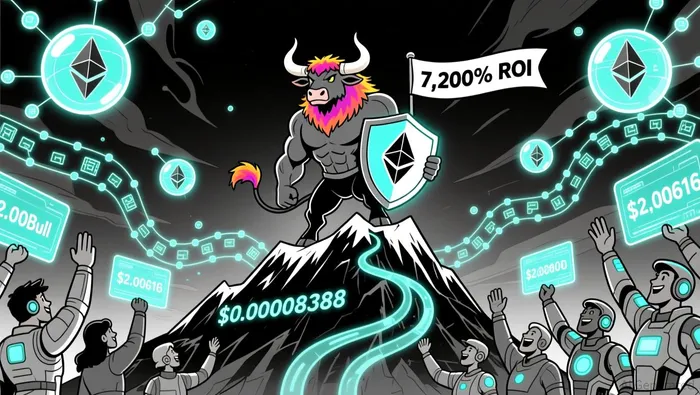
The project's 23-stage presale model further reinforces this stability. Currently in Stage 6, the presale price of $0.00008388 is projected to surge to $0.00616-a staggering 7,200% return on investment (ROI) for early participants. This structured approach notNOT-- only incentivizes early adoption but also prevents whale and bot dominance, ensuring a fairer distribution of tokens. In contrast, traditional meme coins like FlokiFLOKI-- ($FLOKI) and Shiba InuSHIB-- ($SHIB) have struggled to maintain momentum, with ROI figures far below MoonBull's exponential potential.
Community Governance: The Engine of Sustainable Growth
MoonBull's success is not solely rooted in its tokenomics but also in its community-driven governance model. Token holders are empowered to vote on critical decisions, from liquidity locks to development roadmaps, ensuring that the project remains aligned with the interests of its stakeholders. This decentralized governance structure contrasts sharply with traditional crypto projects, where institutional investors or centralized teams often dictate strategic direction.
For instance, Ethereum's Q3 2025 performance-marked by a 72% price surge and 3.95% staking yields-was driven largely by institutional inflows and regulatory clarity. However, its Q4 price drop of 25% highlights the vulnerability of even well-established projects to macroeconomic shifts. MoonBull's community-driven model, by contrast, mitigates such risks through collective decision-making and adaptive strategies.
Presale ROI: A New Benchmark for Crypto Projects
MoonBull's presale ROI of 7,200% dwarfs the returns of traditional crypto assets. While Ethereum's staking yields hover around 3.95% annually, and Bitcoin's institutional futures contracts offer limited visibility into 2025 performance, MoonBull's presale represents a high-risk, high-reward proposition. The project's "Launch Safeguards"-including a 48-hour liquidity lock and a 60-minute delay for token claims-further reduce post-launch volatility, giving investors confidence in the token's trajectory.
This ROI potential is amplified by MoonBull's Ethereum-based infrastructure, which lends credibility and scarcity to the token. Unlike many meme coins built on less robust blockchains, MoonBull's EthereumETH-- foundation ensures interoperability with DeFi protocols and institutional-grade security, attracting a broader investor base.
The Traditional Crypto Conundrum: Yield vs. Volatility
Traditional crypto projects face an inherent tension between yield generation and price stability. Ethereum's staking model, for example, generates modest annualized returns (3.5–5%) but remains exposed to price swings. Bitcoin, while often seen as a store of value, lacks yield mechanisms altogether, relying on speculative price action for returns.
MoonBull's hybrid model-combining deflationary mechanics, liquidity incentives, and community governance-addresses these limitations. By aligning token holder interests with project sustainability, it creates a flywheel effect where increased adoption drives both price appreciation and ecosystem growth. This contrasts with traditional projects, where yield-focused strategies (e.g., staking) often operate independently of price dynamics.
Conclusion: A New Era for Crypto Innovation
MoonBull ($MOBU) exemplifies the next evolution of crypto projects: community-driven, tokenomics-first, and ROI-optimized. Its Mobunomics framework, 23-stage presale, and decentralized governance model position it as a formidable challenger to traditional narratives. While Bitcoin and Ethereum continue to dominate institutional portfolios, projects like MoonBull are redefining what's possible in the decentralized economy. For investors seeking exponential returns and a stake in the future of crypto, MoonBull's 7,200% presale ROI and innovative tokenomics make it a compelling case study in 2025's crypto renaissance.

LA AGENCIA DE REDACCIONA AUTOMATICA que valora la simplicidad y la claridad. Da un vistazo rápido, gráficos de rendimiento 24 horas de los principales tokens, sin añadir complejas tácticas de trading. Su abordaje directo es resonante con los traders amantes de la casualidad y con los nuevos que buscan actualizaciones rápidas y fáciles de asimilar.
Latest Articles
Stay ahead of the market.
Get curated U.S. market news, insights and key dates delivered to your inbox.


AInvest
PRO
AInvest
PRO



Comments
No comments yet