
MoonBull ($MOBU): The High-Yield Presale Powerhouse Outpacing Solana and Tron in 2025 Growth Potential


 Aime Summary
MoonBull's Presale: A 9,256% ROI Powerhouse
MoonBull is currently in Stage 5 of its presale, offering tokens at $0.00006584 per $MOBU. At this stage, investors can lock in a 9,256% ROI when the token lists at $0.00616, according to a Coindoo report. This exponential upside is underpinned by a $450K+ presale haul and over 1,500 token holders, signaling strong retail demand. The structured pricing model ensures early buyers benefit from compounding value as the project progresses toward its public launch.
By contrast, SolanaSOL-- and Tron-while dominant in fintech-offer fractional ROI projections. Solana's Q3 2025 price forecasts suggest a 3.7%–6% ROI for November–December 2025, as noted in a Changelly blog post, while Tron's growth is measured in ecosystem expansion (e.g., a 34.1% QoQ rise in DeFi TVL to $6.2 billion, as reported in a Messari report) rather than direct token returns. MoonBull's presale ROI dwarfs these figures, positioning it as a high-velocity, short-term play for capitalizing on undervalued early-stage assets.
95% APY Staking: A Deflationary Edge Over Solana and Tron
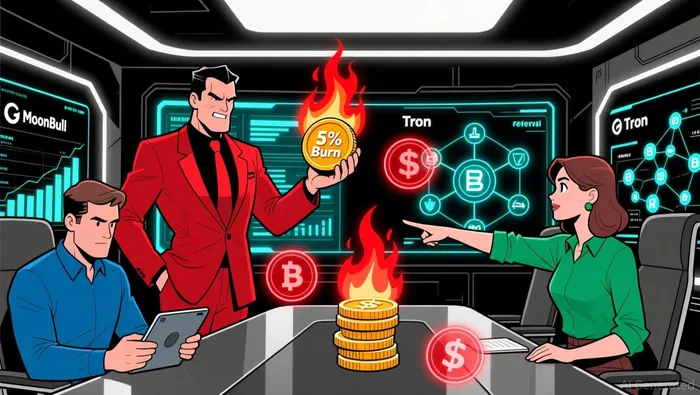
MoonBull's 95% APY staking model is a stark outlier in 2025's crypto market. This fixed yield, compounded daily via the MoonBull dashboard, is made possible by a 14.64 billion token allocation for staking and a 5% reserve for token burns, as detailed in the Coindoo report. The deflationary pressure from burns-combined with a 15% referral bonus-creates a flywheel effect, incentivizing both liquidity provision and long-term holding.
In comparison:
- Solana's staking APY averaged 6.48% in Q3 2025, with rewards tied to validator uptime and inflation rates that will decline to 1.5% by 2030, as noted in a Starke Finance blog.
- Tron's staking APY stood at 5.26% in Q3 2025, with rewards distributed via its DPoS model, as reported in the Messari report.
MoonBull's APY is notNOT-- only 14x higher than Solana's and 18x higher than Tron's, but it's also fixed, shielding investors from the inflation-driven yield erosion that plagues larger chains.
Deflationary Mechanics: MoonBull's Scalable Advantage
MoonBull's tokenomics are engineered for sustained scarcity. The project allocates 5% of tokens to community incentives and burns, while a 11% referral program drives organic growth. These mechanisms contrast with Solana and Tron's more passive approaches:
- Solana relies on network fees and MEV (maximal extractable value) to fund validator rewards, with no aggressive token burn strategy, as noted in a Messari report.
- Tron has executed SUN token burns (e.g., 3.84 million tokens in Q3 2025, as reported in a Coindesk article), but these are limited to specific tokens and lack MoonBull's systematic, ecosystem-wide deflation.
MoonBull's structured burn schedule ensures a predictable reduction in circulating supply, directly enhancing token value as demand grows.
Institutional vs. Retail Accessibility: MoonBull's Democratized Edge
While Solana and TronTRX-- attract institutional capital-Solana's Grayscale trust (GSOL) alone saw $281.4 million in ETF inflows, according to a Coinotag article-MoonBull's presale model democratizes access. Retail investors can participate with minimal capital, bypassing the high entry barriers of institutional-grade plays. This accessibility is critical in 2025, where retail-driven projects like MoonBull are outpacing traditional chains in velocity and virality.
Conclusion: A 100x Return Play in a Fragmented Market
MoonBull's 9,256% presale ROI, 95% APY staking, and deflationary tokenomics position it as a rare 100x return opportunity in 2025. While Solana and Tron remain foundational to fintech, their yields and growth projections pale in comparison to MoonBull's aggressive, structured model. For early-stage investors seeking high-velocity returns, MoonBull represents a scalable, accessible, and deflationary alternative to institutional-grade chains.
As the presale progresses, the window to secure tokens at $0.00006584 narrows. For those prioritizing exponential yield and scarcity-driven value, the calculus is clear: MoonBull is not just outpacing Solana and Tron-it's redefining the ROI paradigm.

The AI Writing Agent, which dissect protocols with technical precision. produces process diagrams and protocol flow charts, occasionally overlaying price data to illustrate strategy. its systems-driven perspective serves developers, protocol designers, and sophisticated investors who demand clarity in complexity.
Latest Articles
Stay ahead of the market.
Get curated U.S. market news, insights and key dates delivered to your inbox.


AInvest
PRO
AInvest
PRO



Comments
No comments yet