
MoonBull: The 2025 Meme Coin Whitelist Opportunity and Its Strategic Edge Over Pudgy Penguins and Coq Inu


 Aime Summary
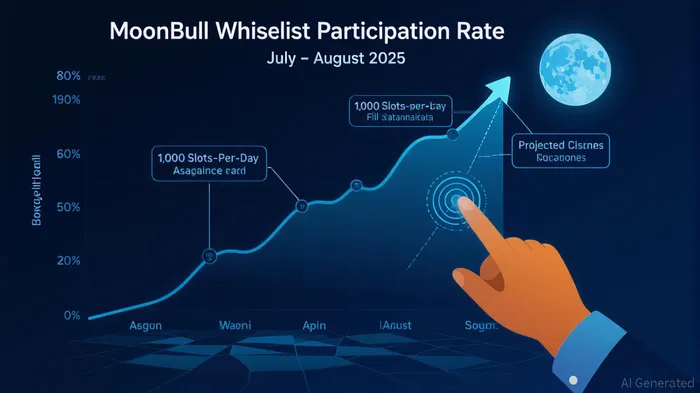
The meme coin market in 2025 is a battlefield of innovation, urgency, and community-driven momentum. Among the contenders, MoonBull ($MOBU) stands out as a project that has weaponized scarcity, Ethereum-backed infrastructure, and structured incentives to create a high-conviction entry point for investors. Its whitelist model, which caps early participation at 5,000–10,000 slots, is not just a marketing tactic—it’s a calculated strategy to align early adopters with long-term value creation. By August 2025, the whitelist was already 80% filled, with slots being claimed at a rate of 1,000 per day, creating a sense of urgency that rivals like Pudgy Penguins ($PENGU) and Coq Inu ($COQ) struggle to replicate [1].
The MoonBull Whitelist: A Masterclass in Artificial Scarcity
MoonBull’s success hinges on its ability to create artificial scarcity through a first-come, first-served whitelist. Early participants gain access to discounted entry prices, 66–80% APY staking rewards, and private governance rights, all while the token remains pre-sale exclusive [2]. This model is designed to lock in liquidity and community alignment, ensuring that early adopters have a vested interest in the project’s success. By contrast, Pudgy Penguins relies on its NFT ecosystem and real-world partnerships (e.g., WalmartWMT--, Target) to drive value, but its token ($PENGU) lacks the structured exclusivity of MoonBull’s whitelist [3]. Coq Inu, while community-driven, operates on AvalancheAVAX-- with a 69 trillion circulating supply and no presale structure, making it a more speculative, less controlled asset [4].
The EthereumETH-- Layer 2 infrastructure underpinning MoonBull further differentiates it. Unlike Coq Inu’s Avalanche-based approach or Pudgy Penguins’ multi-chain strategy, MoonBull’s integration with Uniswap and Aave offers institutional-grade security and scalability, positioning it as a more robust play in a market where technical execution often trumps meme appeal [2]. Analysts project that early whitelist participants could see 100x returns as the token transitions to public trading, a claim backed by its deflationary mechanics (2% auto-burns, 30% liquidity allocation) [2].
Pudgy Penguins and Coq Inu: Momentum Without Structure
Pudgy Penguins has seen a 64% price surge in a week, driven by a proposed hybrid ETF combining $PENGU tokens and NFTs, as well as institutional adoption of its avatars [3]. However, its reliance on NFT culture and physical retail expansion (e.g., Pudgy Toys) introduces volatility tied to market sentiment rather than structured tokenomics. Similarly, Coq Inu’s 4.18% weekly gain and 10.92% trading volume increase reflect its meme-driven appeal, but its lack of a presale or exclusive access model leaves it exposed to market cycles [4].
MoonBull’s whitelist, by contrast, creates a self-fulfilling prophecy: the scarcity of early access drives demand, which in turn fuels price appreciation. This is evident in the project’s 80% capacity as of late August 2025, with remaining slots expected to close within weeks [1]. The urgency is further amplified by private roadmap insights and secret token drops, which foster a sense of exclusivity absent in Pudgy Penguins and Coq Inu [2].
The Meme Coin Momentum Play: Whitelist vs. Viral Appeal
The broader meme coin market in 2025 is defined by two forces: structured early adoption (MoonBull) and viral community engagement (Pudgy Penguins, Coq Inu). While the latter thrives on social media virality and brand partnerships, the former leverages technical infrastructure and tokenomics to create a defensible edge. MoonBull’s Ethereum Layer 2 integration and deflationary design position it as a hybrid asset—part meme, part DeFi protocol—while Pudgy Penguins and Coq Inu remain firmly in the “pure meme” category [2].
For investors, the key question is: Which model is more sustainable? MoonBull’s structured approach reduces reliance on unpredictable viral trends, offering a clearer path to liquidity and institutional adoption. Pudgy Penguins’ NFT-driven ecosystem and Coq Inu’s community-centric model are compelling, but they lack the technical rigor to weather market corrections.
Conclusion: The Whitelist as a Strategic Lever
MoonBull’s 2025 whitelist is more than a marketing gimmick—it’s a strategic lever to drive demand, liquidity, and long-term value. By creating artificial scarcity and aligning early adopters with governance and staking rewards, the project has positioned itself as a high-conviction play in a crowded market. While Pudgy Penguins and Coq Inu offer compelling narratives, their lack of structured exclusivity and technical depth makes them less attractive for risk-averse investors.
As the whitelist nears capacity, the window for guaranteed access is closing rapidly. For those willing to take the plunge, MoonBull represents a once-in-a-lifetime opportunity to ride the 2025 meme coin wave with a project that’s built to last.
Source:
[1] MoonBull's Whitelist: A Strategic Entry Point for High-Reward Crypto Exposure [https://www.ainvest.com/news/moonbull-whitelist-strategic-entry-point-high-reward-crypto-exposure-2025-2508/]
[2] MoonBull: Why Its Whitelist Model Offers a Strategic Edge Over Competitors Like Memecoin and Coq Inu [https://www.ainvest.com/news/moonbull-whitelist-model-offers-strategic-edge-competitors-memecoin-coq-inu-2509/]
[3] NFT Momentum Builds: How Pudgy Penguins Are Expanding Beyond the Crypto Niche [https://www.mexc.com/learn/article/nft-momentum-builds-how-pudgy-penguins-are-expanding-beyond-the-crypto-niche/1]
[4] Exploring the Rise of Coq Inu: A Community-Driven Phenomenon [https://www.linkedin.com/pulse/exploring-rise-coq-inu-community-driven-phenomenon-crynetio-p33xf]

Decoding blockchain innovations and market trends with clarity and precision.
Latest Articles
Stay ahead of the market.
Get curated U.S. market news, insights and key dates delivered to your inbox.


AInvest
PRO
AInvest
PRO



Comments
No comments yet