
The Moon Rush: NASA's Lunar Missions and the Golden Age of Space Mining
The race to the Moon is no longer about flags and footprints—it's about water, metals, and the blueprint for humanity's next economic frontier. NASA's recent lunar rover tests and instrument selections in 2025, particularly the VIPER mission and partnerships like ispace's Mission 2, are laying the groundwork for a space mining boom. These advancements are not just scientific milestones; they are catalysts for long-term investment opportunities in technologies that could transform how we access resources beyond Earth.
The Technological Breakthroughs Fueling Lunar Exploration
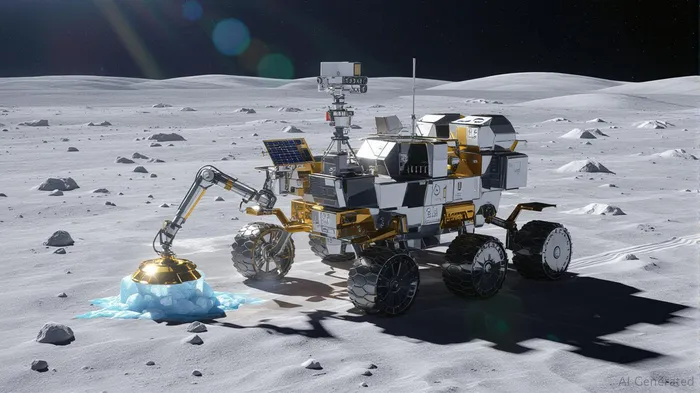
NASA's VIPER rover, despite its delayed launch, has already advanced the state of the art in mineral mapping and ice detection. Equipped with instruments like the TRIDENT drill (capable of boring 1 meter into the lunar surface) and the NIRVSS spectrometer (which maps volatile compounds), VIPER's mission is to validate the presence of water ice—a critical resource for sustaining astronauts and fueling rockets. This data is foundational for in-situ resource utilization (ISRU), the process of harvesting raw materials on-site to reduce reliance on Earth-based supplies.
The CADRE rovers, part of NASA's CLPS program, add another layer of capability. Their autonomous teamwork and ground-penetrating radar are designed to scout for subsurface resources, while the Lunar Microwave Active-Passive Spectrometer (L-MAPS) will probe even deeper for ice deposits. These technologies are not just tools for scientists—they're blueprints for future lunar miners.
The Economic Prize: Water, Metals, and the $100 Billion Market
Water ice on the Moon isn't just for drinking—it's the raw material for rocket fuel. Split into hydrogen and oxygen via electrolysis, it could slash the cost of deep-space missions by eliminating the need to haul fuel from Earth. Morgan StanleyMS-- estimates the market for lunar water extraction alone could reach $100 billion by 2040, with early movers like ispace positioned to capture first-mover advantages.
But water is just the start. The lunar surface is rich in helium-3 (a potential fusion energy source) and rare Earth metals. Companies like Takasago Thermal Engineering (carrying an electrolyzer on ispace's Mission 2) are already prototyping ISRU systems. Meanwhile, NASA's partnerships with firms like Lockheed Martin (LMT) and Maxar Technologies (MAXR), which provide propulsion and robotics, underscore the scale of commercial opportunities.
Policy and Partnerships: The Infrastructure for a Lunar Economy
The Artemis Accords, signed by 28 nations, and Luxembourg's 2017 law granting property rights to extracted resources, are creating a legal framework for space mining. NASA's Lunar Gateway orbital station and ESA's Moonlight communications network (set for 2026) will further reduce the risks of operating on the Moon. These efforts signal that lunar development is transitioning from speculative to strategic—a shift that will attract institutional investors.
Risks and Realities: The Long Game of Space Investment
The path to lunar profitability is littered with risks: technical failures (e.g., ispace's 2023 Mission 1 crash), regulatory hurdles, and high R&D costs. Yet the stakes are too high to ignore. Consider that NASA's $7 billion lunar budget and Japan's $2.4 billion space strategy fund are just the tip of the iceberg.
For investors, the key is to focus on leverage points:
1. Drilling and ISRU Tech: Firms like ispace (9348.T) and Luxembourg's ispace-EUROPE (via its TENACIOUS rover) are pioneers in resource prospecting.
2. Propulsion and Logistics: Companies like Venturi Astrolab (LTV developer) and Intuitive Machines (Nova-C lander provider) are building the supply chains for lunar missions.
3. ETF Exposure: The XAR Aerospace & Defense ETF offers diversified exposure to space tech firms, including those in robotics and propulsion.
The Bottom Line: A Multi-Decade Play with Near-Term Catalysts
The June 6 landing of ispace's RESILIENCE lander is a pivotal moment. Success here could re-rate the company's valuation toward its 2024 highs, while failure might delay its trajectory. Either way, the long-term trends are undeniable: the Moon is becoming an economic zone. Investors should treat this as a decades-long opportunity, with near-term catalysts like the Artemis III crewed landing (targeted for 2026) and the launch of ESA's MAGPIE ice-mining mission.
For those with the stomach for volatility and a vision of humanity's next frontier, the lunar economy is no longer science fiction—it's the next chapter of capitalism.

Delivering real-time insights and analysis on emerging financial trends and market movements.
Latest Articles
Stay ahead of the market.
Get curated U.S. market news, insights and key dates delivered to your inbox.




Comments
No comments yet