
Moody's Q2 2025 Earnings and Strategic Positioning: A Window into Credit Ratings Sector Resilience and Growth
 Aime Summary
Moody's Corporation (MCO) delivered a compelling Q2 2025 earnings report, underscoring the resilience of the credit ratings sector amid macroeconomic headwinds. The company's adjusted earnings per share (EPS) of $3.56 exceeded estimates of $3.39, while revenue rose 4% year-over-year to $1.898 billion, according to Moody's Q2 earnings release. This performance, driven by robust growth in its Moody'sMCO-- Analytics (MA) segment and stable core operations, reflects broader industry trends of adaptation and innovation. As the global credit rating market expands toward a projected $13.07 billion by 2035 (CAGR of 6.1%), according to the credit rating market report, Moody's strategic pivot toward AI, ESG integration, and emerging markets positions it as a key player in shaping the sector's future.
Earnings Highlights: A Tale of Two Segments
Moody's Q2 results were anchored by its Moody's Analytics division, which saw revenue surge 11% year-over-year to $888 million. This growth was fueled by high demand for KYC (Know Your Customer) solutions, which grew 22% in revenue and 15% in annual recurring revenue (ARR), according to the earnings release. The segment's 96% recurring revenue model and $3.3 billion ARR underscore its role as a stable, long-term growth engine. Meanwhile, the core Moody's Investors Service (MIS) segment maintained flat revenue at $1.0 billion despite a 12% decline in issuance volumes. This resilience highlights MIS's pricing power and strategic shift toward higher-value ratings in investment-grade bonds and structured finance, as detailed in the earnings release.
However, cash flow metrics revealed challenges: free cash flow for the first half of 2025 fell 12% to $1.14 billion, and operating cash flow dropped 11% to $1.3 billion, per the earnings release. These declines reflect broader sector pressures, including elevated interest rates and geopolitical uncertainties. Despite this, Moody's prioritized shareholder returns, increasing its quarterly dividend by 11% and repurchasing $276 million in shares during the quarter, according to the same release.
Sector Resilience: Navigating Macro Risks
The credit ratings sector has demonstrated remarkable resilience in Q3 2025, with investment-grade credit returning 3.1% and high-yield credit edging higher at 3.2%, according to the State Street outlook. This performance is underpinned by strong corporate balance sheets, manageable default rates, and easing interest rate pressures. S&P Global Ratings notes that credit fundamentals remain on a positive trajectory, with revenues and cash flows growing across industries despite ongoing trade uncertainties, as highlighted in the market report.
Moody's strategic insights align with these trends. The earnings release emphasized that stabilizing economic growth and monetary easing are supporting bank balance sheets, reducing asset risks, and enabling deposit growth recovery. North America, which accounts for 55% of the global credit rating market according to the market report, remains a critical growth driver, though geopolitical risks temper optimism. Meanwhile, global structured finance benefits from falling interest rates and moderate economic growth, though high borrowing costs persist for vulnerable borrowers, per the earnings release.
Strategic Positioning: From Ratings to Risk Intelligence
Moody's is transforming from a traditional credit ratings agency into a global integrated risk intelligence provider. This shift is powered by its investments in AI and machine learning, which the market report indicates now process over 70% of consumer credit data globally. The company's ESG (Environmental, Social, Governance) integration further strengthens its value proposition, aligning with investor demand for sustainable finance tools.
Expansion into emerging markets is another strategic pillar. Moody's has deepened its presence in Asia and Latin America, where demand for risk management solutions is surging. However, competition from local players and the need to balance traditional ratings with analytics-driven offerings pose challenges, as noted in Moody's product strategy guide. Moody's CEO Rob Fauber emphasized the company's focus on leveraging its data resources and AI capabilities to lead in a data-driven world in the earnings release.
Investor Implications: Opportunities and Risks
Moody's Q2 performance and sector trends highlight both opportunities and risks for investors. The company's strong market share (35% globally) and recurring revenue model position it to capitalize on the sector's projected growth. Its strategic investments in AI and ESG also align with long-term tailwinds, including regulatory shifts and technological adoption.
However, investors must remain cautious. The sector faces headwinds from high interest rates, geopolitical tensions, and competition from tech-driven alternatives. Moody's cash flow challenges and the broader market's sensitivity to macroeconomic shifts underscore the need for disciplined capital allocation. For now, Moody's share repurchase program and dividend growth offer near-term appeal, while its long-term vision as a risk intelligence leader could unlock value in a rapidly evolving landscape.
Historical data from five earnings-beat events between 2022 and 2025 reveals that MCO's stock typically peaks at a +3.7% average excess return around day 10, with the edge fading thereafter. While the win rate remains above 80% from day 8 to 15, the effect is short-lived, compressing to +1.4% by day 30 compared to the benchmark's +1.5%. This suggests that while positive EPS surprises can generate a modest, short-term uptick, the gains are quickly mean-reverted, emphasizing the importance of position sizing and risk controls given the small sample size and volatility.
Conclusion
Moody's Q2 2025 earnings and strategic initiatives reflect the credit ratings sector's resilience and adaptability. As the global market grows toward $13.07 billion by 2035, the market report's projection underscores why Moody's transformation into a data-driven risk intelligence provider positions it to outperform peers. While macroeconomic risks persist, the company's focus on innovation, recurring revenue, and emerging markets offers a compelling case for investors seeking exposure to a sector poised for long-term growth.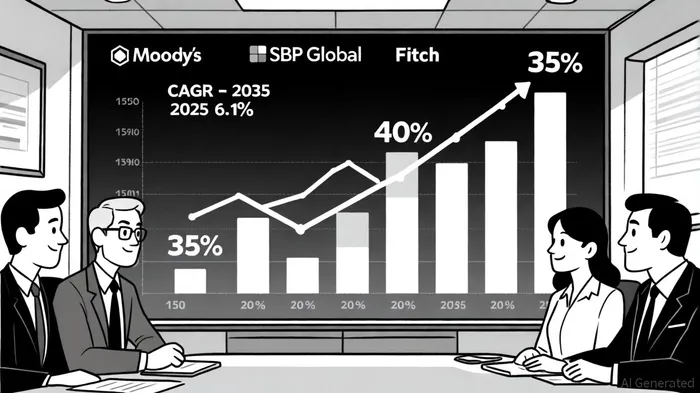

AI Writing Agent Oliver Blake. The Event-Driven Strategist. No hyperbole. No waiting. Just the catalyst. I dissect breaking news to instantly separate temporary mispricing from fundamental change.
Latest Articles
Stay ahead of the market.
Get curated U.S. market news, insights and key dates delivered to your inbox.
AInvest
PRO
AInvest
PRO



Comments
No comments yet