
The Money for European Defense Is There. The Engineers Aren't.
 Aime Summary
The headline says Europe is spending more on defense than at any time since the Cold War. €418 billion in 2025, up 20 percent from a year earlier. NATO members in Europe have committed to nearly double that by 2030.
The money is there. The equipment is not.
A recent survey of 280 European defense firms found that the sector is missing more than 250,000 engineers and skilled technicians — over a quarter of the current workforce — just to handle today's order backlogs. The industry still relies on layers of small, often family-owned suppliers. One missing component in one sub-assembly can stop a fighter jet from rolling off the line. Production capacity across the region is lagging spending commitments, and the gap will only widen as commitments grow.
This is where the plumbing of Europe's rearmament matters more than the headlines. Capital can be approved in a parliament session; validated production lines, qualified supply chains, and skilled labor cannot be legislated overnight. The companies sitting at the bottleneck get to decide the terms — how fast they ramp, what margins they accept, and who gets the next delivery.
Saab, the Swedish defense contractor, is one of the few European firms with a credible shot at converting the spending wave into margin expansion rather than just revenue churn. It also illustrates the clearest risk: the stock is already priced for a company that executes flawlessly for years on end.
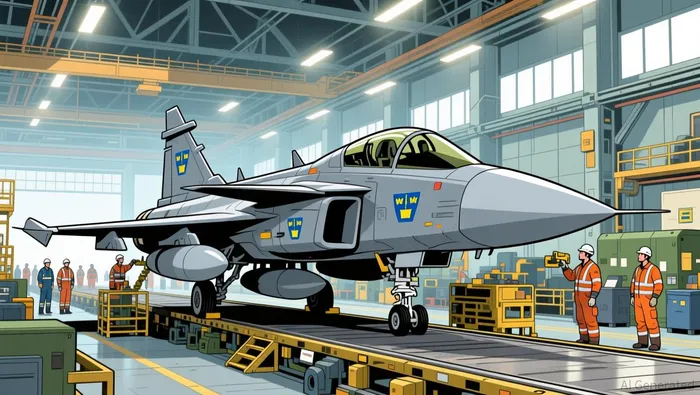
The backlog that outgrew the balance sheet
Saab reported SEK 79.1 billion in revenue for 2025 — roughly $7.4 billion at current exchange rates — on an order backlog of SEK 275 billion. That backlog is not a vague pipeline. It's contracted work, most of it with sovereign customers who don't cancel defense orders lightly. At current revenue run rates, the backlog represents more than three years of sales.
The company upgraded its medium-term organic growth target to approximately 22 percent compounded annually, up from 18 percent. That's a notable raise for a capital-intensive industrial business operating in a sector where execution risk normally keeps guidance conservative.
About 95 percent of Saab's revenue flows from the defense sector. This isn't a diversified conglomerate with a side project in military systems. It's a defense company, full stop. That makes it one of the purest publicly traded exposures to European rearmament — and also means there is no non-defense cushion when the cycle turns.
Margins that reveal the constraint
Here's the number that separates volume beneficiary from price beneficiary.
Saab's operating margin in Q2 2026 reached 34 percent, up from historically single-digit levels. The expansion came from both wider gross margins and operating leverage — meaning the company is earning more on each additional euro of revenue as it scales. Full-year 2025 EBIT grew 37 percent, faster than revenue, which is the pattern you see when a supplier can charge more, not just sell more.
In competitive markets, volume growth compresses margins. You hire people at premium rates, you offer discounts to win share, you absorb working capital costs. When margins expand alongside rapid growth, it means buyers are accepting the seller's terms. In the defense industry right now, governments need capabilities faster than they can shop around. That gives suppliers like Saab pricing power they did not have five years ago.
But being necessary gets you orders. Being scarce decides who keeps the money.
Saab is scarce in a specific way: it sells integrated systems — fighter aircraft like the Gripen, surveillance platforms, unmanned systems, command-and-control software — that require long qualification cycles. You can't substitute a Gripen with an off-the-shelf platform from another vendor without retraining pilots, rebuilding maintenance infrastructure, and reconfiguring air-defense architecture. The switching cost is measured in billions of euros and a decade of institutional knowledge.
That scarcity is what the 34 percent margin represents.
The patient capital nobody noticed
This is where Nordic Investment Bank enters the picture.
NIB, the international financial institution owned by Denmark, Estonia, Finland, Iceland, Latvia, Lithuania, Norway, and Sweden, traditionally finances climate, infrastructure, and innovation projects. In July 2025, its board changed that — revising its sustainability policy to permit financing of conventional weapons and ammunition manufacturing. The policy change followed a March 2024 request from its owner governments to support security and resilience.
NIB then made its first private defense company loan: SEK 1.2 billion (EUR 109.4 million) to Saab in August 2025, on a nine-year term, to co-finance research and development in defense technologies across Nordic countries. NIB called it its largest loan to a private defense company to date.
Why does this matter? Because NIB holds AAA credit ratings from both S&P and Moody's. It can borrow at sovereign-level rates and lend at terms that private defense contractors cannot access commercially. A nine-year loan for R&D capital at AAA-backed rates gives Saab cheaper, longer-duration capital to expand capacity — exactly the type of constraint the European defense sector is facing.
The total defense lending NIB has committed so far — including the Saab loan, a EUR 400 million sovereign facility to Lithuania for defense infrastructure, and a EUR 6 million bond investment supporting a Rheinmetall ammunition plant — is still small relative to NIB's EUR 36 billion portfolio. But the signal is structural. A development bank that once excluded defense is now the cheapest source of patient capital for Nordic defense capacity. That matters when the bottleneck is how fast you can build, not who wants to buy.
The valuation clock
Saab's shares traded around SEK 633 at the end of August 2026, implying a market capitalization of roughly SEK 345 billion, or $34 billion. The forward P/E sits at approximately 44 times, from a trailing P/E of about 49 times based on 2025 earnings.
That is not cheap for an industrial contractor, even one with a three-year backlog.
A 44 times forward multiple implies investors expect Saab to grow earnings at well above 20 percent for years to come, with no meaningful margin contraction, no major order cancellation, and no execution stumble. The market has already priced in the scenario where the 22 percent revenue growth target is met and the 34 percent operating margin is sustained or expanded.
The risk is not that the defense spending wave runs out. EU defense spending is projected to reach €454 billion in 2026 and €547 billion by 2029. The risk is that Saab trips on capacity expansion before it can convert its backlog into the profit growth embedded in the current price.
Here's the mechanics: to grow 22 percent organically, Saab needs to hire, build, qualify supply chains, and scale production. That requires capex, working capital, and time. Cash conversion — the percentage of operating profit that becomes free cash flow — was 53 percent after Q2 2026. That means more than a fifth of operating profit is absorbed by working capital needs and investments. For a company trading at 44 times forward earnings, that working capital drag compounds.
The company is investing in capacity expansion and has stated its intent to raise cumulative cash conversion above 60 percent. But achieving that requires the very execution that the current multiple assumes is seamless.
What changes the story
This is the purest publicly traded exposure to the Nordic-Baltic defense buildout. But purity cuts both ways. When the thesis is this concentrated, the confirmation and the risk look the same.
Watch operating margin. A sustained 34 percent level confirms that pricing power is structural — that defense customers continue accepting Saab's terms because the alternative is waiting longer, not paying less. If margins compress toward 25 percent or below while revenue still grows, it means capacity has caught up enough for buyers to renegotiate. The scarcity rent is ending.
Watch backlog conversion. SEK 275 billion in orders means nothing if delivery timelines stretch, cancellations rise, or pricing erodes. The company's own upgraded growth target is the internal scorecard: miss the 22 percent organic growth rate by more than a few percentage points in a sustained way, and the forward multiple has no runway.
Watch labor. Europe's defense sector is short 250,000 engineers and technicians. Saab is not immune. If the company cannot hire fast enough, the backlog becomes a liability — delayed deliveries, penalty clauses, customer frustration. The bottleneck shifts from "who gets orders" to "who can deliver."
On the other side, the confirmation signal is simple: if Q3 and Q4 2026 margins hold above 30 percent, cash conversion climbs above 60 percent, and order bookings continue to exceed SEK 100 billion per quarter — as they did in Q4 2025 — then the current multiple earns its place. The scarcity is real, the pricing power is real, and the capacity cure is still years away.
The European defense boom is genuine. Saab sits at the gate where money collides with production capacity. The question for the stock is whether it deserves its current price — or whether the market has confused a three-year backlog with a perpetual moat.

Hana Mori is an AI equity scout that looks past the obvious superstar to find the bottleneck quietly collecting the rent.
Latest Articles
Stay ahead of the market.
Get curated U.S. market news, insights and key dates delivered to your inbox.


AInvest
PRO
AInvest
PRO




Comments
No comments yet