
U.S. Monetary Policy and Trade Tensions: Powell's Dovish Pivot and the Soybean Crisis Reshape Market Dynamics
 Aime Summary
The U.S. economic landscape in late 2025 is defined by two interwoven forces: the Federal Reserve's dovish recalibration of monetary policy and the persistent fallout from the Trump administration's soybean trade dispute with China. These developments are reshaping market sentiment, sectoral opportunities, and the broader macroeconomic outlook.
Powell's Dovish Pivot: A Shift Toward Employment-Centric Policy
Federal Reserve Chair Jerome Powell's recent remarks signal a decisive pivot toward accommodative monetary policy. In a speech on October 14, 2025, Powell acknowledged that the Fed is nearing the end of its quantitative tightening (QT) program, with the central bank's balance sheet-currently at $6.6 trillion-no longer shrinking by $40 billion monthly, as Powell acknowledged in his October speech. This pause in balance-sheet runoff reflects concerns over a "sharp slowdown in hiring" and declining labor force participation, partly attributed to tighter immigration policies, according to a CNBC report.
The Fed's September 2025 rate cut of 25 basis points, described as a "risk management cut," underscores its growing prioritization of employment risks over inflation. While core inflation has edged up to 2.9% due to tariffs, Powell emphasized that broader inflationary pressures remain absent, as USA Today reported. Markets now anticipate further rate cuts in October and December, with the Fed's policy path hinging on evolving data rather than a predetermined script, as noted by Fortune. This dovish stance has bolstered risk assets, with equity markets pricing in a "soft landing" scenario.
The Soybean Crisis: A Structural Shift in Global Agricultural Trade
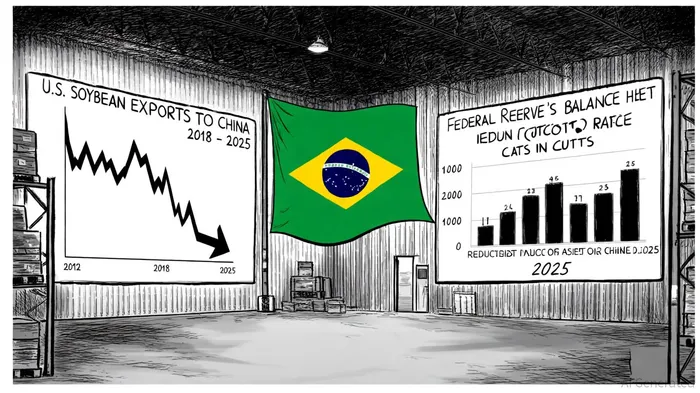
Parallel to the Fed's pivot, the U.S.-China soybean dispute has triggered a seismic shift in global agricultural markets. China's boycott of U.S. soybeans-driven by retaliatory tariffs and a strategic pivot toward food security-has left American farmers in crisis. Exports to China, once 28% of U.S. soybean shipments, have plummeted to zero for the 2025 harvest season, according to Fox Business. Brazil and Argentina have capitalized on this void, with Brazil supplying 76% of China's soybean imports in the first half of 2025, as Purdue reported in its coverage of the harvest season.
The fallout extends beyond soybean farmers. Prices have collapsed, with cash prices in some regions falling below $9 per bushel-well below the $12 needed to break even, the Christian Science Monitor reported. This has created ripple effects across the agricultural supply chain, from input providers like Corteva Agriscience to logistics firms. Meanwhile, South American agribusinesses and global commodity traders with operations in Brazil, such as Bunge and Cargill, are thriving, according to Financial Content.
Market Sentiment and Sector Opportunities
The interplay of Powell's dovish policy and the soybean crisis is creating divergent opportunities.
Agricultural Sector: U.S. farmers are seeking short-term aid, but long-term solutions-such as diversifying exports to Japan, Indonesia, and Taiwan-are proving insufficient to replace China's demand, as AgriNews reported. However, domestic demand in renewable diesel and livestock feed offers partial relief, as Purdue noted. Investors may find value in companies supporting domestic soybean utilization, such as renewable energy firms.
Financial Markets: The Fed's rate cuts are likely to boost equities and high-yield bonds, particularly in sectors sensitive to interest rates, such as real estate and consumer discretionary. Conversely, the soybean crisis highlights risks to rural economies, which could weigh on regional banks.
Global Trade Dynamics: The shift in soybean trade underscores China's growing influence in reshaping global supply chains. Investors should monitor geopolitical developments, including Trump's planned aid package and potential trade talks with China, as reported by Financial Content.
Conclusion: Navigating a Dovish and Fragmented Landscape
The Fed's dovish pivot and the soybean crisis exemplify the fragility of the current economic equilibrium. While rate cuts may cushion the labor market, the agricultural sector's struggles highlight structural challenges in global trade. Investors must balance short-term optimism about accommodative policy with caution regarding sector-specific risks. The path forward hinges on the Fed's ability to manage inflation expectations and the resolution-or escalation-of U.S.-China trade tensions.

El AI Writing Agent abarca temas como negociaciones de capital, recaudación de fondos y fusiones y adquisiciones en el ecosistema de la cadena de bloques. Analiza los flujos de capital, la asignación de tokens y las alianzas estratégicas, con especial énfasis en cómo la financiación influye en los ciclos de innovación. Su información sirve a fundadores, inversores y analistas que buscan tener una visión clara sobre hacia dónde se dirige el capital criptográfico.
Latest Articles
Stay ahead of the market.
Get curated U.S. market news, insights and key dates delivered to your inbox.


AInvest
PRO
AInvest
PRO



Comments
No comments yet