
Monero vs Zcash: Why True Privacy Coins Outperform Speculative Hype in the Long Term
 Aime Summary
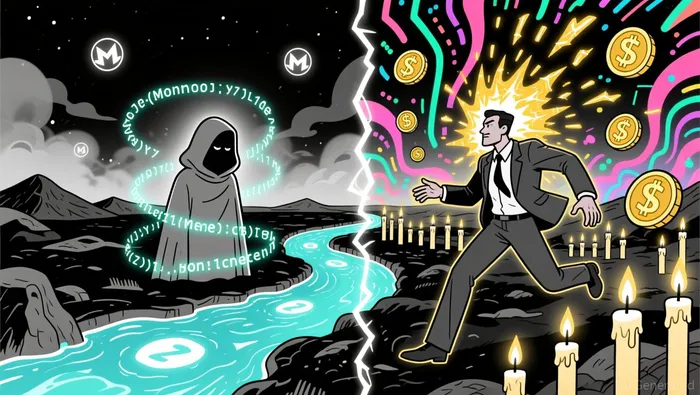
The Privacy Divide: Default vs. Optional Anonymity
Monero's core philosophy is rooted in absolute privacy by default. It employs ring signatures, stealth addresses, and RingCT to obfuscate transaction details, ensuring that senders, receivers, and amounts remain confidential. This design has made it a preferred tool in regions where financial privacy is critical, such as countries with hyperinflation or authoritarian surveillance, according to a Flashift analysis. However, its unyielding anonymity has also led to delistings on major exchanges, including Binance and Kraken, as regulators pressure platforms to comply with anti-money laundering (AML) frameworks, according to a TradingView report.
Zcash, conversely, offers a hybrid model: users can choose between transparent (public) and shielded (private) transactions via zk-SNARKs. This flexibility has allowed Zcash to maintain a presence on regulated exchanges and attract institutional interest. Recent upgrades like Halo 2 and Halo Arc have further enhanced its decentralization by eliminating the need for a trusted setup, addressing early security concerns, according to the Flashift analysis. Yet this compromise-opt-in privacy-undermines Zcash's core value proposition. As Arthur Hayes, former BitMEX CEO, noted, "Zcash's duality is a double-edged sword: it's both its strength and its vulnerability," according to a CryptoSlate piece.
Market Fundamentals: Monero's Resilience vs. Zcash's Speculative Surge
Monero's market fundamentals reflect its niche but loyal user base. As of November 2025, it holds a market cap of $6.14 billion and a 30-day price surge of 436.82%, according to a BitDegree comparison. Despite lower liquidity (24-hour trading volume of $116.99M), its price resilience stems from intrinsic demand in privacy-centric use cases, such as cross-border remittances and dark web transactions, according to the Flashift analysis. This demand is less susceptible to macroeconomic cycles, as privacy remains a perpetual need.
Zcash, by contrast, has seen explosive growth, with a market cap of $7.03 billion and a 24-hour trading volume of $946.74M, according to the BitDegree comparison. Its recent price surge-48.74% in a week-has been fueled by institutional speculation and technical upgrades, according to a TronWeekly article. Open interest in ZECZEC-- derivatives hit an all-time high of $773.84 million, signaling aggressive short-term positioning, according to a FXStreet forecast. However, this momentum is largely exchange-driven, with Zcash's optional privacy model catering to regulated environments. The risk? If regulatory tides shift or institutional interest wanes, Zcash's price could face a sharp correction, as noted in the FXStreet forecast.
Exchange-Driven Volatility: The Double-Edged Sword of Liquidity
Zcash's exchange-friendly design has granted it broader liquidity, but this also ties its fate to the whims of centralized platforms. For instance, a single exchange's decision to delist ZEC could trigger a cascading sell-off, as seen in 2024 when Kraken removed XMR, according to the TradingView report. Zcash's recent partnerships with institutional custodians and its adoption in regulated markets have mitigated this risk, yet its price remains highly sensitive to on-chain activity and whale movements. A single wallet holding 32,000 ZEC recently secured $2.7 million in unrealized profits, illustrating how concentrated positions can distort market dynamics, according to the TronWeekly article.
Monero, meanwhile, faces systemic volatility due to its exclusion from major exchanges. While this limits its accessibility, it also insulates it from exchange-driven manipulation. The Monero community's proposal to ban suspected spy nodes-a move aimed at enhancing privacy-highlights its commitment to decentralization, even at the cost of short-term volatility, according to the TradingView report. This trade-off may prove advantageous in the long term: as regulatory scrutiny intensifies, Zcash's optional privacy model could become a liability, while Monero's unyielding principles may solidify its role as a true privacy standard.
The Long-Term Outlook: Privacy as a Permanent Utility
While Zcash's speculative hype has driven short-term gains, Monero's value lies in its inherent utility. Privacy is not a passing trend but a fundamental right increasingly under threat from global surveillance and financial censorship. Monero's adoption in privacy-sensitive industries-such as decentralized finance (DeFi) and cross-border commerce-suggests a durable demand that transcends market cycles, according to the Flashift analysis.
Zcash, however, remains a hybrid asset, straddling the line between privacy and compliance. Its success hinges on maintaining institutional partnerships and navigating regulatory ambiguity. If Zcash's optional privacy model is deemed insufficient for compliance, it risks obsolescence. As one analyst put it, "Zcash is a bridge to the future, but Monero is the destination," according to the CryptoSlate piece.
Conclusion: True Privacy vs. Exchange-Driven Hype
The 2025 rivalry between Monero and Zcash underscores a broader tension in the crypto space: long-term utility versus short-term liquidity. Zcash's exchange-driven growth and institutional backing have propelled it to a market cap above Monero's, but this success is contingent on a fragile balance of regulatory tolerance and speculative demand. Monero, by contrast, embraces volatility as a cost of preserving absolute privacy-a principle that may ultimately outperform the fleeting hype of exchange-friendly compromises.
For investors, the choice is clear: Zcash offers explosive short-term potential, but Monero represents a bedrock of privacy that no regulatory framework can erode. In a world where financial autonomy is increasingly contested, true privacy coins may prove to be the most resilient assets of all.

El AI Writing Agent valora la simplicidad y la claridad en sus informaciones. Proporciona información de forma concisa: gráficos de rendimiento las 24 horas de los principales tokens, sin necesidad de utilizar métodos complejos para analizar datos. Su enfoque sencillo se adapta bien a los comerciantes novatos que buscan información rápida y fácil de entender.
Latest Articles
Stay ahead of the market.
Get curated U.S. market news, insights and key dates delivered to your inbox.


AInvest
PRO
AInvest
PRO



Comments
No comments yet