
Monero (XMR): Navigating Regulatory Challenges and Privacy Demand in 2025
 Aime Summary
Regulatory Tightrope: Privacy Coins Under Scrutiny
The regulatory environment for privacy coins has grown increasingly hostile in 2025. Jurisdictions like the U.S., EU, and Japan have classified privacy coins as "anonymity-enhancing crypto-assets," leading to delistings on major exchanges such as Binance, Kraken, and Poloniex, according to a CoinDesk report. For instance, Monero's refusal to implement opt-in traceability-a feature that would allow partial transaction transparency-has made it incompatible with frameworks like the FATF Travel Rule, further complicating its institutional adoption, as Insider Finance's analysis notes.
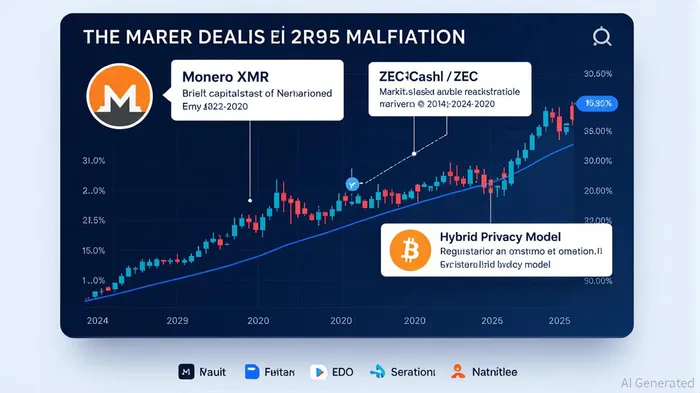
Zcash (ZEC), by contrast, has leveraged its optional-privacy model to gain regulatory favor. By allowing users to choose between transparent and shielded transactions, ZcashZEC-- has attracted institutional interest and even surpassed Monero in market capitalization for the first time in seven years, reaching $7.5 billion compared to XMR's $6.3 billion, according to CryptoSlate. This shift underscores the growing preference for privacy solutions that align with compliance frameworks, even if it means sacrificing absolute anonymity.
Monero's Resilience: Adoption Metrics and Market Performance
Despite regulatory headwinds, Monero has demonstrated remarkable resilience. As of November 2025, XMR's price surged 13.4% monthly, hitting an intraday high of $377.63, outperforming a broader crypto market slump, according to a Coinotag report. This growth is attributed to heightened demand for privacy, particularly as investors anticipate 2026 regulations requiring wallet ownership reporting, as the Coinotag report notes. Monero's technology-ring signatures, stealth addresses, and Bulletproofs-continues to attract users seeking non-correlated assets in an increasingly surveilled financial ecosystem, the Coinotag report observes.
Regionally, Monero's adoption has thrived in areas with economic instability. South Korea reported a 41% increase in XMR-based transactions following new privacy-friendly retail payment rules, while Latin America and Asia-Pacific saw rising demand for anonymous remittances, according to a CoinLaw analysis. These trends highlight Monero's role as a de facto digital cash in markets where privacy is a premium commodity.
Institutional Hesitancy and Cautious Optimism
Institutional investment in privacy coins remains cautious. While 24% of new privacy coin wallets in 2025 were created by institutional investors testing privacy-preserving payment systems, according to a Bitget report, liquidity constraints and regulatory uncertainty persist as barriers. For example, a $330 million BitcoinBTC-- ransomware payout in April 2025 was laundered through Monero, triggering a 50% single-day price spike but also drawing renewed regulatory ire, as OKX's analysis details.
However, Monero's decentralized structure offers a unique advantage. Even if the core development team were to disband, its open-source codebase ensures continuity, allowing new contributors to adapt to evolving regulations, as a The Standard report observes. This resilience has attracted niche institutional players, particularly in regions where privacy is a strategic asset.
Long-Term Investment Potential: Privacy as a Necessity
Monero's long-term viability hinges on its ability to balance privacy with regulatory pragmatism. While the EU's planned 2027 restrictions on anonymous crypto accounts pose a risk, the growing demand for privacy-preserving solutions may offset these challenges. Monero's 58% dominance in the privacy-coin market cap (versus Zcash's 21%) suggests it remains the preferred choice for users prioritizing absolute anonymity, according to a CoinLaw statistics page.
Innovations like Bulletproofs+ and the upcoming Seraphis upgrade aim to address scalability and usability concerns, further solidifying Monero's position. Additionally, its role as a "privacy anchor" in a multi-chain world-enabling users of transparent blockchains to conduct private transactions-positions it as a critical infrastructure asset, as a YesMining report notes.
Conclusion: A Privacy-First Thesis in a Surveillance Era
Monero's journey in 2025 reflects the broader tension between privacy and regulation. While Zcash's regulatory flexibility has temporarily dethroned XMR, Monero's unwavering commitment to anonymity ensures its relevance in a world where financial privacy is increasingly commodified. For investors, the key lies in balancing short-term regulatory risks with long-term demand for privacy-preserving technologies. As global surveillance intensifies, Monero's role as a digital cash alternative may provePROVE-- irreplaceable-provided it can navigate the regulatory maze without compromising its core principles.

Stay ahead of the market.
Get curated U.S. market news, insights and key dates delivered to your inbox.






Comments
No comments yet