
Monero Surpasses All-Time High Amid Rising Demand for Privacy and Regulatory Scrutiny
 Aime Summary
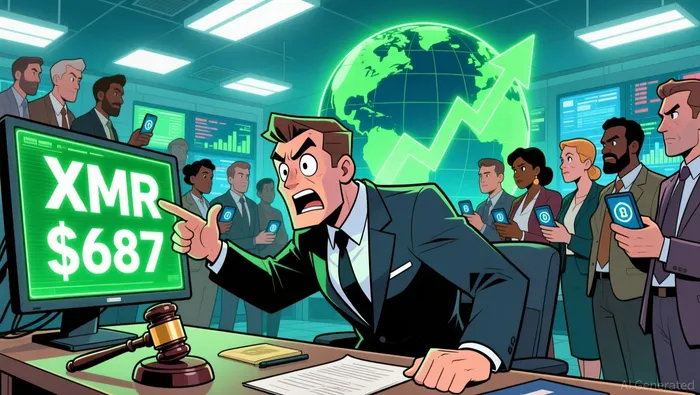
- Monero (XMR) reached an all-time high of $687 on January 13, 2026, driven by rising demand for blockchain privacy and increased global surveillance.
- The surge is attributed to investor interest in financial privacy as a critical civil right, with Monero's untraceable transactions gaining popularity among privacy advocates.
- Dubai's recent regulatory ban on privacy tokens, including MoneroXMR--, highlights the growing regulatory challenges and scrutiny faced by privacy-focused cryptocurrencies.
Monero's price action this week reflects strong buying pressure, supported by a surge in trading volume and a 45% weekly gain, pushing its market cap to $12 billion. The broader privacy coin market is experiencing a rally, with Zcash (ZEC) losing ground following governance disputes that led to a 15% price drop.
Monero's technical features, such as Ring Signatures and mandatory transaction obfuscation, differentiate it from transparent blockchains like BitcoinBTC-- and EthereumETH--, making it a preferred choice for investors seeking censorship-resistant alternatives. Institutional investors and development firms have also shown interest in privacy-preserving technologies, with some citing their potential to safeguard user data and maintain financial sovereignty.
However, the surge has not been without risks. Santiment data indicates that Monero's development activity has declined since the beginning of January, while social media dominance has peaked, signaling potential overheating and a possible correction. Thin liquidity in the privacy coin sector also raises concerns about sharp price swings and sudden reversals, despite the positive technical outlook for Monero and its peers.
Regulatory uncertainty remains a key risk for privacy-focused cryptocurrencies. Dubai's 2026 ban on privacy tokens, which prohibited trading, promotion, and derivatives involving such coins, has intensified demand for Monero by creating a scarcity effect on major exchanges. Meanwhile, the European Union is planning to ban privacy coins like Monero and ZcashZEC-- from 2027 as part of broader anti-money laundering (AML) regulations.
The market is now watching how these regulatory developments, coupled with Monero's strong fundamentals and growing institutional interest, will shape its long-term trajectory. Analysts caution that while Monero's privacy features and decentralized development model offer resilience, investors should remain cautious as sentiment indicators suggest overheating and potential pullbacks.
What Drives Monero's Recent Price Surge?
Monero's price surge to record levels is largely attributed to heightened demand for financial privacy amid increased regulatory scrutiny and surveillance. Investors are increasingly recognizing privacy as a fundamental civil right in the digital economy, which has driven capital into privacy-focused cryptocurrencies like Monero.
The broader macroeconomic environment also plays a role. As governments implement stricter KYC and AML protocols, investors are seeking alternative means to protect their financial data from exposure. Monero's untraceable transactions, combined with its mandatory obfuscation features, make it an attractive option for those looking to safeguard their assets.
The recent governance crisis at Electric Coin Company, which led to a 15% price drop for Zcash, further shifted capital toward Monero as a more resilient privacy coin. Zcash's optional privacy features and centralized governance model have drawn criticism, while Monero's decentralized development model ensures no single point of failure. This philosophical divergence has led to a reallocation of capital within the privacy coin sector.
What Risks and Uncertainties Remain for Monero?
Despite Monero's strong price performance, several risks remain. Santiment data indicates that development activity has been declining since the start of January, raising concerns about long-term sustainability and ecosystem progress. While price momentum is driven by social media hype and investor FOMO, this divergence between speculation and development activity could signal a potential correction.
Thin liquidity in the privacy coin sector also poses a challenge. Unlike major cryptocurrencies like Bitcoin and Ethereum, Monero trades with lower volume and market depth, making it more susceptible to sharp price swings and sudden reversals. Analysts warn that investors should be cautious about entering new positions without waiting for a reduction in hype and a clearer price direction, as sentiment indicators suggest overheating and potential pullbacks.
Regulatory actions remain a key uncertainty. Dubai's 2026 ban on privacy tokens has already impacted liquidity and trading activity, and further regulatory moves in other jurisdictions could create additional headwinds for Monero and its peers. The European Union's planned ban on privacy coins from 2027, as part of broader AML regulations, is another factor that investors must monitor.
In summary, Monero's recent surge reflects a growing demand for financial privacy and a shift in investor sentiment toward privacy-focused assets. However, regulatory uncertainty, thin liquidity, and potential overheating in the market highlight the need for caution and a long-term view as the sector evolves.

Blending traditional trading wisdom with cutting-edge cryptocurrency insights.
Latest Articles
Stay ahead of the market.
Get curated U.S. market news, insights and key dates delivered to your inbox.


AInvest
PRO
AInvest
PRO



Comments
No comments yet