
Monero Surges to All-Time High on Rising Demand for Privacy-Focused Cryptocurrencies
 Aime Summary
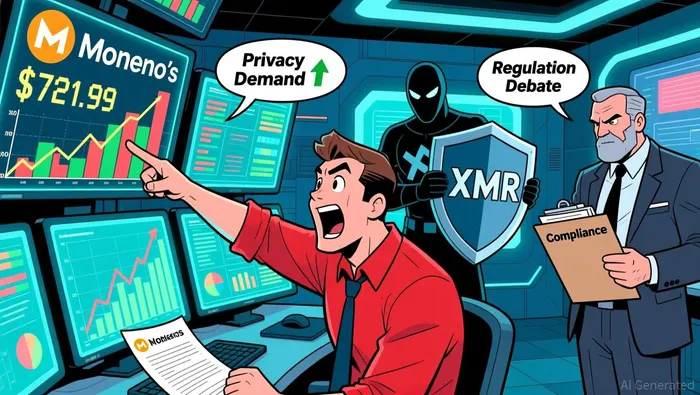
Monero (XMR) reached an all-time high of $721.99 in early 2026, driven by increased demand for privacy-focused cryptocurrencies.
Regulatory tightening on KYC and AML requirements globally has intensified interest in privacy coins, as users seek to protect transaction anonymity.
Dubai's 2026 ban on privacy tokens and the EU's 2027 regulatory plans to restrict anonymous accounts have triggered front-running behavior among investors.
Monero's recent price surge has drawn attention from both retail and institutional investors, as global financial regulations grow stricter. The blockchain's default privacy features—such as ring signatures, stealth addresses, and confidential amounts— have made it a preferred choice for users prioritizing anonymity.
With the EU and Dubai implementing policies targeting privacy coins, investors are acting preemptively to secure access to these assets before potential restrictions take effect. The surge also reflects broader concerns over financial surveillance, as governments worldwide expand oversight of digital transactions.
Monero's ascent has coincided with a decline in ZcashZEC--, its main privacy-focused competitor. Zcash's recent governance issues and development team departures have led to capital shifts toward MoneroXMR--, reinforcing its position as the leading privacy coin.
Additionally, Monero benefits from strong social media interest and liquidity, creating a feedback loop of demand that has pushed its price above $700.
Despite Monero's strong performance, technical indicators suggest potential short-term volatility. Metrics like the Relative Strength Index (RSI) and Money Flow Index (MFI) indicate overbought conditions, raising the likelihood of pullbacks near key resistance levels.
Analysts caution that while the long-term fundamentals for Monero remain bullish, the current momentum may lead to corrections in the near term.
Why is privacy becoming a key concern for investors?
The tightening of global KYC and AML regulations has made privacy a critical factor for investors and users. As governments expand digital transaction surveillance, demand for privacy-focused cryptocurrencies is rising. Monero's ability to obscure wallet balances, transaction amounts, and sender identities has made it a favored tool for users seeking financial autonomy.
The cryptocurrency's surge also reflects a broader industry shift, with major players like Ethereum exploring ways to embed privacy into their blockchains.
This trend is not limited to individual users. Institutional investors and developers are increasingly viewing privacy as essential for the long-term adoption of blockchain technology. Firms such as Galaxy Digital and Andreessen Horowitz's crypto arm have emphasized the importance of privacy-preserving technologies in recent months.
These developments indicate that the demand for privacy is evolving from a niche concern to a mainstream investment consideration.
What are the regulatory risks for Monero and privacy coins?
Privacy coins face significant regulatory headwinds, with several jurisdictions implementing or planning restrictions. Dubai's 2026 ban on privacy tokens has prohibited trading and promotion of these assets on regulated exchanges, while the EU plans to ban anonymous accounts and privacy coins by 2027. These measures are framed as anti-money laundering and sanctions compliance initiatives, but they have also triggered a surge in demand as investors buy before restrictions take effect.
Despite these regulatory pressures, Monero's decentralized structure and protocol-level privacy features have helped it maintain its position as the leading privacy coin. However, the risk of delistings and compliance challenges remains. A 2025 51% attack on Monero and subsequent exchange delistings highlighted vulnerabilities in the market.
While the U.S. Treasury has shown some flexibility—such as its 2025 reversal of Tornado CashTORN-- sanctions— privacy coins continue to be scrutinized for their potential use in financial crime.
What does Monero's growth mean for the broader crypto market?
Monero's rise has implications beyond the privacy coin segment. Its price surge has outpaced major cryptocurrencies like BitcoinBTC-- and EthereumETH--, reflecting a shift in investor preferences toward privacy and security.
As global regulations evolve, the demand for privacy-focused assets is likely to continue shaping market dynamics. Monero's performance also highlights the potential for niche crypto segments to experience sharp price movements when liquidity becomes constrained.
For now, Monero's rally underscores the growing importance of privacy in the digital economy. While regulatory risks and technical indicators suggest caution, the long-term fundamentals for Monero remain strong. As governments and regulators continue to navigate the balance between privacy and compliance, Monero's role as a leading privacy coin is likely to remain a topic of interest for investors and policymakers alike.

Blending traditional trading wisdom with cutting-edge cryptocurrency insights.
Latest Articles
Stay ahead of the market.
Get curated U.S. market news, insights and key dates delivered to your inbox.






Comments
No comments yet