
Monero Surges Amid $282M Theft and Privacy Demand
 Aime Summary
- Monero (XMR) surged to a record high of $799 in early 2026 due to a $282 million social engineering scam and increased demand for privacy-focused assets according to market analysis.
- The theft involved converting stolen BitcoinBTC-- and LitecoinLTC-- into MoneroXMR-- via instant exchanges and cross-chain protocols, utilizing XMR's default anonymity to obscure transaction trails as detailed in reports.
- Monero's price increase was also influenced by the removal of U.S. sanctions on privacy coins in 2025, fostering a more favorable regulatory environment for privacy-focused cryptocurrencies.
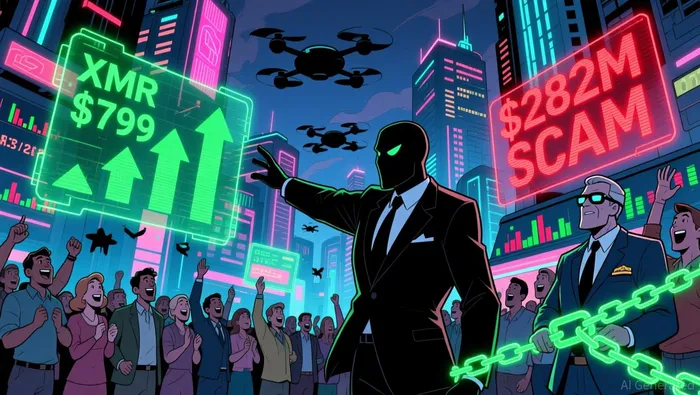
Monero's price surge to $799 in early 2026 was fueled by a $282 million social engineering scam and rising demand for privacy-focused cryptocurrencies. The theft involved the conversion of stolen Bitcoin and Litecoin into Monero through instant exchanges and cross-chain protocols like THORChain, leveraging XMR's default anonymity to obscure transaction trails. This sudden influx of stolen assets into the market significantly impacted XMR's price, pushing it to an all-time high.
The surge highlighted both the strengths and vulnerabilities of privacy coins. Monero's robust cryptographic features, such as ring signatures and stealth addresses, made the movement of the stolen funds nearly impossible to trace. However, this same anonymity also raised regulatory concerns, particularly in the EU, which is considering a potential ban on Monero by 2027. Despite the rally, several risk factors remain, including overbought conditions and speculative inflows, which could lead to a price correction.
The removal of U.S. sanctions on privacy coins in 2025 significantly contributed to Monero's adoption and optimismOP--. Monero's surge is attributed to its default anonymity features, such as ring signatures and stealth addresses, which offer a structural advantage over other privacy coins like ZcashZEC--. Institutional adoption of privacy coins is rising, especially in light of the removal of U.S. sanctions in 2025, which has fostered a more favorable regulatory environment.
Why is Monero's surge significant for investors?
Monero's surge to $799 in early 2026 highlights both the potential and the risks associated with privacy-focused cryptocurrencies. As the market continues to evolve, investors will need to closely monitor regulatory developments, technical indicators, and broader market trends to assess the future trajectory of XMRXMR--. The removal of U.S. sanctions on privacy coins has been a significant catalyst for Monero's adoption. The shift in regulatory sentiment has encouraged more investors to consider privacy-focused assets like Monero, which provide a unique value proposition. Analysts highlight the growing importance of financial privacy as a fundamental right, which is becoming more relevant in the context of increasing financial regulations.
Despite the bullish momentum, Monero faces several risks. Regulatory pressures are intensifying, with the European UnionU-- expected to ban privacy coins by 2027. This could impact its long-term viability and adoption, particularly if major exchanges delist the asset to comply with compliance requirements. Additionally, the speculative nature of the current rally raises concerns about a potential overcorrection.
What are the regulatory challenges facing Monero?
Monero's surge has also been bolstered by renewed interest from experts and firms in the crypto space, including CardanoADA-- founder Charles Hoskinson, who has stated that privacy coins will play a key role in the next generation of crypto. However, regulatory challenges persist, including delistings from major exchanges like Binance, Kraken, and OKX, and potential EU AML rules, which threaten Monero's widespread adoption. Analysts project further price increases, with price targets as high as $965 and $1,000. Despite the positive momentum, Monero faces significant barriers to mainstream adoption due to AML and KYC compliance issues. The European Union is expected to introduce stricter AML rules that could prohibit handling anonymous crypto assets.
Dubai's Dubai Financial Services Authority (DFSA) banned privacy tokens on January 12, impacting privacy-focused coins like Monero (XMR) and Zcash (ZEC). Privacy tokens obscure transaction details, including the sender, receiver, and amount. The DFSA cited the difficulty of complying with global Financial Action Task Force (FATF) standards as the basis for the ban. Privacy tokens make it nearly impossible to comply with AML checks, which regulators have long disliked. In response to these rule changes, leading privacy tokens such as XMR and ZECZEC-- have surged over the past 24 hours, highlighting the crypto community's sentiment on the matter.

Blending traditional trading wisdom with cutting-edge cryptocurrency insights.
Latest Articles
Stay ahead of the market.
Get curated U.S. market news, insights and key dates delivered to your inbox.


AInvest
PRO
AInvest
PRO



Comments
No comments yet