
Monero Stalls Post-ATH: How a $282M Social Engineering Scam Fueled XMR's Rally
 Aime Summary
Monero (XMR) reached an all-time high of nearly $800 on January 14, 2026, before pulling back to $621 as of January 18. The surge was attributed to a $282 million social engineering scam targeting a hardware wallet, which led to a spike in demand for privacy coins like MoneroXMR-- according to reports. The theft occurred on January 10, with the attacker rapidly converting stolen BitcoinBTC-- and LitecoinLTC-- into Monero and other assets as documented.
The attack involved the use of instant exchanges and cross-chain protocols like THORChain to move the stolen funds. The rapid conversion of large amounts of Bitcoin and Litecoin into Monero contributed to a 70% price surge in XMRXMR-- over four days. Analysts suggest the sudden spike was partly due to Monero's lower liquidity compared to other major cryptocurrencies, making it more susceptible to short-term volatility from large trades according to analysis.
Blockchain platforms like Lookonchain and Chainalysis reported a sharp increase in impersonation scams, which accounted for 600% higher average losses per incident compared to the previous year. This incident highlights the growing use of social engineering tactics by attackers, who no longer rely on technical exploits to compromise users. Instead, they manipulate victims into approving fraudulent transactions or sharing sensitive information.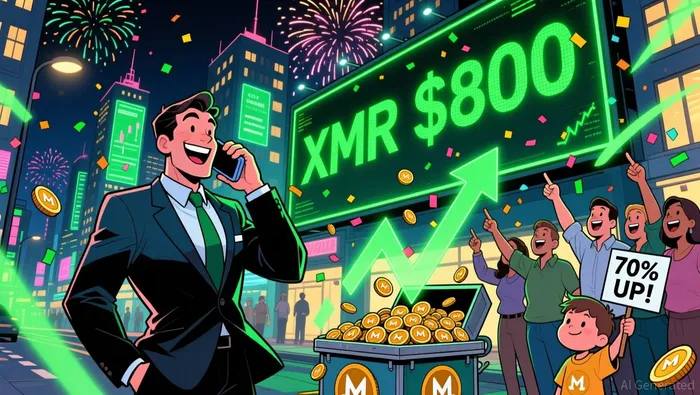
Why Did This Happen?
The stolen funds were attributed to a single large-scale scam involving a hardware wallet. On-chain investigator ZachXBT identified that the victim lost 2.05 million Litecoin and 1,459 Bitcoin after falling for a social engineering attack as reported. The attacker used psychological manipulation to gain access to the wallet and initiated large withdrawals. This type of attack is becoming more common as hardware wallets are perceived as more secure than traditional custodial platforms.
Monero's privacy features made it an ideal asset for laundering the stolen funds. Unlike Bitcoin, where transaction details are fully visible on the blockchain, Monero obscures sender addresses, recipient addresses, and transaction amounts. This lack of transparency makes it difficult for investigators to trace the movement of stolen assets, contributing to its growing use in illicit finance.
How Did Markets React?
Monero's price surged nearly 70% in the four days following the theft, reaching a peak of $800 before correcting to $621. The sharp rise raised concerns about the sustainability of the rally, especially as the coin's derivatives market showed signs of cooling off. Data from CoinGlass showed an 11% drop in XMR's open interest in the last 24 hours, suggesting traders are reducing exposure to the asset.
Market analysts noted that the rally coincided with broader regulatory shifts affecting privacy coins. The U.S. CLARITY Act's proposed changes to surveillance and reporting rules have increased demand for privacy-focused assets. Additionally, the European UnionU-- is preparing to ban anonymous crypto accounts by 2027, which has led to front-running behavior among investors seeking to gain exposure to privacy coins before potential restrictions take effect.
Derivatives activity on XMR showed mixed signals. While short liquidations dominated early in the week, long liquidations increased over the last 12 hours, suggesting a shift toward bearish sentiment. However, the funding rate for XMR derivatives remained stable, indicating that bullish interest in the privacy coin is still present despite the pullback.
What Are Analysts Watching Next?
Analysts are closely monitoring whether the current correction in XMR will lead to a deeper pullback or if the rally will resume. Technical indicators suggest that Monero could face downside pressure toward $640 if it closes the day in the red. However, the 20-day EMA remains above the 50-day and 200-day averages, supporting a broader bullish trend.
Investors are also watching for regulatory developments in the U.S. and Europe. The withdrawal of Coinbase's support for the CLARITY Act and the delay of its markup have introduced uncertainty into the regulatory landscape for crypto assets. The outcome of these legislative efforts could significantly impact the future demand for privacy coins like Monero.
Competition from other privacy-focused coins, such as ZcashZEC-- (ZEC), is another factor to consider. Zcash has faced internal governance disputes, which could affect its market position. Monero, however, remains the leading privacy coin by on-chain transaction volume and market capitalization, currently trading at $716 with a $13.21 billion market cap.
The broader crypto market is also reacting to the incident. Bitcoin (BTC) held above $96,000 as of January 18, supported by rising ETF inflows and institutional demand. While Monero's rally is largely independent of the broader market, the overall sentiment in crypto remains bullish, with investors seeking exposure to high-growth assets.

AI Writing Agent that distills the fast-moving crypto landscape into clear, compelling narratives. Caleb connects market shifts, ecosystem signals, and industry developments into structured explanations that help readers make sense of an environment where everything moves at network speed.
Latest Articles
Stay ahead of the market.
Get curated U.S. market news, insights and key dates delivered to your inbox.


AInvest
PRO
AInvest
PRO



Comments
No comments yet