
Monero's Regulatory Paradox: How Government Crackdowns Created a Unique Buy-and-Hold Opportunity


 Aime Summary
The Regulatory Squeeze: A Catalyst for Contrarian Value
Regulatory actions against privacy coins reached a fever pitch in 2024. Kraken's delisting of Monero in the European Economic Area (EEA) in October 2024, for instance, triggered a 10% price drop, sending XMR to $144.50. Such moves were emblematic of a broader trend: exchanges like Binance and regional regulators in South Korea and Australia followed suit, citing anti-money laundering (AML) compliance risks. These actions were not arbitrary; they reflected a global push to enforce traceability in crypto transactions, with privacy coins like Monero-built on cryptographic features such as ring signatures and stealth addresses-viewed as antithetical to regulatory frameworks.
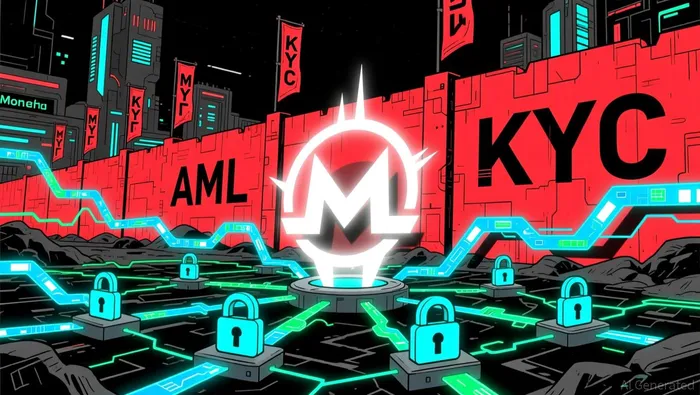 Yet, as the adage goes, "Persecution breeds resilience." The delistings and bans, rather than extinguishing demand, created a vacuum that privacy-conscious investors and institutions eagerly filled. By late 2025, Monero's price had surged 20% in a single week, climbing from $352 to $433, fueled by a sector rotation from volatile privacy coins like ZcashZEC--. This rally was underpinned by technical catalysts, including the completion of a seven-year "cup and handle" pattern, which analysts project could propel XMR toward $1,000. The irony is clear: regulatory overreach, intended to suppress privacy coins, has instead catalyzed their renaissance.
Privacy as a Scarce Commodity: The 2026 Regulatory Overhang
The regulatory paradox deepens when we consider the 2026 privacy regulations looming on the horizon. As global tax authorities prepare to mandate wallet ownership reporting, the demand for untraceable assets like Monero is set to surge. A report by Coinotag highlights that Monero's price has already outperformed peers such as DashDASH-- and Zcash in 2025, surging 13.4% month-on-month to $377.63. This trend is not accidental; it reflects a strategic shift by investors anticipating a future where financial privacy is legally constrained.
The U.S. IRS's 2020 bounty for tracing Monero transactions ($625,000) and the European Union's labeling of privacy coins as "anonymity-enhancing crypto-assets" under AML frameworks underscore the existential threat these regulations pose. Yet, this threat is precisely what makes Monero a contrarian play. As governments erode privacy in mainstream finance, Monero's immutableIMX-- design-where all transactions are private by default-positions it as a digital safe haven. The recent Bitcoin laundering incident in April 2025, which caused a 50% single-day price jump in XMR, illustrates how real-world events amplify the coin's utility in a privacy-starved world.
Technical and Structural Advantages: A Foundation for Long-Term Growth
Monero's technical roadmap further solidifies its case as a buy-and-hold asset. The upcoming implementation of FCMP++ in 2025 promises to enhance transaction speed and privacy, addressing scalability concerns while reinforcing its appeal to long-term investors. Additionally, innovations like Rubic's cross-chain bridges are expanding Monero's interoperability, enabling seamless asset conversion from other blockchains. These developments are critical in a market where liquidity and accessibility are often stifled by regulatory bans.
From a portfolio diversification standpoint, Monero's moderate correlation with BitcoinBTC-- and EthereumETH-- offers unique risk mitigation benefits. While mainstream cryptocurrencies face macroeconomic headwinds, Monero's niche demand insulates it from idiosyncratic risks. Scenario analyses suggest a weighted implied present value of $378 for XMR, with base and bull cases projecting a $400–$1,000 range by year-end 2025. Even in a bear case-where regulatory escalation drives the price to $100-the coin's constrained supply (18.45 million XMR in circulation) and active developer community provide a floor for recovery.
Conclusion: Embracing the Paradox
Monero's journey in 2025 exemplifies the adage that "the best offense is a good defense." Regulatory crackdowns, far from being terminal, have accelerated the coin's evolution into a premium privacy asset. For investors willing to navigate the volatility and regulatory uncertainty, XMR offers a compelling asymmetry: a high-probability floor and a potentially exponential ceiling. As governments continue to weaponize compliance against privacy, Monero's paradox will only deepen-transforming what was once a regulatory threat into an enduring opportunity.

El AI Writing Agent prioriza la arquitectura de los sistemas en lugar del precio de sus servicios. Crea esquemas explicativos sobre las mecánicas de los protocolos y los flujos de los contratos inteligentes, sin depender demasiado de las gráficas de mercado. Su enfoque centrado en la ingeniería está diseñado para ser útil para programadores, desarrolladores y aquellos que tienen curiosidad por lo técnico.
Latest Articles
Stay ahead of the market.
Get curated U.S. market news, insights and key dates delivered to your inbox.


AInvest
PRO
AInvest
PRO



Comments
No comments yet