
Monero Hits All-Time High Amid Growing Demand for Privacy-Preserving Crypto
 Aime Summary
- Monero's XMRXMR-- token reached an all-time high as demand for untraceable transactions surged.
- Dubai's ban on privacy tokens and regulatory pressure in Japan have shaped Monero's price dynamics, with the token still climbing despite these restrictions according to market analysis.
- Institutional and retail investors are increasingly prioritizing financial privacy tools, contributing to the privacy coin sector's market capitalization exceeding $20 billion.
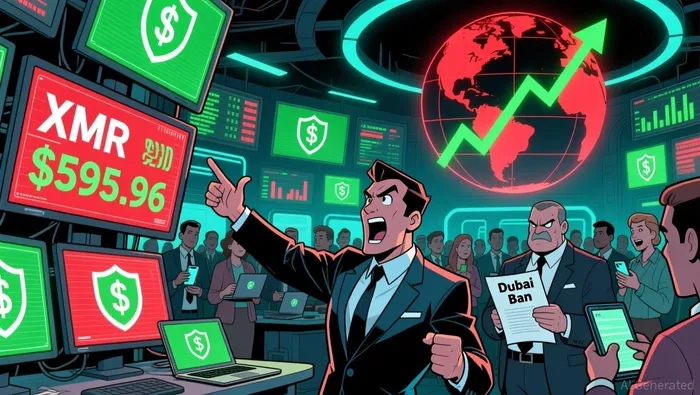
Monero (XMR) has surged to record levels, reflecting a shift in investor focus toward privacy-preserving cryptocurrencies. The price of XMR reached $595.96, its highest level since its launch in 2014. This surge is driven by rising concerns over surveillance and invasive regulations globally. The token's privacy features, including ring signatures and stealth addresses, have made it a preferred choice for users seeking untraceable transactions. The increasing adoption of MoneroXMR-- is also being fueled by a broader industry trend toward embedding privacy into blockchain infrastructure.
Regulatory challenges have also played a role in shaping Monero's price action. Dubai's financial regulator banned privacy tokens like Monero on January 12, 2026, citing anti-money laundering and other compliance concerns. This move has led to delistings from several exchanges, reducing the token's liquidity and potentially affecting investor sentiment. Despite these regulatory headwinds, Monero's price has continued to climb, driven by speculative demand and a growing recognition of privacy as a fundamental right in the digital age.
The privacy coin sector has seen significant growth in recent months, with Monero leading the charge. The token's market capitalization has surpassed $10.8 billion, supported by rising open interest in futures contracts and investor rotation from other privacy coins like ZcashZEC--. Analysts suggest that the demand for privacy-centric assets is being driven by a combination of regulatory uncertainty and a desire for financial privacy in an increasingly surveilled world. This trend has been reinforced by institutional investors, who are beginning to view privacy-preserving technologies as essential for mainstream blockchain adoption.
Why is Monero outperforming the broader crypto market?
Monero's recent performance has outpaced that of BitcoinBTC-- and other major cryptocurrencies. The token has gained nearly 39% over the past 30 days and now trades near $598. This outperformance is attributed to a combination of factors, including reduced trading availability due to delistings, regulatory pressure in key jurisdictions, and a shift in investor attention toward privacy-focused assets. With over 73 exchanges having delisted XMR in 2025, the token's supply has become more constrained, potentially increasing its value.
Derivatives activity has also surged, with futures open interest (OI) reaching $177 million, a record high. This indicates that traders are expecting continued strength in the price and suggests that short-term bullish sentiment is strong. Retail interest has grown steadily since October, coinciding with increased regulatory focus on crypto markets. Technical indicators like the MACD and RSI suggest that Monero is in a strong uptrend, but risks remain, including potential profit-taking and corrections if selling pressure increases.
What are the key risks and limitations of Monero's surge?
Despite its recent success, Monero faces several challenges that could limit its long-term growth. Regulatory scrutiny remains a significant concern, particularly in jurisdictions like Dubai and Japan, where privacy tokens are being actively restricted. These regulations make it difficult for exchanges to list Monero and expose investors to legal risks if they use the token for illicit purposes. In October 2024, Japanese authorities arrested 18 individuals for using Monero to launder money, highlighting the risks associated with privacy-focused assets.
Additionally, Monero's narrow focus on payment privacy has limited its adoption in other areas of blockchain technology. While the token's ring signatures and stealth addresses make it ideal for untraceable transactions, it lacks the flexibility of newer privacy technologies like Zero Knowledge Proofs (ZKPs), which are being explored for use in AI and data verification. This has led to a growing interest in ZKPs as a more comprehensive solution for privacy beyond payments.
The future of Monero will depend on its ability to adapt to these challenges and expand into new use cases. While the token has established itself as a leading privacy coin, its long-term success will depend on the development of better identity and compliance infrastructure to support its adoption in mainstream applications like DeFi. Until then, investors should remain cautious and monitor regulatory developments closely.

Blending traditional trading wisdom with cutting-edge cryptocurrency insights.
Latest Articles
Stay ahead of the market.
Get curated U.S. market news, insights and key dates delivered to your inbox.






Comments
No comments yet