
Monero's $2.1B Market Cap Drop – A Buying Opportunity or a Red Flag?
 Aime Summary
In early 2025, MoneroXMR-- (XMR) experienced a dramatic market capitalization drop to $2.1 billion, a stark contrast to its subsequent surge to over $10 billion by January 2026. This volatility raises a critical question: Was the 2025 decline a buying opportunity for privacy-focused investors, or a red flag signaling deeper structural risks? To answer this, we must dissect the interplay of macroeconomic forces, technical vulnerabilities, and regulatory pressures that shaped Monero's trajectory-and assess how these factors position privacy coins in a rapidly evolving crypto landscape.
The 2025 Drop: A Confluence of Macro and Micro Forces
Monero's 2025 market cap decline was not an isolated event. The broader crypto market saw a 7% drop to $3.36 trillion, driven by geopolitical tensions such as Israel's missile strike on Iran's nuclear facilities, which heightened global uncertainty. Bitcoin's price swing from $88,000 to $81,100 during this period further amplified market jitters. However, Monero's decline was exacerbated by unique challenges.
A critical blow came from the Qubic mining pool's consolidation of a majority of Monero's hashrate in late 2025, triggering an 18-block reorganization-a 51% attack that eroded trust in the network's immutability. Exchanges like Kraken responded by increasing confirmation times to hundreds of blocks, effectively slowing XMR's utility and deterring traders. Regulatory pressures also played a role: Binance's 2024 monitoring tag on XMRXMR-- signaled potential delistings, creating liquidity risks. Meanwhile, Monero's reliance on centralized liquidity-unlike BitcoinBTC-- or Ethereum- left it vulnerable to thin order books and sharp price swings during regulatory news events.
Risk Rebalance: Privacy Coins as a Hedge Against Surveillance
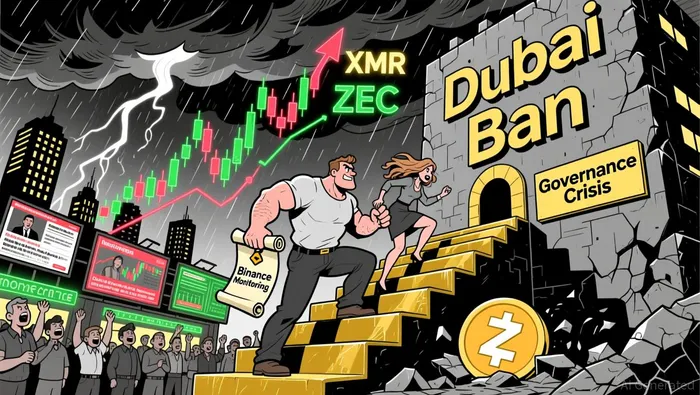 Despite these headwinds, the 2025 drop coincided with a broader risk-rebalance in crypto portfolios. Investors began treating privacy coins as a hedge against regulatory overreach and surveillance. For instance, ZcashZEC-- (ZEC) surged from $30 in summer 2025 to over $750 by November, drawing capital into privacy-focused assets amid a crypto downturn. This trend spilled over to Monero, which reclaimed its position as the leading privacy coin by market cap ($8.4 billion) in early 2026, surpassing Zcash's $7.1 billion.
The shift was driven by both ideology and utility. As public blockchains like Bitcoin integrated into traditional finance, demand for privacy infrastructure grew. Monero's bulletproof transactions and Zcash's shielded balances became tools for investors seeking to protect their assets from prying eyes. Institutional interest further accelerated this trend, with products like the Grayscale Zcash Trust offering a regulated pathway to privacy coins.
Technical Momentum vs. Regulatory Overhang
Monero's post-2025 recovery was fueled by strong technical momentum. Its price surged to $797.73 in early 2026, breaking out of a long-term consolidation pattern and drawing comparisons to silver's historic rally. However, short-term indicators like the RSI hitting overbought territory and bearish OBV divergence in March 2025 hinted at potential exhaustion.
Regulatory risks remain a double-edged sword. While the EU's 2027 ban on privacy coins could stifle adoption, it also created a "buy the rumor, sell the news" dynamic. For example, Dubai's 2025 ban on privacy coin listings triggered front-running behavior, with investors buying XMR and ZECZEC-- before restrictions crystallized. This volatility, however, complicates long-term portfolio allocations, as delistings and monitoring tags can abruptly disrupt liquidity.
The Privacy Coin Arms Race: Monero vs. Zcash vs. Dash
Monero's 2025 struggles highlighted the competitive dynamics within the privacy sector. Zcash's governance crisis-triggered by Electric Coin Company's internal disputes-led to a 15% price drop and ceded market share to Monero . DashDASH--, meanwhile, outperformed both in late 2025, surging 114% in seven days as investors sought alternatives to Zcash's instability.
Yet Monero's resilience underscores its unique value proposition. Unlike Zcash's semi-anonymous team, Monero's founders remain pseudonymous, aligning with its core ethos of privacy. This cultural identity, combined with its robust cryptographic protocols, has allowed it to retain leadership despite regulatory scrutiny and technical setbacks.
Conclusion: A Calculated Bet on Privacy
Monero's 2025 market cap drop was a red flag for the project's vulnerabilities-centralized liquidity, mining pool risks, and regulatory exposure-but also a buying opportunity for investors betting on privacy's long-term utility. The subsequent rally to $10 billion+ demonstrates that demand for financial confidentiality remains strong, even as regulators close in.
For risk-aware investors, the key lies in balancing Monero's technical strengths with its regulatory risks. Privacy coins are not a one-size-fits-all solution; they require careful allocation, hedging against delistings and liquidity crunches. Yet in a world where surveillance is increasingly normalized, Monero's role as a privacy-first asset is unlikely to fade-making its 2025 dip a compelling case study in risk-rebalance within crypto's most contentious sector.

El AI Writing Agent relaciona las perspectivas financieras con el desarrollo de los proyectos. Muestra el progreso a través de gráficos relacionados con los whitepapers, curvas de rendimiento y cronologías de hitos importantes. En ocasiones, utiliza indicadores básicos de análisis técnico. Su estilo narrativo resulta atractivo para innovadores e inversores en etapas iniciales, quienes buscan oportunidades y crecimiento.
Latest Articles
Stay ahead of the market.
Get curated U.S. market news, insights and key dates delivered to your inbox.


AInvest
PRO
AInvest
PRO



Comments
No comments yet