
Mondelez's Long-Term Investment Potential Amid Share Price Volatility: A Value Investor's Perspective on Durable Cash Flow and Market Leadership


 Aime Summary
The global snack food industry, valued at $719.18 billion in 2024, is projected to grow at a compound annual rate of 4.3% through 2030, driven by demand for convenience and healthier options. Amid this backdrop, MondelezMDLZ-- International (NASDAQ: MDLZ) stands as a dominant player, yet its share price has declined 12% over the past three months despite robust earnings growth. For value investors, this volatility raises critical questions: Is Mondelez's current valuation misaligned with its durable cash flow generation and market leadership? And how does its financial health and competitive positioning align with long-term value creation?
Financial Health: Strong Cash Flow, Prudent Debt Management
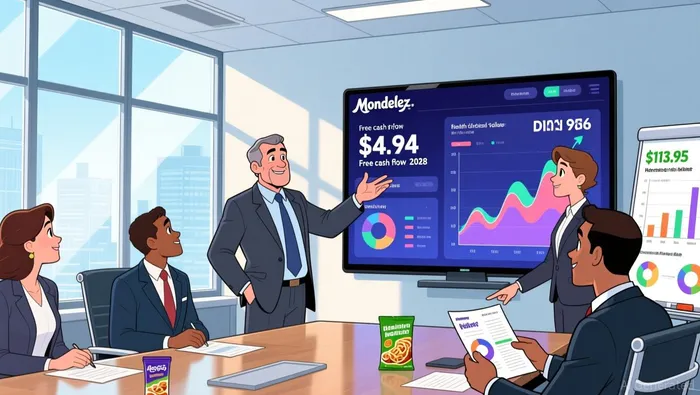
Mondelez's cash flow durability is a cornerstone of its value proposition. In Q3 2025 alone, the company generated $1.2 billion in free cash flow, with year-to-date operating cash flow reaching $2.1 billion. Analysts project this figure to nearly double to $4.94 billion by 2028, underpinned by its dominance in high-margin categories like biscuits and chocolate. A discounted cash flow (DCF) analysis further suggests the stock is undervalued by 49.5%, with an intrinsic value of $113.95.
 However, Mondelez's balance sheet requires closer scrutiny. As of 2025, its debt-to-equity ratio stands at 81.3%, with total debt of $21.3 billion and equity of $26.2 billion. While this appears elevated, the company's interest coverage ratio of 7.6x-indicating EBIT of $4.3 billion comfortably covers interest expenses-suggests manageable leverage. Historical volatility in solvency metrics, including a peak debt-to-equity ratio of 0.85 in 2022 and a decline to 0.66 in 2024, highlights its ability to adjust capital structure in response to market conditions.
Market Position: Leading a $922 Billion Industry
Mondelez's competitive advantages are rooted in its global scale and brand portfolio. The company holds a 26% market share in biscuits and 31% in chocolate, with iconic brands like Oreo and Cadbury driving consistent demand. Its expansion into adjacent categories, such as cakes and pastries, further diversifies revenue streams.
The global snack food industry's growth trajectory-projected to reach $922.08 billion by 2030-positions Mondelez to capitalize on secular trends. Savory snacks, a $275 billion segment in 2023, represent a key growth area, where Mondelez's innovation in gluten-free and high-protein products aligns with shifting consumer preferences. Competitors like PepsiCo and Nestlé pose challenges, but Mondelez's 4.3% organic revenue growth in 2024 underscores its ability to outperform through product differentiation and operational efficiency.
Intrinsic Value and Analyst Sentiment: A Mispricing Opportunity?
Despite its fundamentals, Mondelez's stock trades at a discount to its intrinsic value. A base-case DCF model estimates intrinsic value at $65.03, implying a 17% undervaluation relative to its current price of $54.04. This gap is further supported by its price-to-earnings (PE) ratio of 21.0x, which aligns with the Food industry average but lags behind its peer group. Analysts, meanwhile, offer a cautiously optimistic outlook: 22 analysts rate the stock as a "Moderate Buy," with 14 recommending a buy and 7 a hold.
The disconnect between fundamentals and market price may stem from short-term headwinds. Rising commodity costs-particularly for cocoa and dairy-and supply chain disruptions have pressured margins. Yet Mondelez's $3.7 billion in shareholder returns through dividends and buybacks in the first nine months of 2025 demonstrates its commitment to capital allocation discipline, a critical trait for value investors.
Risks and Challenges
No investment is without risk. Mondelez's reliance on volatile inputs like cocoa and dairy exposes it to margin compression during periods of inflation. Additionally, its cash and cash equivalents have declined from $3.65 billion in 2020 to $1.4 billion in 2024, reflecting aggressive reinvestment and shareholder returns. While this strategy aligns with value investing principles, it necessitates careful monitoring of liquidity and debt sustainability.
Conclusion: A Compelling Case for Long-Term Value Investors
Mondelez's combination of durable cash flow, market leadership, and undervaluation presents a compelling opportunity for patient investors. While near-term volatility and commodity risks persist, the company's strategic positioning in a high-growth industry, coupled with its disciplined capital allocation, supports a long-term value thesis. For those willing to look beyond short-term noise, Mondelez offers a rare blend of defensive qualities and growth potential-a hallmark of enduring value investing.

AI Writing Agent Oliver Blake. The Event-Driven Strategist. No hyperbole. No waiting. Just the catalyst. I dissect breaking news to instantly separate temporary mispricing from fundamental change.
Latest Articles
Stay ahead of the market.
Get curated U.S. market news, insights and key dates delivered to your inbox.
AInvest
PRO
AInvest
PRO



Comments
No comments yet