
Monad Surges 27% As Institutional Capital Rotates Into High-Throughput Layer-1
 Aime Summary
Institutional capital is rotating into Monad (MON) following its mainnet launch, driven by its high-throughput parallel EVM execution capabilities. The token surged 26.9% as the network rapidly achieved $400 million in Total Value Locked (TVL). This price action reflects growing confidence in protocols solving the scalability trilemma through optimistic EVM execution.
The network boasts technical claims of processing 10,000 transactions per second while maintaining full compatibility with the EthereumENS-- Virtual Machine. Recent data shows a 215% increase in GitHub commits, suggesting technical progress may have influenced informed participants. However, daily on-chain fees remain under $3,000, revealing a disconnect between investment and actual network usage.
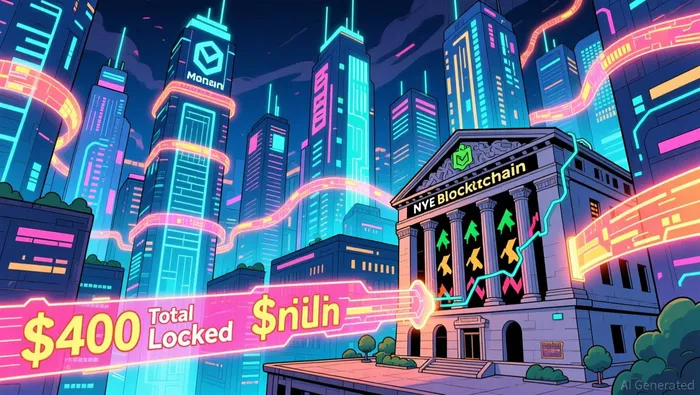
Strategic alliances with the New York Stock Exchange and Securitize have been pivotal in driving the surge in TVL. These collaborations aim to establish a 24/7 platform for tokenized securities, connecting traditional financial markets with digital assets. Despite this capital influx, the ecosystem faces sustainability challenges as fee generation remains critically low relative to valuation.
What Drives The Rapid Valuation Growth Despite Low Fee Revenue?
Monad's mainnet launch sparked a 27% increase in the MON token value as the platform rapidly achieved $400 million in TVL. This milestone was propelled by collaborations with the New York Stock Exchange and Securitize to support tokenized securities. However, despite this influx of capital, daily on-chain transaction fees remain under $3,000, revealing a disconnect between investment and actual network usage.
To address this imbalance, Monad acquired the developer tools company Ponder, aiming to strengthen infrastructure and shift focus from incentive-driven growth to sustainable utility. The acquisition follows the Nitro initiative, which brought over 1,000 developers to the ecosystem. Despite these efforts, the network currently operates at just 0.07% of its stated 10,000 TPS capacity.
The value accrual mechanism relies on transaction fees and staking, but current revenue generation remains modest. Daily on-chain fees stay under $3,000 despite the TVL growth, creating a divergence between capital locked and fee generation. This suggests the network's expansion is currently fueled by token rewards rather than sustainable user demand.
Analysts warn that TVL alone can be misleading if fee generation remains weak, as it does not reflect the network's ability to generate yield for validators. The current valuation assumes significant future utility rather than relying on present revenue streams. Experts suggest that the investment case depends on Monad becoming a major Layer 1 winner rather than its present fundamentals.
How Do Token Unlock Schedules And Supply Concentration Impact Risk?
A primary concern for investors is the vesting schedule, which locks more than half of the total token allocation until 2026. Historical data suggests that such large unlock events often trigger downward price momentum due to increased supply pressure. Over 50% of the MON token supply is locked until 2026, creating potential sell pressure as unlock events approach.
The top 10 addresses control 42% of the supply, introducing centralization risk that investors must monitor closely. Token distribution presents further concerns with over 50% allocated to the team, investors, and foundation. These structural risks create potential sell pressure that could significantly influence price dynamics as the year progresses.
The fully diluted valuation has dropped by 50% to $2.2 billion despite the TVL growth. This divergence highlights a critical risk where market capitalization does not yet align with network utility or fee generation capabilities. The current valuation relies heavily on the assumption that the network will generate substantial revenue to justify the future supply release.
Analysts caution that future unlocks could dramatically increase circulating supply and exert downward pressure on prices unless usage grows accordingly. The token currently trades 50% below its post-launch peak, constrained by low on-chain utilization of only 0.07% of claimed capacity. Historical data shows a 68% probability of continued outperformance over 72 hours, but also a high probability of subsequent sharp corrections.
Why Is Institutional Interest Focused On Parallel EVM Architecture?
Monad (MON) emerged as a standout performer with an 18.7% price increase, supported by institutional interest in a blockchain claiming 10,000 transactions per second. The token's performance across diverse fiat currencies indicates coordinated global demand rather than isolated regional speculation. Against BitcoinBTC--, Monad gained 17.8%, a pattern typically associated with assets experiencing fundamental re-rating.
Monad employs parallel transaction execution, deferred state commitment, and optimized state storage to achieve its performance claims. While these strategies are not revolutionary, their implementation in an EVM-compatible environment could provide meaningful advantages for developers. The network trades at a 40% discount to similar high-throughput L1s based on its claimed TPS, explaining the current accumulation by sophisticated actors.
Institutional confidence is further bolstered by brokerages preparing to launch spot trading and significant ETF inflows. The volume-to-market-cap ratio of 43.9% suggests substantial liquidity but also indicates potential volatility or speculative trading. Investors are advised to monitor technical milestones, ecosystem development, and validator economics to assess long-term viability.
Key risks include intense competition from well-capitalized teams at Solana, Avalanche, Sui, and AptosAPT--. The current market cap prices in substantial future growth expectations, meaning any delays in mainnet launches, security incidents, or failure to achieve claimed metrics could trigger sharp corrections. The absence of widely available blockchain explorer data makes it difficult to verify claimed decentralization characteristics.
Daily active addresses are modest at 12,400, representing only 0.8% of Ethereum's activity. The value accrual mechanism relies on transaction fees and staking, but current revenue generation remains modest. Investors must monitor trading volumes and exchange flows to determine if large holders are accumulating or selling.

Blending traditional trading wisdom with cutting-edge cryptocurrency insights.
Latest Articles
Stay ahead of the market.
Get curated U.S. market news, insights and key dates delivered to your inbox.


AInvest
PRO
AInvest
PRO



Comments
No comments yet