
Monad Surges 25% On NYSE Partnerships And TVL Milestone Amid Tokenomics Risks
 Aime Summary
Monad's native token MON surged over 25% in 24 hours, reaching $0.0325 with trading volume hitting $155 million. This rally outperformed major cryptocurrencies like BitcoinBTC-- and EthereumETH--, signaling concentrated buying pressure rather than broad market momentum. The price movement coincides with the network crossing $400 million in Total Value Locked (TVL) and strategic alliances with the New York Stock Exchange.
Analysts note that while the TVL growth is significant, daily on-chain fees remain under $3,000. This discrepancy suggests that current expansion may be driven by capital incentives rather than sustainable organic usage. The high fully diluted valuation of $2.2 billion contrasts with a market cap of roughly $332 million, highlighting potential valuation risks.
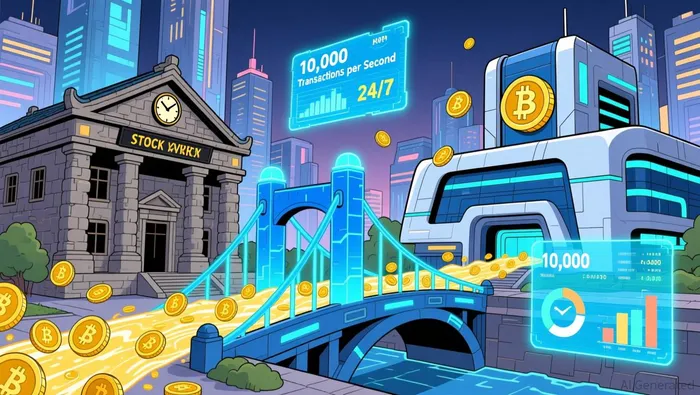
The network's ability to process 10,000 transactions per second while maintaining EVM compatibility has attracted developer interest. GitHub commits have surged 215% in two weeks, and the Nitro initiative has brought over 1,000 builders to the platform. However, skepticism remains regarding whether the network can maintain this momentum without the initial incentive structures.
What Is Driving The Recent Price Surge?
The primary catalyst for the recent price action is the announcement of strategic partnerships between Monad and the New York Stock Exchange. These alliances aim to create a 24/7 platform for tokenized securities, bridging traditional finance with digital assets. Collaborations with Securitize further strengthen regulatory compliance and institutional confidence for the ecosystem.
Trading volume reached $187.7 million, representing approximately 55% of the market capitalization. This high volume-to-market-cap ratio indicates genuine market interest rather than low-liquidity manipulation. The rally also coincided with a 34% week-over-week growth in active addresses, suggesting increased network engagement.
DeFi protocols on the network are showing signs of robust activity. The Neverland DeFi ecosystem saw its Total Value Locked climb to $40.79 million, with total borrowed funds reaching $103.82 million. These metrics contributed to the broader network TVL reaching $388.91 million.
Despite the optimism, the surge faces headwinds from a high fully diluted valuation. Over half of the MON token supply is locked until 2026, which historically triggers downward price momentum upon unlock. Arthur Hayes has cautioned that this structure could expose the token to sharp price corrections.
How Do Fee Metrics Compare To Total Value Locked?
A critical metric for long-term viability is the ratio of fee revenue to Total Value Locked. Despite TVL exceeding $400 million, daily on-chain fees remain below $3,000. Critics argue that high TVL figures may be driven by token incentives rather than genuine economic demand.
The discrepancy between high transaction volumes and low fee generation suggests incentive-driven activity. Daily active addresses are rising, but the translation of developer adoption into transaction volume and gas fee revenue is still in question. Without a clear ramp-up in revenue, the current valuation lacks a fundamental anchor.
Institutional positioning is evident from the high volume-to-market-cap ratio, but long-term success depends on generating meaningful fees. The network must achieve massive utility growth to justify its size, creating potential for downward pressure if adoption lags.
Ethereum's TVL has declined 6.3% with daily active addresses down 18%, while Monad sees rising engagement. However, Ethereum faces headwinds from reduced gas demand, whereas Monad is still proving its scalability claims under real-world conditions. The key metric to watch will be whether active daily addresses sustain growth beyond the current narrative-driven accumulation.
What Are The Key Risks For Long-Term Holders?
The most significant risk for long-term holders is the supply structure of the MON token. An 89.17% locked supply overhang creates massive potential for future selling pressure. The initial 10% supply unlock via a public sale created concentrated selling pressure at known price levels.
Any future unlocking of the remaining supply could dramatically increase circulating supply and pressure the price. This is particularly concerning if distribution channels like airdrops lead to coordinated selling. The high fully diluted valuation implies the network must achieve massive utility growth to justify its size.
Technical validation of the 10,000 TPS claim remains pending, as testnet performance and mainnet performance often diverge significantly. The Layer 1 narrative faces headwinds in 2026 as Ethereum's Layer 2 scaling reduces the urgency for alternatives. Investors face risks including limited historical data for technical analysis and potential volatility from the high turnover ratio.
While the EVM-compatible high-performance niche remains underserved, the 2021-2022 cycle saw dozens of projects fail to gain meaningful adoption. Continued development of developer tooling and real-world applications will be crucial for long-term success. The platform faces a test in maintaining liquidity without organic usage if initial incentives wane.
Position sizing should account for potential 30-50% retracements common in micro-cap tokens during correction phases. The current price action may already price in immediate catalysts, leaving little room for error if adoption targets are missed. Investors are advised to monitor volume sustainability and on-chain adoption metrics to distinguish between speculation and fundamental traction. According to analysis, the current price action may already price in immediate catalysts, leaving little room for error if adoption targets are missed.

Blending traditional trading wisdom with cutting-edge cryptocurrency insights.
Latest Articles
Stay ahead of the market.
Get curated U.S. market news, insights and key dates delivered to your inbox.


AInvest
PRO
AInvest
PRO



Comments
No comments yet