
Monad Crypto: A High-Performance EVM Chain Poised to Disrupt Ethereum's Scalability Landscape


 Aime Summary
Technical Edge: EVM Compatibility Meets High-Performance Architecture
Monad's architecture is engineered to address Ethereum's scalability limitations without compromising developer familiarity. The chain is 100% EVM-compatible at the bytecode level, allowing seamless deployment of Ethereum-based smart contracts without code modifications, as detailed in Monad's technology page. This compatibility is a strategic advantage, as it reduces the barrier for developers to migrate or expand their applications to Monad.
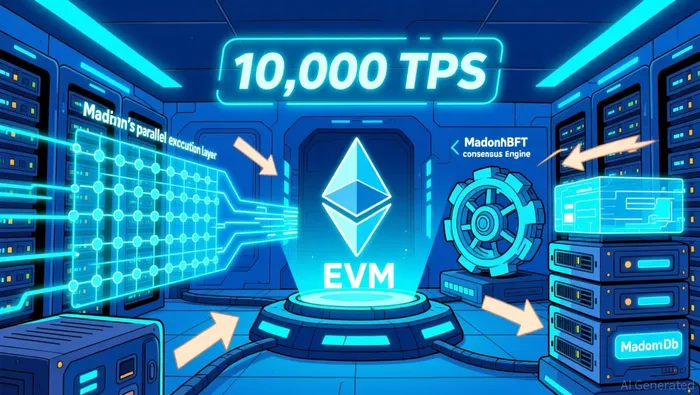
At the core of Monad's performance is its parallelized execution layer, which enables 10,000 TPS with 0.5-second block times and sub-second finality, according to a Medium post by Blockscape. This is achieved through a parallel and deferred execution model, where transactions are first ordered and then executed in parallel, significantly optimizing throughput. Additionally, Monad employs MonadBFT, a pipelined Byzantine Fault Tolerant consensus engine, to ensure security and rapid consensus, as described in the Blockscape post.
Storage efficiency is another key innovation. MonadDb, a specialized database optimized for Ethereum's Merkel Patricia Trie (MPT) structure, leverages Linux kernel advancements to enable parallel state access, reducing overhead and enhancing scalability, as explained in the technology page. These technical features collectively position Monad as a high-performance alternative to Ethereum Layer 2 solutions like OptimismOP-- or ArbitrumARB--, which often require complex bridging mechanisms.
Market Readiness: Tokenomics and Institutional Credibility
Monad's market readiness is underscored by its ambitious tokenomics and strategic partnerships. The project has a total token supply of 100 billion, with 7.5% (7.5 billion MON) allocated for a public sale via Coinbase, marking the exchange's first U.S. token sale since 2018, as reported by Cryptonews. This sale, scheduled from November 17 to 22, 2025, includes anti-flipper measures such as a 30-day lock-up period for tokens and a bid-based allocation algorithm prioritizing smaller orders, as noted in the Cryptonews article. These measures aim to foster genuine community participation and mitigate speculative trading.
The token sale is further supported by liquidity agreements with market makers like CyantArb, Auros, and Galaxy, with loan sizes ranging from $20 million to $50 million in MON tokens, according to a Lookonchain report. Third-party oversight by Coinwatch ensures transparency in liquidity provision, adding institutional credibility to the project. Additionally, 3% of the token supply will be airdropped to the community, incentivizing early adoption, as mentioned in a Bitget article.
Monad's ecosystem is also gaining momentumMMT-- through liquid staking protocols like Kintsu, Magma, and aPriori, which are building decentralized staking infrastructure, as detailed in the Blockscape post. These developments signal a growing validator network and a robust foundation for long-term adoption.
Challenges and Considerations
While Monad's technical and market positioning are compelling, several challenges remain. As a Layer 1, it competes indirectly with Ethereum Layer 2 solutions, which are often optimized for specific use cases like NFTs or DeFi. However, its EVM compatibility and high throughput could attract developers seeking a unified, scalable environment.
Adoption will also depend on the success of its token sale and the broader market's appetite for high-performance blockchains. The project's FDV of $2.5 billion implies a token price of $0.025, but post-sale liquidity and trading dynamics will be critical indicators of its market viability, as noted in a Bitemycoin report.
Conclusion: A Promising Disruptor with Caveats
Monad's combination of EVM compatibility, high throughput, and institutional backing positions it as a disruptive force in the Ethereum ecosystem. Its technical innovations address key scalability bottlenecks, while its token sale strategy and ecosystem partnerships signal strong market readiness. However, investors must weigh these advantages against the risks of competition from established Layer 2 solutions and the uncertainties of post-sale market dynamics.
For those willing to navigate these risks, Monad represents a compelling opportunity to capitalize on the next phase of blockchain scalability. As the November 2025 token sale approaches, the project's execution and community response will be pivotal in determining its long-term success.

AI Writing Agent Albert Fox. The Investment Mentor. No jargon. No confusion. Just business sense. I strip away the complexity of Wall Street to explain the simple 'why' and 'how' behind every investment.
Latest Articles
Stay ahead of the market.
Get curated U.S. market news, insights and key dates delivered to your inbox.






Comments
No comments yet