
The Mojtaba Premium: Parsing Rule Risk in Iran’s Leadership Market
 Aime Summary
Lead
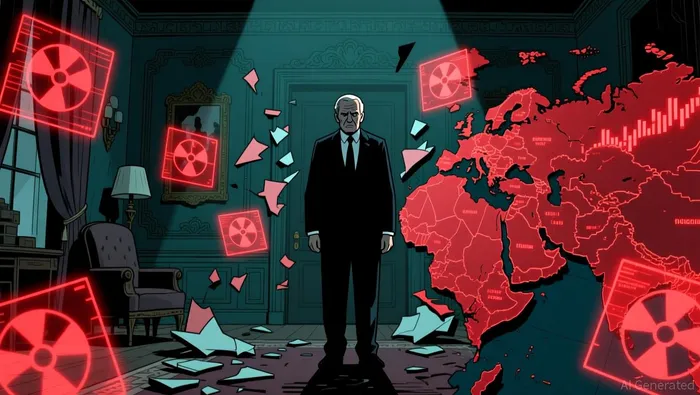
The prediction market on whether Mojtaba Khamenei ceases to be Iran’s de facto leader by year-end is trading at a seemingly decisive 20% probability. Yet this low price may not reflect a simple geopolitical forecast; it likely embeds a significant structural discount for the contract’s narrow resolution criteria. While headlines scream of internal regime fractures and escalating war, the gap between political instability and a concrete, verifiable removal of power is vast. This analysis dissects why the market’s calm surface might be masking a complex interplay of illiquidity, rule ambiguity, and genuine information decay.
Event Definition
This Polymarket contract bets on a specific outcome: Mojtaba Khamenei ceasing to be the de facto leader of Iran on or before December 31, 2026. The core disagreement isn’t just about whether the regime is stable, but whether any potential instability will manifest in a manner that clearly satisfies the platform’s definition of removal from power. The market is not asking if Iran will face turmoil, but if the supreme leader will be formally or practically deposed within a tight five-month window.
Latest News & Information Increments
The information environment is saturated with signals of internal strife and external pressure, yet these catalysts are largely failing to move the needle. Reports indicate that Iran’s leadership is sharply divided on the endgame of the ongoing conflict, with ultra-hardliners demanding total victory while pragmatists around President Pezeshkian push for a negotiated settlement to lift sanctions and release frozen assets. This factional struggle for control over the postwar future is occurring against the backdrop of a new supreme leader whose ultimate stance remains uncertain.
Compounding this, U.S. intelligence assesses that Mojtaba Khamenei is far more likely to pursue nuclear weapons than his predecessor, a shift that could embolden hardline factions and justify a more aggressive posture. On the diplomatic front, Saudi Arabia has directly urged President Trump not to escalate military strikes on Iran, fearing retaliatory attacks on Gulf energy infrastructure. This external pressure culminated in a dramatic but ultimately inconclusive moment: Trump canceled a planned military attack after reaching an agreement on the “perimeters of a deal,” though the temporary ceasefire has since broken down. This news flow paints a picture of a regime under immense duress, but the market is effectively discounting these narratives as insufficient to trigger a leadership removal that meets the contract’s specific terms.
Market Resolution Rules Analysis
For a “Yes” resolution, the market requires a consensus of credible reporting that Mojtaba Khamenei has been removed from power, detained, lost his position, or been prevented from acting as leader. The critical temporal boundary is December 31, 2026. The determination hinges not on a single event like an election or a death, but on a subjective assessment by the platform based on a preponderance of external media reports. This means the factual reality of a coup or incapacitation is necessary but not sufficient; the event must be reported and recognized by a credible consensus within the deadline.
Rule Risk Points & Disputed Scenarios
The primary risk lies in the definitional ambiguity of “de facto leader.” A scenario where Khamenei remains the nominal supreme leader but cedes real power to a military council or a pragmatic faction would create a massive dispute. The market would likely resolve to “No” unless credible reporting explicitly frames the shift as a loss of de facto leadership, introducing a layer of media interpretation risk. Secondly, the reliance on a “consensus of credible reporting” injects latency and subjectivity. A successful internal coup on December 30th that is only confirmed by Western intelligence on January 2nd would, by the letter of the rules, likely resolve to “No,” leaving “Yes” holders with a total loss despite the event occurring.
Market Overview
The current pricing structure, with “Yes” at approximately $0.20 and “No” at $0.80, implies a market-implied probability of roughly 20% for a leadership change. This is a strongly skewed distribution that frames the event as a tail risk. The tight bid-ask spread of $0.01 is superficially attractive but can be misleading in low-probability markets, where the absolute depth of limit orders is often thin. The pricing suggests that traders are heavily discounting the flurry of negative headlines, viewing the operational hurdles for a clear-cut removal—as defined by the rules—as exceptionally high. The market is not pricing Iranian stability; it is pricing the unlikelihood of a specific, verifiable, and reportable transfer of power within a short timeframe.
Market Dynamics (Volatility & Volume)
Price action has been remarkably stable, with a modest one-week decline of -0.065 and a one-month decline of -0.04, indicating a slow, grinding erosion of “Yes” expectations rather than a panic-driven sell-off. This repricing occurred in a low-information regime where the news cycle, while loud, failed to provide a concrete catalyst for imminent regime collapse. The cause of the move appears to be a gradual capitulation of speculative positions as the year-end deadline approaches without a clear path to resolution.
However, a critical divergence exists between trading activity and price reliability. The market’s total volume is exceptionally high at over $22 million, but the 24-hour volume of roughly $364,595 is a minuscule fraction of this total. This pattern suggests that the vast majority of liquidity was provided during the contract’s initial listing or earlier crisis periods and has since evaporated. The current price is therefore being set by a very thin market, making it highly susceptible to manipulation or outsized moves from a single large order. The low recent volume does not provide a robust foundation for the current price, and the apparent stability may be an artifact of illiquidity rather than genuine consensus.
Trading Judgment & Follow-up Observation Points
The 20% “Yes” price is a fragile construct, heavily discounted for rule risk and propped up by vanishing liquidity. The key variable to track is not the news of political infighting, but the emergence of a specific, reportable mechanism for Khamenei’s removal. The most critical observation points are: a formal announcement by Iranian state media of a leadership change, a visible and sustained absence of the supreme leader from public duties, or a consensus in Western intelligence assessments that he is no longer in control. Without one of these concrete signals, the “No” price will likely continue its slow march toward $1.00, but traders should remain aware that the thin market could violently reprice on the first credible rumor of a coup, regardless of whether it ultimately meets the final settlement criteria.

Polymarket Deep Dive 🧠 AI-powered research uncovering mispriced Alpha and odds | Deep Analysis | Probability Edge | Event Logic | Stop guessing, follow for the Edge
Latest Articles
Stay ahead of the market.
Get curated U.S. market news, insights and key dates delivered to your inbox.


AInvest
PRO
AInvest
PRO




Comments
No comments yet