
T-Mobile's Subscriber Growth and Competitive Edge Over Verizon and AT&T
 Aime Summary
In the rapidly evolving U.S. telecommunications landscape, T-Mobile USTMUS-- (TMUS) has emerged as a disruptive force, outpacing both Verizon CommunicationsVZ-- (VZ) and AT&TT-- (T) in subscriber growth, pricing innovation, and 5G deployment. This shift is not merely a short-term market fluctuation but a structural reordering of the industry, driven by T-Mobile's ability to align customer-centric strategies with technological foresight. For investors, understanding this transformation is critical to identifying long-term value in a sector long dominated by oligopolistic dynamics.
Strategic Pricing: The Un-Carrier Model Redefined
T-Mobile's pricing strategy has consistently defied conventional telecom wisdom. By prioritizing affordability without compromising service quality, the company has captured market share from both price-sensitive and premium customers. In Q2 2025, T-MobileTMUS-- added 1.7 million postpaid net subscribers—the highest quarterly total in its history—while maintaining a postpaid churn rate of 0.90%, well below industry averages. This success stems from a dual approach:
1. Value-Driven Plans: T-Mobile's “Experience” tier plans, such as the “Experience Beyond” offering, have seen adoption rates more than double compared to the previous year. These plans leverage T-Mobile's network performance to justify higher average revenue per account (ARPA), which grew by over 5% year-over-year—the strongest rate in eight years.
2. Customer Retention Guarantees: Initiatives like the 3-Year Price Lock and Free Phone Guarantee have reduced customer switching costs, creating a sticky relationship with users. T-Mobile's ability to retain customers while raising prices (or at least maintaining them) contrasts sharply with Verizon's struggles, where postpaid phone subscriber losses have persisted for five consecutive quarters.
5G Network Expansion: A Dual-Track Dominance
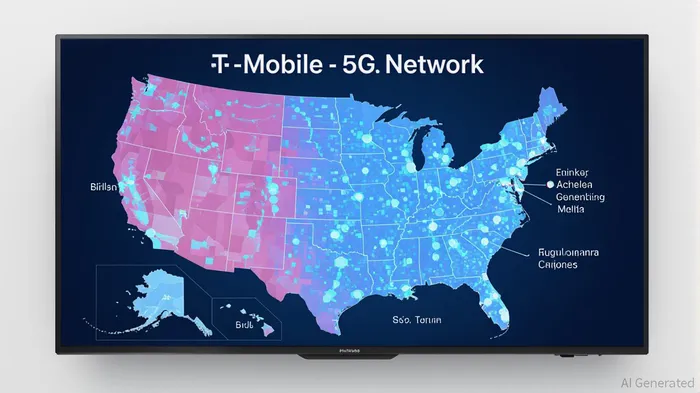
T-Mobile's 5G strategy is a masterclass in leveraging both scale and innovation. The carrier's low-band 600 MHz spectrum provides ubiquitous coverage, while mid-band and high-band mmWave capabilities ensure speed parity with competitors. By Q4 2024, T-Mobile's median 5G FWA download speed had surged by 50% to 205.44 Mbps, outpacing Verizon's 150.47 Mbps and AT&T's 145.30 Mbps. This performance has translated into a 6.43 million FWA subscriber base, representing 58% of the U.S. FWA market.
But T-Mobile's edge extends beyond terrestrial infrastructure. The company's T-Satellite service, launched in Q2 2025, covers 500,000 square miles of previously underserved regions, leveraging SpaceX's Starlink to deliver connectivity where fiber and traditional 5G are impractical. This satellite-to-cell capability positions T-Mobile to dominate rural broadband markets, where AT&T's fiber-centric strategy and Verizon's FWA-only approach face inherent limitations.
Customer Acquisition and Financial Resilience
T-Mobile's ability to convert market share gains into financial strength is equally compelling. The company's Q2 2025 results included $21.13 billion in revenue, a 6.9% year-over-year increase, and $3.2 billion in net income—a 10% year-over-year jump. These figures outperform both VerizonVZ-- and AT&T, which reported flat or declining postpaid phone subscriber growth.
T-Mobile's financial discipline is evident in its capital allocation strategy. The carrier returned $3.5 billion to shareholders in Q2 2025 through buybacks and dividends, while simultaneously investing in Metronet (a fiber provider) and UScellular (a regional carrier set to close on August 1, 2025). These acquisitions are expected to expand T-Mobile's site coverage by 33% and capacity by 50%, further solidifying its network leadership.
The Bigger Picture: Reshaping the Telecom Industry
The broader implications of T-Mobile's success are profound. By challenging the status quo, the carrier is accelerating the “Cord-Cutting 2.0” trend, where traditional cable providers like ComcastCMCSA-- and Charter CommunicationsCHTR-- are losing 5G FWA and fiber customers to telecoms. In Q1 2025, cable providers collectively lost 259,000 internet subscribers—a stark indicator of the shifting competitive landscape.
For investors, T-Mobile's trajectory offers a rare combination of top-line growth, pricing power, and technological differentiation. The company's 2025 guidance—postpaid net additions of 6.1–6.4 million and core adjusted EBITDA of $33.3–$33.7 billion—reflects confidence in its ability to sustain momentum. Meanwhile, Verizon and AT&T's reliance on legacy infrastructure and conservative pricing models leaves them vulnerable to T-Mobile's agile, customer-first approach.
Investment Implications
T-Mobile's stock has outperformed its peers over the past 12 months, with a compound annual growth rate (CAGR) of 18% versus Verizon's 4% and AT&T's flat performance. This outperformance is justified by T-Mobile's superior execution in a sector where innovation and customer experience are increasingly decisive.
However, risks remain. Regulatory scrutiny of T-Mobile's acquisitions and the potential for margin compression in the broadband segment could temper growth. Investors should monitor the company's debt levels and its ability to integrate Metronet and UScellular without operational hiccups.
In conclusion, T-Mobile's strategic pricing, 5G expansion, and customer acquisition model are not just reshaping the U.S. telecom industry—they are redefining the rules of competition. For investors seeking exposure to a sector poised for transformation, T-Mobile represents a compelling long-term opportunity. The question is no longer whether T-Mobile can sustain its lead, but how quickly its peers can adapt—or whether they will be left behind.

Delivering real-time insights and analysis on emerging financial trends and market movements.
Latest Articles
Stay ahead of the market.
Get curated U.S. market news, insights and key dates delivered to your inbox.




Comments
No comments yet