

The layoff notices are easy to read as fear. T-MobileTMUS-- cut more than 4,500 jobs in the first half of 2026, with U.S. headcount falling from 70,036 at the end of 2025 to 65,365 by June 30, 2026, a roughly 6.7% shrink in six months as reported in the industry trade press. That is genuinely hard on the people affected, and it is the kind of headline that makes an ordinary investor ask whether something is breaking. The financial numbers say the opposite.
Look at what the same window produced. T-Mobile's second-quarter service revenue rose 9% year over year to $19.0 billion, Core Adjusted EBITDA, a non-GAAP profit measure, rose 12% to $9.5 billion, and adjusted free cash flow, operating cash flow minus capital spending and also non-GAAP, rose 4% to $4.8 billion. Management then raised its full-year adjusted free cash flow guidance to $18.4 billion to $18.8 billion, from $18.1 billion to $18.7 billion.

That is cost discipline running on top of growth rather than distress: the cuts convert into margin and cash flow instead of signaling an impaired revenue base. This is a company whose service revenue grew about 8% in 2025, to $71.3 billion, with roughly $11 billion of net income. The company's own framing points the same way. This spring it said it was eliminating some roles "while continuing to invest and hire in areas", describing the reduction wave as aligning its organization to support "future growth and innovation." The cuts also reach the storefront: the Washington round behind the headlines — 77 roles spanning retail and corporate positions, plus seven store closures — is described by T-Mobile as a "broader retail pivot" toward company-operated stores integrated with digital tools. Fewer bodies, more app.
The plumbing is straightforward: headcount reductions convert into free cash flow under a roughly flat capex plateau.
T-Mobile books workforce-transformation, network-restructuring, and merger-integration charges outside Core Adjusted EBITDA, so as it reduces headcount and shifts the store estate digital, cash operating costs fall while service revenue keeps climbing. Nearly 75% of postpaid phone upgrades now happen digitally, and calls to customer care are down more than 50% since 2021. With capital spending guided at roughly $10 billion, the operating delta flows straight to free cash flow instead of being consumed by new investment.
The raised guide is not the end of the path. At February's Capital Markets Day, T-Mobile targeted adjusted free cash flow of $19.5 billion to $20.5 billion for 2027, again on roughly flat capex.
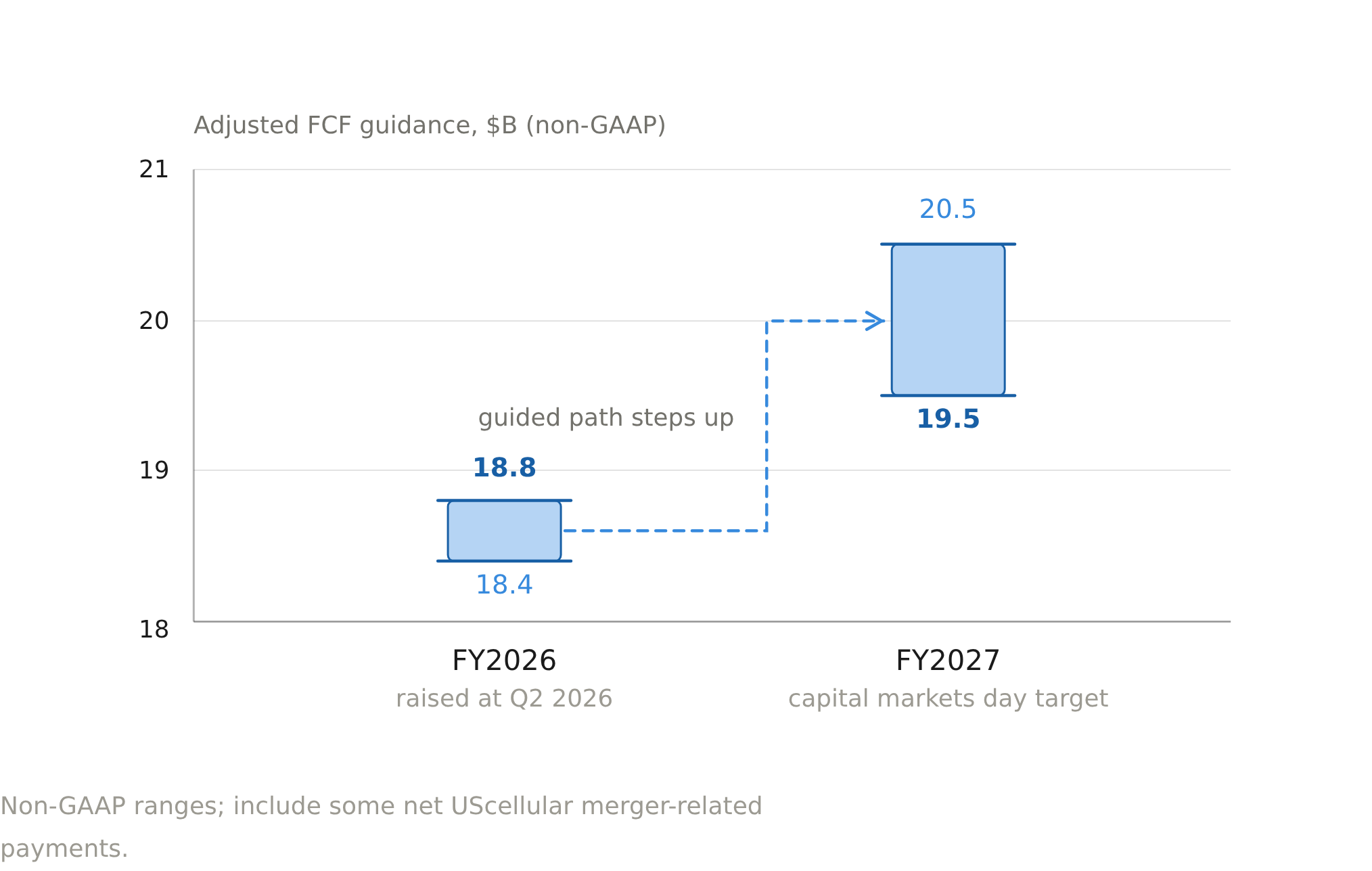
Non-GAAP ranges; include some net UScellular merger-related payments.
| Fiscal year | Low ($B) | High ($B) |
|---|---|---|
| FY2026 | 18.4 | 18.8 |
| FY2027 | 19.5 | 20.5 |
Turn that into a yield you can hold. Ainvest data puts T-Mobile's market cap near $193 billion, with the stock at about 18.2 times trailing earnings and 15.6 times forward earnings. Take the low end of this year's cash flow guide, $18.4 billion, divide by the roughly $193 billion market cap, and the forward free cash flow yield is about 9.5%; the top of the range comes to about 9.8%. That is the cash yield the headcount work is helping to build.
Some of that cash is already coming back to shareholders. T-Mobile returned $3.3 billion in the second quarter, $2.2 billion in buybacks and $1.1 billion in dividends, and lifted its 2026 stockholder return authorization to as much as $18.2 billion. Run the buyback pace over four quarters and it alone works out to roughly 4.6% of the market cap a year.
Now the honest caveats, because a layoff is a clue, not proof. There is no disclosed bridge splitting the guidance raise into headcount savings, UScellular merger synergies, and organic growth, and the cash flow guidance includes some net payments tied to the UScellular deal. Demand deserves as much attention as costs. Postpaid net account additions fell 13% year over year in the second quarter, to 277,000, a drop of 41,000, and total revenue missed analyst forecasts; the stock fell on the print even as the cash flow outlook went up. T-Mobile also cut roughly 5,000 jobs, about 7% of its workforce, in August 2023 with no acquisition pending, so reductions are not reserved for integration programs.
The way to tell an efficiency story from a slowdown is two numbers, checked quarterly: does adjusted free cash flow keep converting toward the $18.4 billion to $18.8 billion range, and does postpaid account growth stop getting worse? Management still guides 2026 to 950,000 to 1.05 million postpaid net account additions, holding the full-year target even after the soft quarter. The Washington round itself, 77 jobs against a workforce near 65,000, is roughly a tenth of one percent of headcount. It is too small to be a decision input in either direction.
The stock has already been through the reset: Ainvest data shows T-Mobile down roughly 28% over the past twelve months and about 11% this year, in the same window it raised cash flow guidance and kept buying back stock. That is a market still pricing the old risk profile while the operating setup gets cleaner. I can be wrong again, and two soft cash flow prints against a rising guide would mean the cost cuts were a symptom, not a cure. But a job-cut headline alone tells you nothing the cash flow doesn't tell you better.








Comments
No comments yet