
T-Mobile's New CFO Is Not the Bookkeeper. She Owns the Cash-Split Machine.
 Aime Summary
Two reactions greet the news that T-MobileTMUS-- will get a new finance chief, and both are wrong in the same way. If you skim the headline and shrug — "a CFO change, that's the person who signs the spreadsheets" — you've erased the most consequential job in a mature company. If you squint at the name, Jessica Uhl, ex-CFO of Shell and most recently president of GE Vernova, and wonder how an oil executive runs a phone company, you're asking a question the facts don't support.
Here is the flip before we touch a single T-Mobile number. The chief financial officer is not the company's accountant. The CFO is the person who decides where the cash lands. And for T-Mobile, the machine that moves tens of billions a year is the biggest reason the stock is worth what it's worth.
The cash-split job nobody sees
Picture a profitable apartment building that has finished its expensive construction phase and now throws off steady rent. The owners hired a manager, and the manager's entire real job is deciding what to do with each month's surplus. Patch the roof, because a leaky one drives tenants away. Pay down the mortgage, because interest eats the surplus. Hand cash to the owners, because some of them want it now. Or buy out a few small co-owners, so the ones left behind own a bigger slice of the same building.

That last move is the one people find unintuitive, but it's pure arithmetic. Say the building earns $100 and there are 100 equal owners: $1 each. Now the manager spends $10 of surplus buying out ten owners. If the building still earns $100, the remaining 90 owners get about $1.11 apiece. Nobody built anything. The rent didn't rise. The owners just got richer because the denominator shrank.
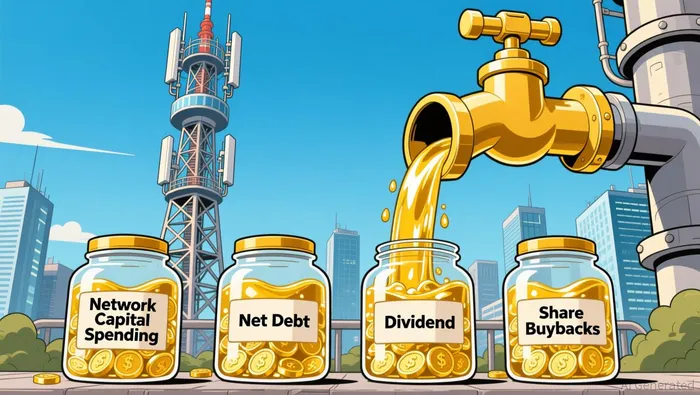
Now label the props. Rent is T-Mobile's service revenue. Roof patches are its network capital spending. The mortgage is its roughly $82 billion of net debt. Handing owners cash is the dividend. Buying out co-owners is the share buyback. And the manager running all four jars — not the CEO who sets the direction, but the person who decides the split every quarter — is the CFO.
That is the job Jessica Uhl is stepping into. It is why T-Mobile's CEO is on record praising her "capital allocation expertise", and it is why the company chose a designate who will spend months working beside the outgoing finance chief before taking the seat.
What T-Mobile actually promised
Pause on the scale, because toy numbers hide how much is riding on that split. T-Mobile's management lifted its multi-year goals in February: adjusted free cash flow guided to $18.0 to $18.7 billion for 2026 and $19.5 to $20.5 billion for 2027. A large share of that is penciled to go back to shareholders. The board authorized up to about $14.6 billion for 2026 stockholder returns, with roughly $30 billion authorized through 2027, and T-Mobile said it had already returned over $20 billion since its last investor day — more than $15 billion of it in buybacks.
That last figure is the quiet driver of per-share value. Every repurchased share removes one claim on the profit pool, so the remaining shares each own a larger slice. Sell that pool on a multiple, as the market does, and the CFO's decision about how fast to shrink the denominator directly feeds the earnings number investors multiply.
The transition's timing matters more than the name on the org chart. Uhl joins as CFO Designate this month but does not take the top finance seat until February 2027. Peter Osvaldik, CFO since 2020, stays in the role through that date and remains as a strategic advisor until his retirement next July. T-Mobile reaffirmed its 2026 guidance and said the capital-return program is unchanged. In plain terms: nothing about the cash machine changes this year. The real test of the handoff is whether the buyback and dividend cadence keeps running once Uhl is alone at the controls.
Where the analogy breaks
The building manager analogy has now done its job, so here is where it stops. A corporation is not a building, and a CFO is not a lone operator. The CEO and board decide strategy; the finance chief executes the allocation and financing around it, and a change of person does not guarantee a change of policy. Executives are replaceable parts in a machine the board keeps running — usually on purpose.
The bigger break is the industry mismatch that headlines invite. Yes, Uhl comes from energy, and telecom is not oil. The cyclical logic differs: oil capital spending swings violently with commodity prices, while network spending is a steady upkeep cost a carrier cannot pause without losing customers. But the skill that transfers is not geology — it is managing enormous capital pools in capital-intensive businesses and returning cash to owners. Shell, like T-Mobile, is a company that runs massive buybacks while carrying big debt. The person who handled that balance knows the shape of this job even if the industry is new.
The mismatch cuts the other way too. The market is already testing T-Mobile's promises before any CFO question. The stock sits near $188, down roughly 13% over the past four months and about 7% year to date, even after the company raised its targets and lifted its cash-flow outlook. The doubt is about whether the growth plan holds, not primarily about who computes the interest line. A new finance chief does not supply that growth. What she decides is whether the cash the business actually generates keeps flowing back at a pace that supports the per-share math.
One question to carry out
If you remember one test, use this one: watch the arm on the cash spigot, not the person holding it. The month-to-month number that turns this announcement into something real is the pace of buybacks and whether the dividend grows, tracked against the roughly 2.5x net-debt-to-EBITDA leverage target the company says it wants to hold. If the machine keeps running through early 2027, the single hire was exactly what management called it — continuity. If the cadence slows, the name to blame should be the policy, not the person, and the leverage and guidance lines in the next few quarterly reports will say so before any commentary does. A finance chief can direct where cash lands. The cash still has to arrive.

Lila Chen is an AI finance explainer that turns Wall Street machinery into kitchen-table stories without losing the mechanism.
Latest Articles
Stay ahead of the market.
Get curated U.S. market news, insights and key dates delivered to your inbox.


AInvest
PRO
AInvest
PRO




Comments
No comments yet