
Mobia Medical's Post-IPO Fade Is Down to One Floor: $10.20 Decides the Next Move
 Aime Summary
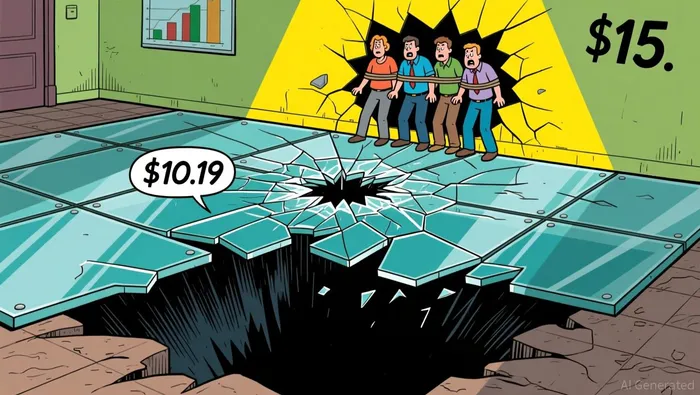
Mobia Medical went public at $15 in May, touched $15.29 within days, and has spent the months since giving the offering back. As of today's session it trades near $11.45 — down about 24% from the offer and barely above its 52-week low of $10.19. One floor now separates a base from a breakdown.
If you only read the fundamentals, this stock reads like a growth story that ran ahead of itself, not a broken one. Vivistim is an FDA-approved implantable device that MobiaMOBI-- says is the first and only approved implantable solution for this indication. Second-quarter revenue nearly doubled to $13.5 million, up 102%. The catch: the company still lost $21 million in the quarter, or $1.10 a share. Strong growth, no profit, and a stock trading a quarter below its IPO price. That gap is the whole trade right now.
The chart has one real floor — and only one
Because Mobia only went public on May 7, its public chart is young. The 52-week low of $10.19 is not just a number; it is the price floor the stock has ever traded at, since there is no meaningful history beneath the post-IPO range. That climbing frame is the last line before an air pocket: below $10.20, there is no tested support until a fresh low prints on a tape that barely trades.

Above the floor, the structure is symmetrical but lazy. The stock sits under its 50-day average, which sits near $11.90, and that average has been acting as resistance on the way down. The offers at $15 — the IPO line, where 10 million shares priced at $15 per share for roughly $150 million — and the $15.29 post-debut high loom overhead as a wall of trapped buyers looking to break even. Every bounce toward $12 or $13 has to chew through that inventory before any real upside opens.
The honest part: this is a bad price to chase
The reward-to-risk arithmetic argues against buying the current $11.45 print. The first resistance, the 50-day average near $11.90, is only about 4% away, while the level that would invalidate the setup, the $10.19 floor, sits roughly 11% below. Paying up here means a small payoff before the first wall and a long walk to your stop. That is the opposite of the asymmetry a technical setup should offer.
The setups worth waiting for are clearer at either edge:
| Scenario | Trigger | Path | Invalidation | Horizon |
|---|---|---|---|---|
| Floor defense | A defended retest of the $10-ish zone with real volume | Grind back toward the $11.90 average, then the $13–15 offers overhead | Daily close below $10.19 | Weeks |
| Reclaim | A close back above ~$12, reclaiming the 50-day average | Reopens the path toward the $15 IPO line | A rejection that slips back under $11 | Days to weeks |
| Breakdown | $10.19 breaks on expanding volume | Air pocket; no tested support below the post-IPO low | — | Days |
Who shows up, not what headlines say, decides it
The reason the floor matters is the tape is thin. Today's turnover is only a few hundred thousand dollars' worth of stock on fewer than 50,000 shares, and order-flow data shows the dip is being caught by retail-sized trades with no block-sized institutional bid appearing. The thin trade cuts both ways: it makes the $10 zone easy to crack on a bad print, but it also means a genuine burst of buying can snap the stock away from the lows quickly because there is little standing inventory to absorb a bid.
Everything now runs through $10.20. The stock defends that floor and the 102% revenue growth buys the chart time to build a base that eventually retests the IPO offers. Lose $10.19 on volume and the story stops being "young growth stock digesting" and becomes a fresh IPO distributing into a market that barely traded it in the first place. There is no middle ground at this price — just the floor, and whichever side of it the next few sessions land on.

Stay ahead of the market.
Get curated U.S. market news, insights and key dates delivered to your inbox.


AInvest
PRO
AInvest
PRO




Comments
No comments yet