
MMT Token TGE and Its Market Impact: Assessing Utility and Adoption Potential in a Volatile Landscape


 Aime Summary
TGE Structure and Allocation: A Foundation for Distribution
The MMT token's TGE in June 2025 was structured around a managed distribution plan by the MFS® Multimarket Income Trust (NYSE: MMT), a closed-end fund. The fund declared a $0.033020 per-share distribution, sourced entirely from "Other Sources," including long-term capital gains and return of capital, as noted in Quantisnow's coverage. This approach ensured consistent payouts but left investors with uncertainty about the tax implications of the distribution, as final breakdowns were deferred until the fiscal year's end, per the same report.
By November 2025, the token's TGE had evolved into a broader market event. Listings on Binance, Bithumb, and Upbit, coupled with Binance's HODLer Airdrop-which distributed 7.5 million MMT tokens to BNBBNB-- holders-catalyzed liquidity and price momentumMMT--, as noted in Bitget's coverage. Institutional backing further solidified the token's credibility, with $10 million in funding secured from Coinbase Ventures, OKX Ventures, and Jump Crypto at a $100 million valuation, according to the same Bitget report.
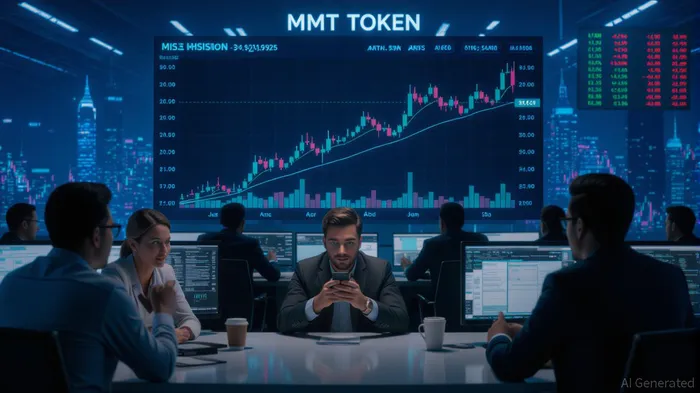
Post-TGE Market Dynamics: Liquidity, Speculation, and Institutional Hype
The MMT token's post-TGE performance was driven by a confluence of factors. Binance's listing alone triggered a 224% 24-hour volume spike to $2.53 billion, while the token's inclusion in the HODLer Airdrop portalPORTAL-- expanded its user base, as Bitget notes. On-chain metrics revealed a 30-day decentralized exchange (DEX) volume of $12 billion and a total value locked (TVL) of $265 million, underscoring its growing role in decentralized trading, per the Bitget report.
However, analysts caution that much of this growth is speculative. The token's volatility-exemplified by a 224% 24-hour price swing post-Binance listing-suggests that retail and institutional investors are trading on liquidity incentives rather than intrinsic utility, according to Bitget. While Momentum Finance's roadmap includes ambitious projects like the ve(3,3) DEX and real-world asset (RWA) integrations, the token's current value proposition remains tied to exchange-driven hype, as Bitget reports.
Utility and Adoption: Building a Sustainable Ecosystem
To transition from speculative frenzy to sustainable adoption, the MMT token must demonstrate tangible utility. Momentum Finance has taken steps in this direction:
- DeFi Integration: The launch of the xSUI liquid staking derivative allows users to earn staking rewards while maintaining liquidity for DeFi activities, as described in Weex's overview.
- Developer Tools: Open-source toolkits and smart contract libraries aim to foster composability with Sui-based projects, enhancing the token's interoperability, as per the Weex overview.
- Institutional Infrastructure: MSafe, a multi-signature wallet for professional users, and custodial solutions slated for 2026 address security and institutional-grade custody needs, according to the Weex overview.
Despite these efforts, challenges persist. Phishing scams and fake airdrops during the TGE highlight vulnerabilities in user education and security protocols, as noted in the Weex overview. Moreover, the token's reliance on exchange listings means its adoption could stall if liquidity incentives wane.
Risks and Realities: A Cautionary Outlook
While the MMT token's post-TGE trajectory is impressive, several risks could undermine its long-term viability. First, the speculative nature of its price surge-driven by a $82 million oversubscribed token sale and exchange airdrops-may not translate to organic adoption, as reported in CoinMarketCap's latest update. Second, the token's utility remains concentrated in DeFi, with limited real-world applications beyond trading and staking. Third, security incidents, such as phishing attacks during the TGE, erode trust and necessitate robust governance reforms, as the CoinMarketCap update notes.
Conclusion: A High-Risk, High-Reward Proposition
The MMT token's TGE has undeniably reshaped its market profile, but its future hinges on balancing speculative momentum with utility-driven adoption. Institutional backing and DeFi integrations provide a strong foundation, yet the token must prove its value beyond liquidity incentives. Investors should monitor key milestones, such as the ve(3,3) DEX launch in May 2026 and RWA integrations, to gauge whether MMT can evolve from a hype-driven asset to a cornerstone of the Move ecosystem.

La combinación de la sabiduría tradicional en el comercio con las perspectivas más avanzadas sobre las criptomonedas.
Latest Articles
Stay ahead of the market.
Get curated U.S. market news, insights and key dates delivered to your inbox.


AInvest
PRO
AInvest
PRO



Comments
No comments yet