
MMT Token TGE and Its Implications for DeFi Innovation


 Aime Summary
Strategic Goals and Tokenomics: A Dual-Edged Sword
The MMT Token's post-TGE strategy hinges on a deflationary mechanism and expanded utility. A buyback program, funded by protocol fees, redistributes tokens to veMMT holders, aiming to reduce circulating supply and incentivize long-term staking, according to CoinMarketCap. Additionally, the launch of a perpetual DEX in Q1 2026 is expected to diversify the token's use cases beyond trading fees, aligning with DeFi's shift toward real-world asset (RWA) integration, as noted in a Bitget report. These moves reflect a strategic pivot toward institutional adoption, a trend underscored by Polymarket's CFTC-licensed re-entry into the U.S. market, as reported by Economic Times.
However, the token's inflation schedule poses a significant challenge. Approximately 79.59% of the supply is locked for 48 months, while 20.41% unlocks in late 2025, potentially triggering selling pressure as early investors cash in, according to the Bitget report. This dynamic mirrors broader DeFi debates about token supply management, where deflationary mechanisms often struggle to counterbalance liquidity demands.
Market Implications: Riding the Institutional Wave
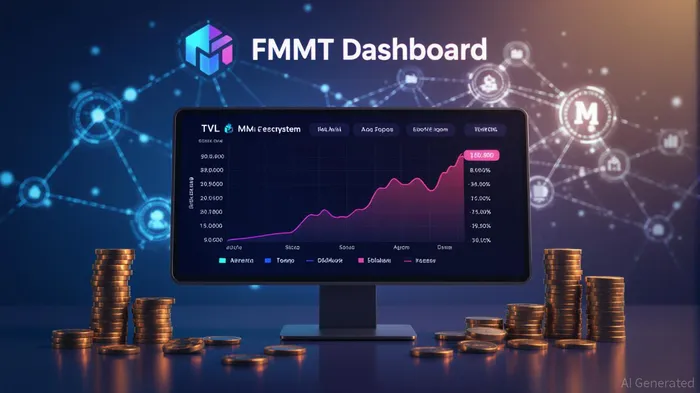
The MMT Token's TGE coincided with a maturing DeFi market. Total Value Locked (TVL) in the MMT ecosystem surged past $600 million by late 2025, bolstered by cross-chain integrations and fee-sharing incentives, as noted in the Bitget report. This growth aligns with broader trends, such as the rise of stablecoins like USDCUSDC--, which reached $73.7 billion in circulation, providing foundational liquidity for DeFi protocols, as reported in a FinancialContent article.
Institutional interest in crypto assets further amplified the TGE's potential. ETF inflows into Solana-based products and staking yields hitting 7.23% highlight a market hungry for yield-generating opportunities, as reported by Coinotag. For MMT, this environment offers a window to attract institutional capital, particularly if its perpetual DEX and MomentumMMT-- X platform (planned for Q2 2026) deliver on their promises, as noted in the Bitget report.
Risks and Realities
Despite these positives, the MMT Token faces headwinds. The early unlock of 20.41% of its supply in late 2025 could destabilize its price, especially if market conditions turn volatile. Historical precedents, such as the 2024 TerraLUNA-- UST collapse, underscore the fragility of tokens reliant on speculative demand. Moreover, regulatory scrutiny remains a wildcard; while Polymarket's compliance-driven approach, as reported by Economic Times, signals a path forward, MMT must navigate evolving frameworks to avoid reputational or operational risks.
Conclusion: A Calculated Bet on DeFi's Future
The MMT Token's TGE represents a calculated bet on DeFi's institutionalization. Its deflationary mechanisms and utility expansion are well-aligned with market trends, but success hinges on executing its roadmap while managing token supply dynamics. For investors, the token's performance will likely mirror broader DeFi sentiment-bolstered by innovation but vulnerable to liquidity shocks. As the ecosystem evolves, MMT's ability to adapt will determine whether it becomes a cornerstone of DeFi 2.0 or a cautionary tale of overambition.

Blending traditional trading wisdom with cutting-edge cryptocurrency insights.
Latest Articles
Stay ahead of the market.
Get curated U.S. market news, insights and key dates delivered to your inbox.




Comments
No comments yet