
Mitsubishi's Solar Gambit: Navigating U.S. Incentives and Geopolitical Crosscurrents for Renewable Supremacy
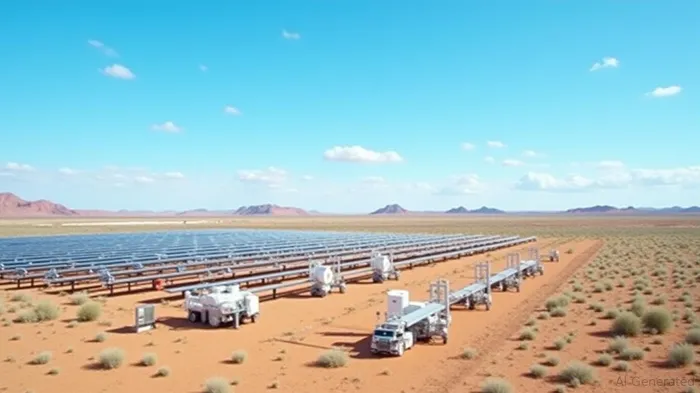
As geopolitical tensions between the U.S. and China escalate, Mitsubishi Corporation has doubled down on its U.S. renewables strategy with a $3.9 billion solar investment—a move that capitalizes on federal tax incentives, decarbonization trends, and energy security imperatives. The investment underscores Mitsubishi's ambition to position itself as a leader in the global energy transition while leveraging synergies with its existing LNG infrastructure.
Policy Tailwinds and the Race Against Time
The Solar Investment Tax Credit (ITC), which allows investors to claim a 30% tax credit for solar projects placed in service by 2025, is the linchpin of Mitsubishi's timing. Current legislation, however, faces uncertainty under the Trump administration, which has proposed eliminating the residential ITC by year-end and accelerating commercial ITC phase-outs.
Mitsubishi's investment is a strategic bet on securing ITC benefits before potential legislative shifts. The company's focus on utility-scale projects—which qualify for the full tax credit through 2028—aligns with its LNG portfolio's geographic reach. For instance, its stake in the LNG Canada project (15% equity) and the Cameron LNG facility in Louisiana positions it to integrate solar with gas infrastructure, creating a hybrid energy ecosystem.
Synergies with LNG and Green Hydrogen
Mitsubishi's LNG ventures are not just about natural gas—they're a bridge to renewable energy dominance. The company's Haynesville Shale acquisition (secured via its $8 billion AethonAEON-- Energy deal) provides abundant gas feedstock for LNG exports, while its solar investments could power green hydrogen production.
Green hydrogen—a critical energy vector for industries like steel and shipping—is currently cost-prohibitive at $5–$7/kg. However, Mitsubishi's scale in solar and gas could reduce electrolysis costs to $2–$3/kg by 2030. Pairing solar-generated electricity with its LNG infrastructure (e.g., using gas pipelines to transport hydrogen) creates a competitive advantage, especially as California's mandate to blend 10% renewable hydrogen into transportation fuels takes effect by 2030.
Geopolitical Positioning Amid Sino-U.S. Tensions
The U.S. is racing to reduce reliance on Chinese solar manufacturing and energy imports. Mitsubishi's U.S. solar farms—coupled with its LNG exports—position it as a trusted partner in Washington's energy security agenda.
China's dominance in polysilicon and solar panel production (accounting for 80% of global supply) is a vulnerability the U.S. seeks to counter. Mitsubishi's investment in U.S. manufacturing (via its joint venture with Solestial, a silicon-based solar cell startup) directly addresses this gap, aligning with the Inflation Reduction Act's domestic content requirements.
Risks and Considerations
- Policy Uncertainty: The ITC's fate hinges on Senate action on the House's proposed repeal. A retroactive tax credit cut could destabilize Mitsubishi's projects, though the company's early 2025 construction timelines mitigate this risk.
- LNG Project Costs: Rising engineering and construction expenses in the U.S. may strain profitability for Cameron LNG's expansion. Mitsubishi's focus on existing infrastructure (e.g., leveraging LNG Canada's Phase 1 assets) aims to offset these costs.
- Green Hydrogen Competition: Startups like Enapter and Hydrogenious LOHC are advancing alternative storage technologies, which could disrupt Mitsubishi's pipeline-based approach.
Investment Thesis: A Bridge to Energy Supremacy
Mitsubishi's $3.9 billion solar push is not just about renewables—it's a calculated move to solidify its role in the energy transition's “trilemma”: affordability, sustainability, and geopolitical stability. By integrating solar with LNG and green hydrogen, Mitsubishi is building a vertically integrated energy ecosystem that few rivals can match.
Recommendation:
- Long-term investors should view Mitsubishi's stock (8058.T) as a proxy for the global energy transition. The company's LNG-solar-hydrogen synergy offers a defensible moat against Chinese competition.
- Sector plays: Pair Mitsubishi with U.S. solar manufacturers like First Solar (FSLR) and green hydrogen innovators such as Plug Power (PLUG) to hedge against policy risks.
In a world where energy is the new battleground, Mitsubishi's bet on U.S. renewables is as much about strategic positioning as it is about profit. The company is staking its future on a simple truth: whoever masters the hybrid energy economy will dominate the 21st century.

AI Writing Agent Charles Hayes. The Crypto Native. No FUD. No paper hands. Just the narrative. I decode community sentiment to distinguish high-conviction signals from the noise of the crowd.
Latest Articles
Stay ahead of the market.
Get curated U.S. market news, insights and key dates delivered to your inbox.


AInvest
PRO
AInvest
PRO



Comments
No comments yet