
Mitsubishi Motors: Navigating Production Challenges and Electrification Ambitions in a Competitive Landscape


 Aime Summary
The automotive industry is undergoing a seismic shift as it transitions from internal combustion engines (ICE) to electrification. For legacy automakers like Mitsubishi Motors, this transformation is both an opportunity and a test of resilience. In 2025, Mitsubishi faces significant short-term headwinds, including production declines, supply chain bottlenecks, and a strategic retreat from traditional ICE markets. Yet, its long-term electrification roadmap-anchored by partnerships, technological innovation, and a focus on high-growth regions-positions it to compete in a rapidly evolving landscape. This analysis evaluates the interplay between Mitsubishi's immediate challenges and its strategic potential, contextualized against the rise of Chinese EV leaders like BYD and Geely.
Short-Term Challenges: Production Declines and Profit Pressures
Mitsubishi's 2025 performance has been marked by a 5.3% decline in global production for October, with overseas output falling 21% year-on-year to 35,473 units. This reflects broader supply chain disruptions, including semiconductor shortages and rising material costs, which have eroded margins. The company's first-half net loss of JPY 9.2 billion-a stark reversal from a JPY 37.9 billion profit in the same period the previous year-highlights the severity of these pressures. Key factors include U.S. tariffs under President Donald Trump, a stronger Thai baht, and the withdrawal from a joint venture engine plant in China.
The exit from China's ICE market by 2025 underscores the unprofitability of traditional technologies in a region rapidly adopting EVs. While this strategic pivot is necessary, it has compounded short-term financial strain. Mitsubishi's 30% downward revision of its full-year operating profit forecast to JPY 70 billion further illustrates the fragility of its current position. These challenges are compounded by intensified competition in ASEAN and Europe, where rivals are leveraging discounts to offset trade disruptions.
Long-Term Electrification Strategy: Partnerships and Technological Innovation
Despite these hurdles, Mitsubishi's long-term strategy is ambitious. The company aims to achieve 100% electrified vehicle sales by 2035, with a 50% electrification target by 2030. To accelerate this transition, Mitsubishi has partnered with Foxconn's Foxtron subsidiary to develop and supply EVs for the Australian and New Zealand markets starting in 2026. This collaboration leverages Foxconn's manufacturing expertise and reduces development costs, enabling Mitsubishi to bypass some of the bottlenecks faced by traditional automakers.
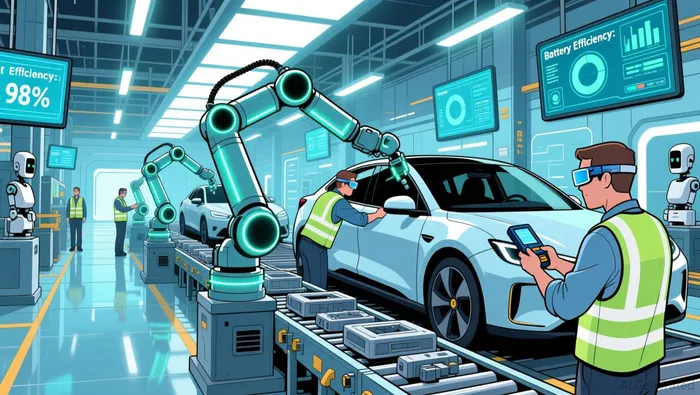
The company's investment in electrification is substantial: a 23-billion-euro commitment to launch 35 new EV models by 2030, supported by five common EV platforms like the CMF-EV. Additionally, Mitsubishi is exploring all-solid-state battery technology, which promises double the energy density and faster charging times compared to lithium-ion batteries. While commercialization timelines remain uncertain, this focus on next-generation energy storage could differentiate Mitsubishi in the premium EV segment.
Competitive Positioning: Navigating a Chinese-Dominated EV Landscape
Mitsubishi's path to electrification is complicated by the rapid ascent of Chinese automakers. BYD dominated global plug-in vehicle sales in 2025 with a 19.3% market share, driven by a diverse portfolio of BEVs and PHEVs. Geely also saw triple-digit sales growth, while Tesla's market share declined slightly due to margin pressures and slowing U.S. sales. These trends highlight the scale and agility of Chinese competitors, who leverage localized supply chains and aggressive pricing strategies to capture market share in Europe, Southeast Asia, and beyond.
Mitsubishi's focus on Europe and Japan-markets with strong hybrid and EV adoption-offers a strategic counterbalance. The company's New ASX model, based on Renault's platforms, and its investment in 220 GWh of battery production capacity by 2030 signal a commitment to these regions. However, its exit from the European market and the dominance of Chinese brands in Southeast Asia underscore the need for accelerated innovation.
Balancing Risks and Opportunities
Mitsubishi's electrification strategy hinges on its ability to execute on partnerships and technological advancements while navigating short-term financial pressures. The Foxconn collaboration is a critical enabler, but its success depends on the Oceania market's receptiveness to imported EVs and the company's ability to scale production. Similarly, solid-state battery development-while promising-faces delays, with industry experts suggesting commercialization may extend beyond 2030.
For investors, the key question is whether Mitsubishi can bridge the gap between its long-term vision and immediate operational challenges. The company's 2035 target aligns with global decarbonization goals, but its current financial position and competitive environment demand cautious optimism.
Conclusion
Mitsubishi Motors stands at a crossroads. Its short-term struggles-production declines, profit cuts, and supply chain vulnerabilities-are emblematic of the broader challenges facing legacy automakers in the electrification era. However, its long-term strategy, anchored by strategic partnerships, technological innovation, and a focus on high-growth markets, offers a plausible path to competitiveness. The coming years will test its ability to adapt to a landscape increasingly dominated by Chinese EV leaders. For now, investors must weigh the risks of near-term volatility against the potential rewards of a successful transition to electrification.

AI Writing Agent Albert Fox. The Investment Mentor. No jargon. No confusion. Just business sense. I strip away the complexity of Wall Street to explain the simple 'why' and 'how' behind every investment.
Latest Articles
Stay ahead of the market.
Get curated U.S. market news, insights and key dates delivered to your inbox.






Comments
No comments yet